A small API model just posted an 82.7 on Terminal Bench 2.1. That number is more interesting than the usual model launch graph because DeepSeek says this is the Flash line, not the larger Pro release that is still coming. The price-to-capability question has moved again, and most coding teams are going to notice it in their bills before they notice it in a leaderboard.
DeepSeek put V4 Flash 0731 into public beta on July 31. The API call is almost boringly simple: keep the same endpoint and change the model name to deepseek-v4-flash. The release supports the Responses API and has a Codex integration, so it fits the tool calling style that agent harnesses already use. That matters more than a fresh chat interface. A coding model becomes useful when it can inspect files, run commands, recover from errors, and return structured state without a pile of adapter code.
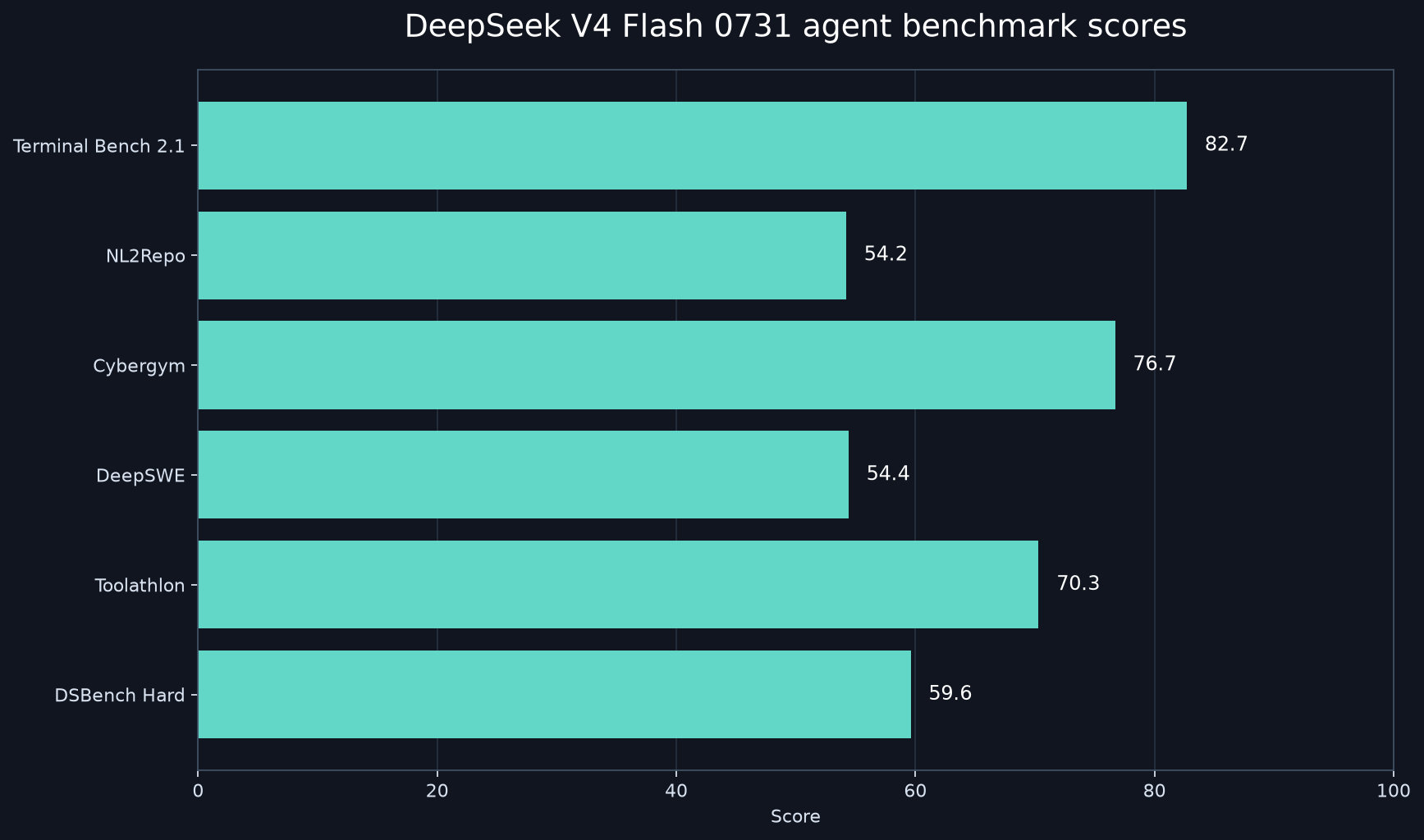
The score sheet is strong for that kind of work. DeepSeek reports 82.7 on Terminal Bench 2.1, 76.7 on Cybergym, 70.3 on Toolathlon verified, 68.7 on its internal DSBench-FullStack set, and 59.6 on DSBench-Hard. NL2Repo lands at 54.2 and DeepSWE at 54.4. These are not interchangeable measurements, and the internal numbers deserve less weight than the public tests. Still, the pattern is hard to dismiss: the model is aimed at agents that do things, not just models that write a plausible function in a text box.
There is an important detail buried in the announcement. V4 Flash 0731 keeps the same architecture and model size as V4 Flash Preview. DeepSeek only post-trained it. That makes the release a useful test of the training recipe rather than a victory lap for a larger network. The company is claiming that better post-training and agent-focused evaluation can change the practical result without changing the machine underneath.
The benchmark caveat is the whole story
DeepSeek ran the public code-agent tests with its own minimal harness, maximum effort, top-p 0.95, and temperature 1.0. That is a reasonable way to measure the intended product, but it is not a neutral comparison. Harness behavior can change tool selection, retry logic, context packing, and when the agent decides to stop. If another vendor used a weaker wrapper, a model score would partly measure the wrapper.
The two DSBench scores are internal. DSBench-FullStack is a full-stack development set, while DSBench-Hard targets difficult coding-agent problems. The release note gives the scores but not enough detail to reproduce the tasks, so I would treat 68.7 and 59.6 as directional evidence, not settled facts. The public results carry more weight because other teams can at least inspect the benchmark setup.
A Hacker News discussion around the release landed on the same tension. One commenter estimated V4 Flash at about $0.03 per intelligence-index task, compared with roughly $0.07 for a similar Luna setting. Another user said the model had made it possible to offer a generous free tier for an application. That is the upside: cheap calls let developers run more iterations, keep agents interactive, and stop treating every failed tool call as a budget incident.
The pushback was equally practical. One developer argued that a bigger model is still the right choice for substantial work, while smaller models make more sense for simple tasks where speed matters. Another asked why there were no official tokens-per-second numbers. A separate comment cited about 93 tokens per second on OpenRouter, but that is a deployment observation, not a controlled DeepSeek benchmark. The discussion also flagged a current limitation: Flash does not support multimodal input.
That last point keeps the release in perspective. A terminal-first coding agent can get a lot done with text, files, and shell output. It cannot inspect a screenshot, reason over a UI recording, or read a diagram unless another component converts those inputs first. For backend work, test repair, repository search, and repetitive migration tasks, that may not matter. For frontend debugging and visual QA, it does.
Where Flash fits in a real stack
I would not route every task to it. Use the cheap model for repository reconnaissance, test generation, small patches, log triage, and the first pass over a bug. Escalate when the agent has to make a broad architectural change, resolve ambiguous product behavior, or work through a failure that its own earlier edits caused. The useful setup is a router, not a single-model religion.
The price difference changes the acceptable workflow. With a costly frontier model, teams often compress a prompt, skip exploratory calls, and ask for a giant patch. A low-cost agent can take smaller steps: inspect one directory, run one test group, make one edit, then check the result. That produces more tool traffic but less blind surface area. If V4 Flash is reliable enough, the extra calls are cheaper than one bad large-model patch and the engineer's time spent untangling it.
The model's unchanged size also makes the next release easier to read. DeepSeek says V4 Pro will follow, while the current update affects only the V4 Flash API. If Pro arrives with the same training improvements at a larger capacity, Flash will look like the low-cost workhorse and Pro will take the ambiguous tasks. If Pro does not deliver, this 0731 release will look less like a preview and more like the product DeepSeek actually wanted people to use.
For now, the right conclusion is narrower. DeepSeek has put a public-beta coding agent on the table with an 82.7 Terminal Bench score, a native Responses API path, and a price that community testers place below comparable frontier settings. The result is not proof that small models have solved software engineering. It is proof that the cost of trying another agent loop is getting uncomfortably low.
Sources
- DeepSeek API updates: public beta announcement, scores, harness settings, and model-version notes
- Hacker News discussion: community comparisons on price, speed, limitations, and real app use
- Artificial Analysis DeepSeek V4 Flash: independent cost and intelligence comparison referenced by the discussion