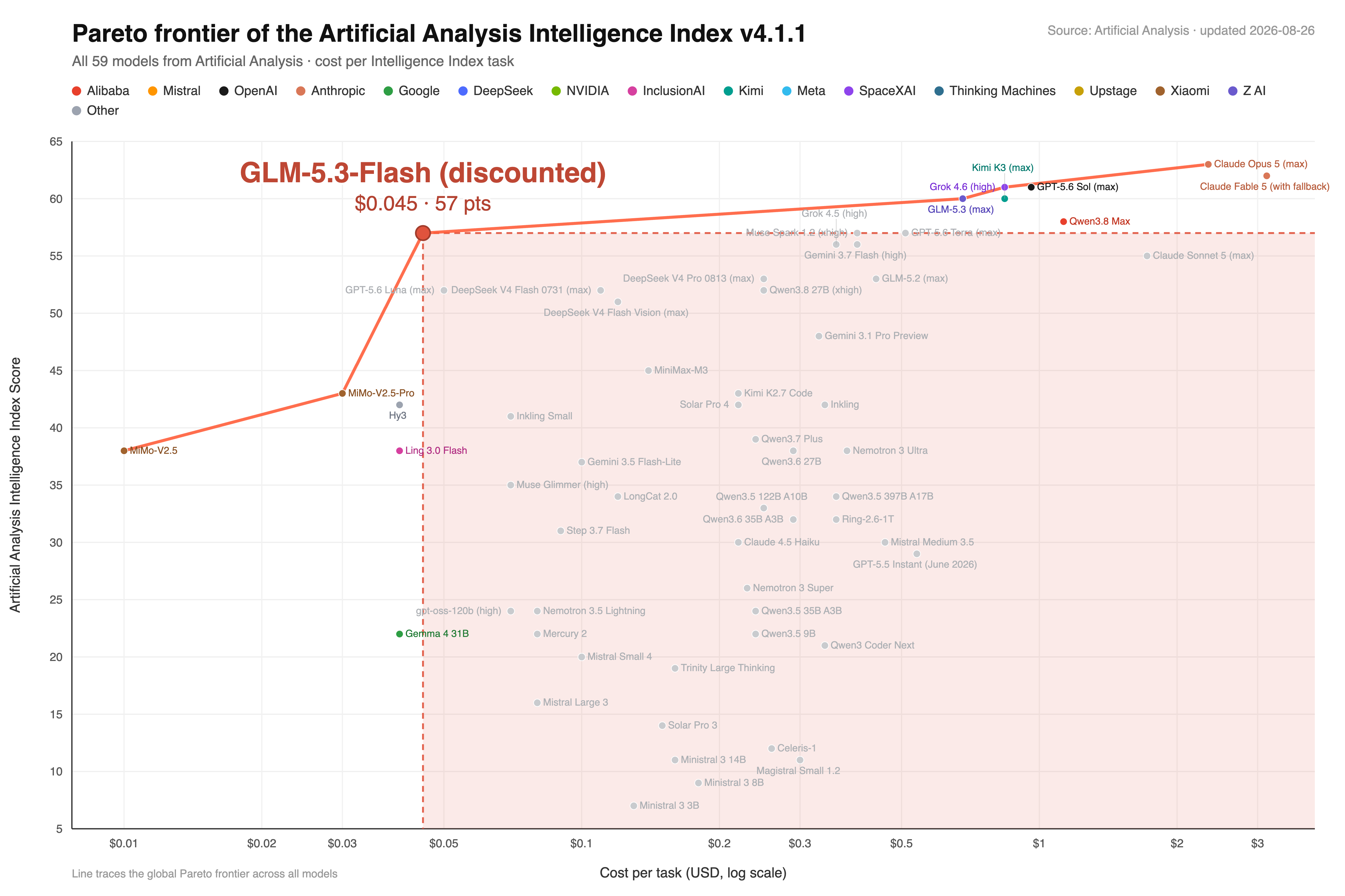
Z.ai is selling the interesting part of GLM-5.3-Flash as a price point: $0.045 per task on the discounted Artificial Analysis calculation. That is cheap enough to make a capable agent model feel disposable. Run it for a batch of small coding jobs, let it inspect a screenshot, or use it as the default worker behind a tool loop and the bill stays tiny.
The hardware story is less friendly. GLM-5.3-Flash has 320 billion total parameters and 18 billion active parameters. Those are very different numbers. The active count helps explain why each token can be cheaper to compute. It does not mean the model is an 18B download that will sit comfortably on a gaming GPU.
The useful question is not whether the release is impressive. It is where the economics survive contact with your workload.
The cost claim needs a unit
Z.ai reports an Artificial Analysis Intelligence Index v4.1.1 score of 57 at $0.045 per task, roughly one tenth of the cost associated with a similar level of intelligence in its comparison. That sounds like an API price, but it is not the same thing as a token price, a full agent run, or a monthly infrastructure bill. A task can contain several model calls, tool outputs, retries, and a long context. Your cost depends on which of those the provider counted.
That does not make the number useless. It gives hosted users a sensible first filter. If a job needs a few calls and the model finishes reliably, a four-and-a-half-cent task is easy to justify. If the job loops through a repository, calls tools repeatedly, and sends hundreds of thousands of tokens back into context, the task label stops being a budget. Measure your own traces.
The release also reports 63.4 on DeepSWE v1.1 versus 46.2 for GLM-5.2, and 48.8 versus 26.2 on AutomationBench. Those are large improvements. They are not guarantees that your agent will complete a ticket. DeepSWE used the mini-swe-agent harness with a six-hour timeout and 400K context. Terminal-Bench 2.1 used Claude Code 2.1.207 with a six-hour timeout and a 65,536-token maximum output. AutomationBench used version 1.0.6 after a null-type handling fix.
Those details matter because a benchmark score includes the harness, timeout, prompt, tool policy, judge, and data set. Swap the harness and you may get a different answer. The scores are evidence that this model deserves a test. They are not a purchase order.
| Measure | GLM-5.3-Flash | GLM-5.2 | What it tells you |
|---|---|---|---|
| Total parameters | 320B | Not stated in the launch comparison | Memory planning still follows the full model size |
| Active parameters | 18B | Not stated in the launch comparison | Per-token compute can be lower than a dense 320B model |
| DeepSWE v1.1 | 63.4 | 46.2 | Better result under the listed agent harness |
| AutomationBench | 48.8 | 26.2 | Better tool automation result under version 1.0.6 |
| Intelligence Index v4.1.1 | 57 | Not stated | Cross-model signal paired with a $0.045 task figure |
A deployment decision, not a leaderboard victory
For local serving, start with memory, not active parameters. A 320B model in BF16 needs about 640 GB just for the raw weights, before KV cache, runtime buffers, quantization metadata, and parallel-serving overhead. That estimate is simple arithmetic from the published parameter count and two bytes per BF16 value. Quantization can reduce the weight footprint, but it does not erase the need for a serious memory budget or make a single 16 GB card plausible.
The model card lists SGLang, vLLM, TokenSpeed, and KTransformers as supported frameworks. That is useful because it gives an engineering path. It is not a hardware recommendation. Framework support means the software stack knows how to execute the model. It does not promise that the model fits in your machine, that your quantization has the same quality, or that long-context throughput will be good.
The architecture explains why Z.ai can make a stronger serving claim than a plain dense model. GLM-5.3-Flash combines sparse and linear attention. Linear attention handles local dependencies through state modeling. Sparse attention retrieves global context through an indexer. The release says IndexPool compresses four indexer key vectors into one at a one-million-token context length. Z.ai reports 3x lower attention compute and 4.4x lower KV-cache size than its GLM-5.3 comparison point.
That is the part worth testing if your workload is context-heavy. A million-token headline is not a free pass to paste an entire company into every prompt. Cache size, prefill time, context management, and retrieval quality still decide whether the system feels usable. The model card says the evaluation setup used a maximum context length of 300,000 tokens for HLE with tools, while the NL2Repo evaluation used 1M context and a 64K maximum output. Those are test settings, not a promise that every deployment will run at those limits.
My decision rule is blunt. Use the hosted API first if you need a cheap agent worker and can observe the real per-task trace. Compare the result against a model you already trust on your own repository, not just DeepSWE. Keep the model in the running if it reaches your acceptance threshold without excessive retries. Drop it if the low unit price is offset by tool loops, slow responses, or review time.
Consider local serving only when you have a concrete reason, such as data residency, predictable high volume, or a network-isolated workflow. Then budget for the full parameter set, not the 18B active figure. Start with a quantized build and a small evaluation set. Record time to first token, decode speed, peak memory, failed tool calls, and completion quality. A benchmark chart will not tell you whether your server spends ten minutes paging memory before the first useful answer.
GLM-5.3-Flash is a good example of where AI model pricing is heading: inference can get startlingly cheap while the machine needed to reproduce it remains expensive. That split is not a contradiction. It is the business model. Hosted users buy access to optimized infrastructure. Local users buy the right to own the headache.
Sources
- Z.ai GLM-5.3-Flash release analysis: official architecture, cost, benchmark, context, and serving details
- GLM-5.3-Flash Hugging Face model card: parameter counts, local frameworks, evaluation notes, and official links
- Z.ai API documentation for GLM-5.3-Flash: hosted API access and deployment documentation
- Hacker News discussion of GLM-5.3-Flash: fresh community discovery link from the release day RSS feed