A model with 276 billion total parameters is not small by any normal definition. Inkling-Small is small only next to Thinking Machines Lab's 975 billion parameter Inkling. That relative label is still useful, because the new model activates 12 billion parameters per token instead of 41 billion and lands surprisingly close to its larger sibling on several serious evaluations.
Thinking Machines released Inkling-Small on July 30 with full weights under Apache 2.0. The model takes text, images, and audio as input, returns text, and supports a context window of up to 1 million tokens according to the company's release and model card. It is available through Hugging Face, Tinker, and third-party inference providers. The important part is not the marketing adjective in the name. It is the ratio between capability and the hardware bill.
The interesting bit is the routing
Inkling-Small is a sparse Mixture-of-Experts transformer with 42 decoder layers. Each token is routed to six of 256 specialist experts, with two shared experts active every time. That gives the model a large pool of learned capacity without running the entire 276 billion parameter system for each token.
The multimodal path is built into the model rather than bolted on through a separate vision or speech service. Thinking Machines says images are split into 40 by 40 pixel patches and passed through a four-layer hierarchical MLP. Audio becomes dMel spectrogram tokens. Both are projected into the same hidden space as text and processed by the decoder. The design is encoder-free, which is a technical detail that matters when an agent needs to mix a screenshot, spoken instructions, and a long text context in one task.
The model also exposes variable thinking effort. A simple request can use less test-time compute, while a hard coding or reasoning task can spend more. That is a more practical control knob than pretending every request deserves the same expensive chain of thought. It lets an operator choose a point on a quality, latency, and cost curve instead of accepting one fixed model behavior.
The numbers are better than the name
On the company's published evaluation suite, Inkling-Small reaches 80.2% on SWE-bench Verified, compared with 77.6% for Inkling. It scores 64.7% on Terminal Bench 2.1, slightly above Inkling's 63.8%, and 31.6% on Humanity's Last Exam without tools, above Inkling's 29.7%. Those are vendor-reported comparisons, so they deserve skepticism, but the direction is hard to dismiss: the smaller model is not merely preserving the older model's score. It beats it on several coding and reasoning tests.
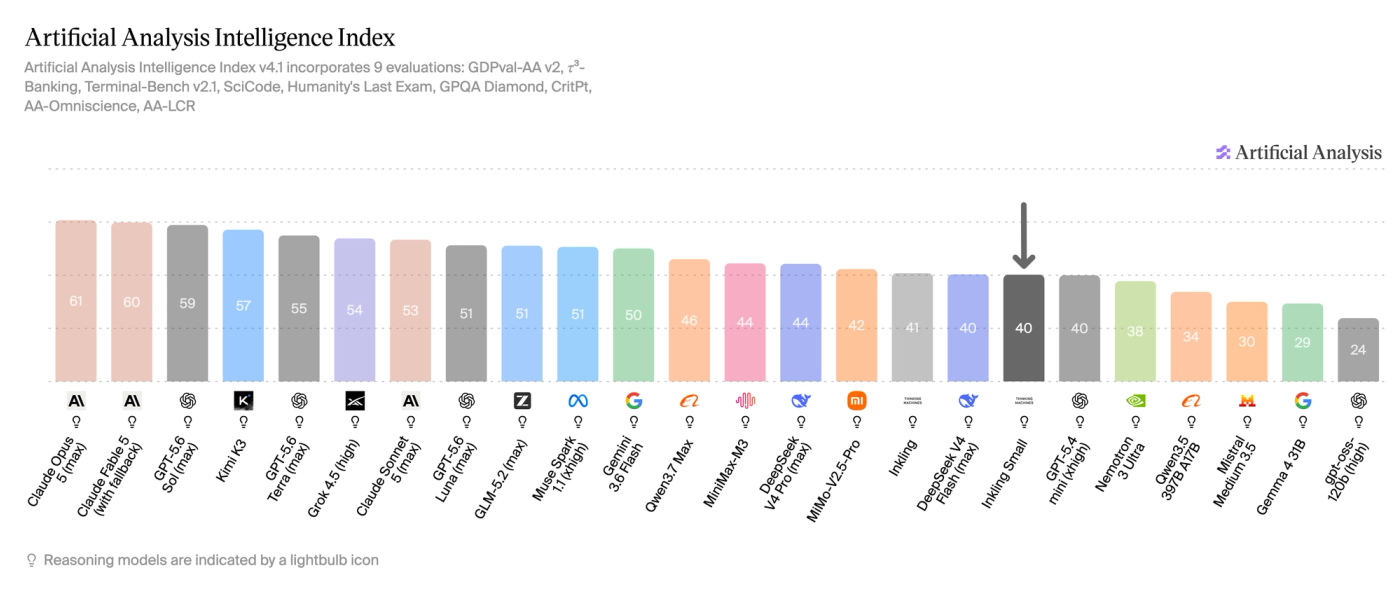
Artificial Analysis gives the two models a useful independent comparison. Inkling-Small scores 40 on its Intelligence Index, one point behind Inkling's 41, while using less than a third of the total and active parameters. The same analysis says Inkling-Small averaged about 24,000 output tokens per task, versus roughly 25,000 for Inkling. DeepSeek V4 Flash averaged around 45,000 tokens on the same index, and GPT-5.4 mini used about 78,000. Token count is not a complete cost model, but fewer generated tokens usually means less waiting and a smaller inference bill when the provider charges by output.
The most interesting result is on AA-Briefcase, Artificial Analysis's long-horizon knowledge-work benchmark. Inkling-Small scored 917 Elo against Inkling's 839 and finished tasks in an average of 34 turns instead of 81. The rubric pass rates were almost identical, 20% versus 19%, which suggests the smaller model may be better at producing a polished answer quickly rather than being dramatically more correct. That distinction matters. A shorter agent trace can save money while still leaving the underlying factual risk untouched.
The weak spots are clear too. Inkling-Small scores 15.5% on Tau 3 Banking, below Inkling's 23.7%. Its SimpleQA Verified score is 20.6%, far below Inkling's 43.9%, and its AA Omniscience score is -9.0 compared with Inkling's 2.1. In plain English, the smaller model is much less dependable when the task rewards broad factual recall. It can write code and operate tools well while still confidently missing basic facts. That is exactly the kind of split that makes retrieval and verification mandatory in production.
The multimodal scores are respectable rather than magical. The company reports 74.0% on MMMU Pro Standard 10, 77.4% on CharXiv RQ without Python and 81.3% with Python. On audio, it reports 54.9% on Audio MC, 77.0% on MMAU, and 90.1% on VoiceBench. Those results put Inkling-Small near other omni models on several tasks, although direct comparisons are messy because some numbers come from internal harnesses and some come from public leaderboards.
Small enough for a server, not your laptop
This is where the name becomes dangerous. The BF16 checkpoint requires at least 600 GB of aggregate VRAM. Thinking Machines lists four NVIDIA B300 GPUs or eight H200 GPUs. The NVFP4 checkpoint cuts the requirement to about 180 GB, with one B300 in W4A4 mode or two H200 GPUs in W4A16 mode. That is a meaningful reduction, but it is not local AI in the usual sense. A gaming PC, MacBook, or ordinary workstation is still out.
The realistic audience is an organization that wants control over model weights, data, and fine-tuning but cannot justify a 975B flagship deployment. Inkling-Small can run on a smaller private cluster, and the official stack lists SGLang, vLLM, TokenSpeed, Unsloth, and Hugging Face support. Tinker provides a simpler route for teams that want to fine-tune without operating the whole cluster.
The release pricing also makes the tradeoff concrete. Thinking Machines lists Inkling output at $4.05 per million tokens and Inkling-Small at $1.20 per million tokens on the comparison page. Hardware cost, batching, cache behavior, and reasoning effort will decide the actual bill, but a 70% lower output-token price gives engineers room to test the model on real workloads instead of only running a few demos.
Apache 2.0 matters here. Companies can generally modify, fine-tune, redistribute, and commercialize the weights while following the license notice requirements. That is a much cleaner starting point than a custom license with usage thresholds or extra commercial conditions. It does not remove the need to audit training data, safety behavior, or regulatory exposure. It does remove one layer of procurement friction.
The catch is that most of the evidence is still fresh and partly vendor controlled. The official numbers use different harnesses for different tasks, and the release notes acknowledge contaminated Terminal Bench solutions by assigning those rollouts a score of zero. Artificial Analysis adds a useful outside view, but one independent index cannot settle whether the model is dependable in a particular company's codebase or document workflow. Fine-tuning can also change refusal behavior and factual calibration, so the base model's safety scores should not be treated as a guarantee after customization.
Still, Inkling-Small is a better argument for sparse models than another leaderboard victory from a giant model. The useful achievement is not that 276 billion parameters sounds impressive. It is that a model with 12 billion active parameters can approach a 975 billion parameter sibling on coding, multimodal work, and several reasoning tests while costing less to serve. That is the direction enterprise open weights need to move: fewer tokens wasted, fewer GPUs tied up, and enough control to make the model fit the job instead of forcing the job around the model.
Sources are linked inline: Thinking Machines' release, the Inkling-Small model card, and Artificial Analysis' independent comparison.