The new Context Language Models paper asks a question every agent engineer eventually hits: should the model decide what stays in its own context, or should the harness keep pruning and summarizing for it?
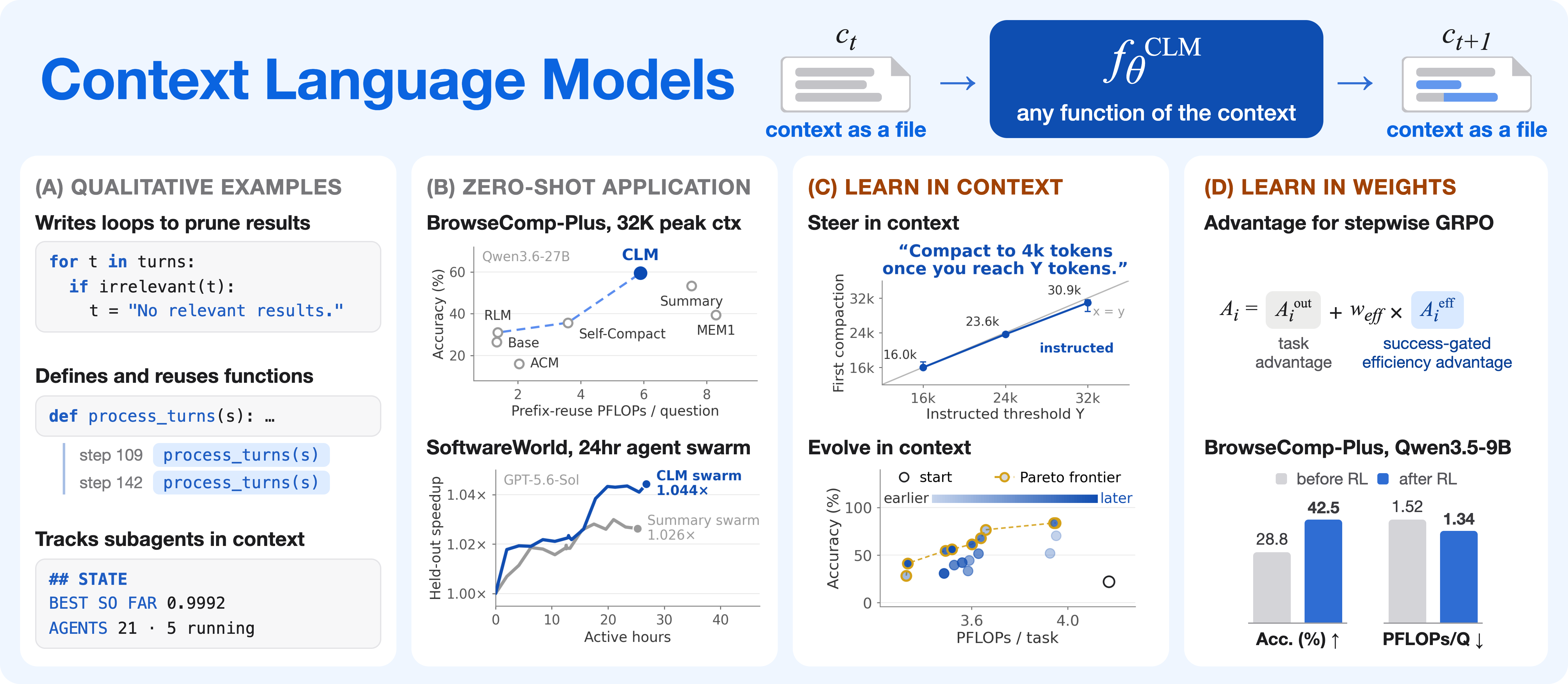
The authors from Meta Superintelligence Labs, University of Washington, MIT, and Trillium Labs posted the work on September 29. Instead of giving an agent a fixed compaction button, their setup mirrors its live context into a file. The model can rewrite that file using ordinary code tools, and each edit updates what it sees on the next turn. Think of it as letting the agent revise its working notebook, not just append another page.
That is an interesting shift in control. It is not yet a drop-in memory feature for your production chatbot. The paper tests particular long-running research and coding setups, and its efficiency measure is prefix-reuse FLOPs, not a cloud invoice. Those distinctions matter more than the headline percentages.
Who should try editable context
A team building an agent that works for hours, reads large tool outputs, and repeatedly revisits earlier decisions has a good reason to test this. On BrowseComp-Plus, the paper reports 11.4% higher accuracy and 21.5% fewer prefix-reuse FLOPs than its strongest context-management baseline. The evaluation used all 830 questions, a 32K context limit, and a shared agent backbone. The result says the agent-managed context policy performed better on that task under those conditions. It does not mean any prompt can become 11.4% smarter by turning on file edits.
The coding result points in the same direction, with a different caveat. On a 10-task subset of EdgeBench, a 12-hour software optimization task, CLM scored 5% higher and used 59% fewer prefix-reuse FLOPs than the comparison approach. For a coding agent that burns cycles rereading its own history, that is worth a controlled pilot. The paper also reports a 24-hour, six-repository swarm experiment, but a small task suite built for the paper is not a general measure of reliability across real teams' repos.
The useful decision is workload-specific:
| Your workload | Sensible move |
|---|---|
| One-shot chat or short tool call | Keep the existing harness. Editable context adds machinery without a long history to manage. |
| Multi-hour research or coding run with repeated history scans | Pilot CLM on a fixed task set and compare against your current compaction policy. |
| Regulated workflow where the model must not erase audit evidence | Keep source events immutable; test editable context only in a derived working copy. |
| High-throughput serving that depends on prefix caching | Measure cache reuse and prefill cost before adopting unrestricted edits. |
Start with a replayable workload, not a live customer. Save the original event log outside the context file. Then run the same task with your current harness and with model-managed context, holding the base model, tools, turn budget, and task inputs constant. Record final task success, tokens and FLOPs if available, repeated tool calls, and whether the agent retained exact file paths or decisions. A summary that looks tidy but drops a critical constraint is a regression, even if the context got smaller.
For teams already budgeting agent usage, this is a different lever from trimming tool output or setting token ceilings. Our guide to agentic CI token budgets covers the bill-side guardrails. CLM changes which information the agent carries forward. Those approaches can work together, but one cannot replace the other.
When a production team should wait
The paper is a preprint, and the repository is a research implementation, not a turnkey service. Its GitHub page lists separate code for a Harbor-based harness, in-context learning, reinforcement learning, and Suffix Cache Reuse. The repository also shows only four commits at the time of review. That is enough to inspect and reproduce parts of a paper, not enough to infer stable APIs, operational support, or safe defaults.
There is a real serving tradeoff. Conventional prefix caching reuses computation when the beginning of a request matches. If an agent rewrites the middle of its context, the prefix stops matching at that point and the server may need to prefill more tokens again. The paper introduces Suffix Cache Reuse to recover some of that lost work and reports 35% lower server-side compute than standard SGLang at matched performance. Treat that as a specific result for their method and setup, not a blanket guarantee for an arbitrary inference stack.
The benchmark tables also do not answer every deployment question. Prefix-reuse FLOPs are useful for comparing computation within an experiment, but they are not latency, dollars, or GPU hours by themselves. The reported tasks are limited in count and duration. Production agents face retries, interruptions, tool failures, access boundaries, changing data, and human handoffs. A context file the model can freely edit creates a separate audit question too: keep the authoritative trace somewhere the model cannot rewrite.
So the decision is simple. If your agent routinely runs for hours and loses useful state, try the code in an isolated, measurable evaluation. If you need a supported memory subsystem for customer traffic this quarter, wait. The result worth watching is not another context-window record. It is whether editable context can keep its accuracy advantage when the task, serving stack, and failure conditions stop being a paper's carefully bounded experiment.
Sources
- Context Language Models paper on arXiv: task design, benchmark results, and prefix-reuse FLOPs analysis.
- Official Meta research repository: research code, serving components, and stated repository scope.