The open-model race just hit an absurd number: 2.8 trillion parameters. That is the headline size of Moonshot AI's Kimi K3, announced on July 16, and it is large enough to make the usual "run it on your laptop" conversation sound like a joke.
K3 is not a normal dense model. Moonshot says it is a Mixture-of-Experts system with 896 experts, only 16 of which are active for a token. The total parameter count is enormous, but the active slice is much smaller. That is the only reason a model in this class can be served at all. It still does not make K3 local-friendly. When the weights arrive, the practical problem will be memory, bandwidth, and serving infrastructure rather than raw FLOPs.
The release is interesting because Moonshot is selling a model that is both huge and unusually open. K3 is available through Kimi, Kimi Code, and the API now. The full weights are promised for July 27, with a technical report expected alongside them. Until those files land, calling it open source is premature. Right now it is an open model announcement with a hosted product attached.
The clever part is the serving math
Kimi K3 combines Kimi Delta Attention with Attention Residuals and a Stable LatentMoE design. The first two are aimed at the problems that appear when a model has to carry information across very long sequences and many layers. Moonshot claims a one-million-token context window and says the new design gives it roughly 2.5 times the scaling efficiency of Kimi K2. That number is a company claim, not an independently reproduced result, but the direction makes sense: a trillion-parameter model needs every efficiency trick it can get.
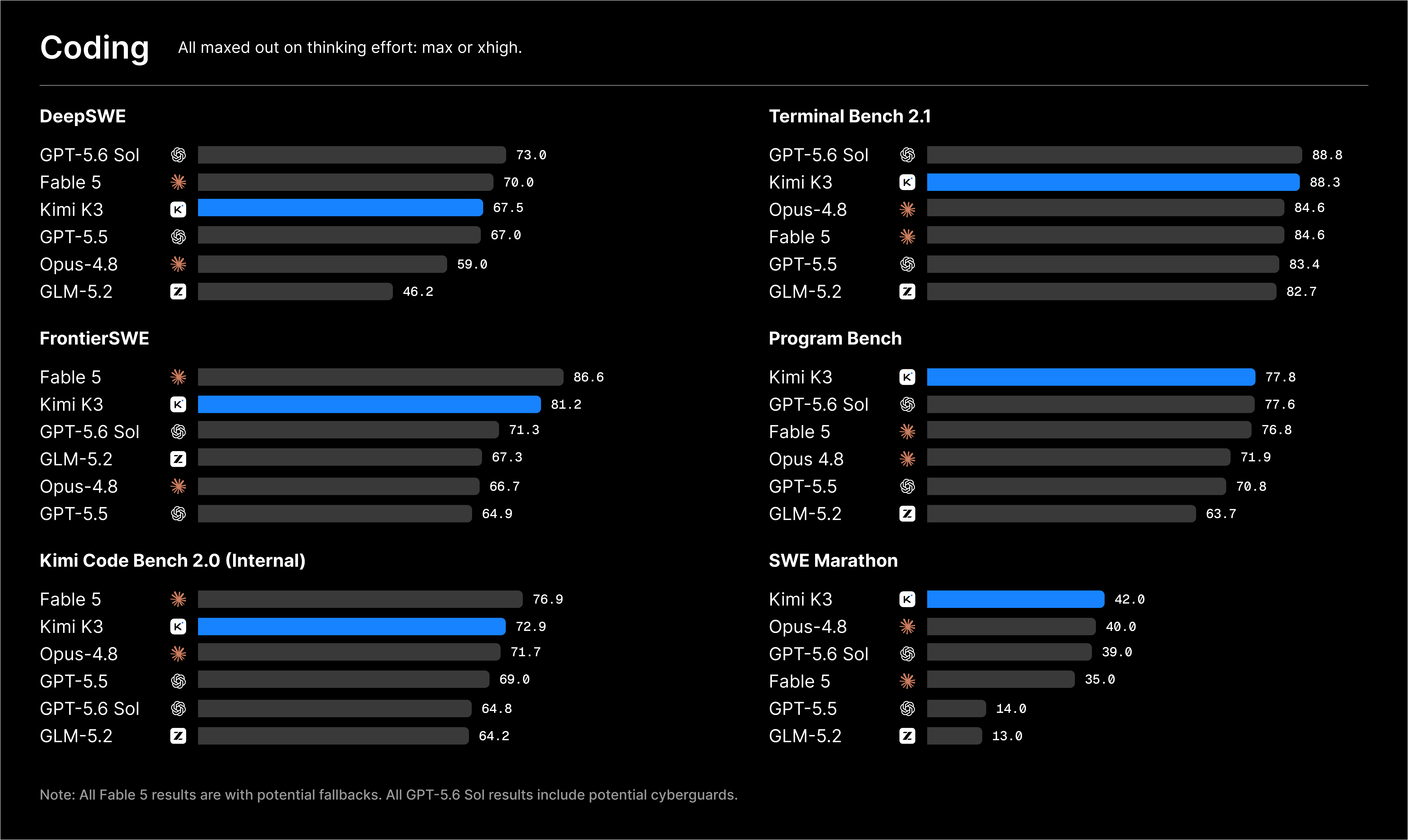
The million-token context is also where K3's coding pitch starts to make sense. Moonshot says the model can work through large repositories, use terminal tools, and keep long engineering sessions alive with limited human input. In its own examples, K3 built MiniTriton, a small Triton-like compiler with an intermediate representation over MLIR, optimization passes, and PTX code generation. The company says MiniTriton matched or beat Triton on some roofline workloads and trained nanoGPT end to end with a loss curve close to the reference implementation.
Those are interesting demonstrations, but they are still demonstrations. A model writing a compiler in a controlled sandbox is not the same thing as an agent surviving a messy production repository with flaky tests, missing documentation, and a human who changes the requirements halfway through. The gap between a polished case study and boring daily reliability is where most coding agents still lose.
K3's chip-design example is even more ambitious. Moonshot says a single 48-hour run produced and verified a 45nm chip using open EDA tools and the Nangate library. The simulated design fits inside 4 square millimeters, closes timing at 100 MHz, and reaches more than 8,700 tokens per second in decode simulation. It contains 1.46 million standard cells, 0.277 MB of SRAM, and an INT4 matrix-multiply array with fused dequantization. That is a fun result. It is also a result from simulation, not silicon. The distinction matters.
The benchmark gap is smaller than the workflow gap
Moonshot's scorecard places K3 near the top of its tested set on coding, agentic work, and multimodal tasks. Third-party coverage from Tom's Hardware reports that K3 beat Claude Fable 5 on a Frontend Code Arena evaluation, while the official release says K3 remained behind Fable 5 and GPT 5.6 Sol overall. Those statements can both be true because benchmark suites measure different things, and because model-plus-harness results are not clean model-only comparisons.
That caveat dominated the Hacker News discussion around the release. The launch thread collected 873 points and more than 400 comments. One commenter called the models "benchmaxxed" and argued that token efficiency and real-world failure modes matter more than a close leaderboard score. Another tester reported that K3 produced a near-identical web app to Fable at roughly half the cost in one task, while a different simple coding task made K3 look twice as expensive and seven times slower. A separate run reported about $5.50 for K3, $6.30 for Qwen 3.8 Max, and roughly $30 for Fable on one web-app job, but the harnesses were different, so those numbers are not a fair laboratory comparison.
That messy result is more useful than a clean press-release ranking. K3 may be close enough to closed models for real programming work while still being slower, more verbose, and more sensitive to the tool wrapper around it. A developer in the thread said K3 was the model they would actually choose as an alternative to Opus 4.8. Another said the model spent too long thinking. Both reports can be true. The answer depends on whether you value subscription access, API price, speed, control, or the ability to inspect and modify the weights.
The official API price listed by LLM Stats is $3 per million input tokens, $0.30 for cached input, and $15 per million output tokens, with a one-million-token context. That is not bargain-bin pricing on output. K3 becomes interesting when a long coding session reuses a large prompt prefix or when the alternative is paying for a closed model with tighter usage limits. It is less compelling for short completions where latency and output cost dominate.
There is another catch buried in Moonshot's own limitations. K3 was trained with preserved thinking history, and the company warns that quality can become unstable when a harness fails to pass the full reasoning history back into the next turn. It also warns that the model can be too proactive when instructions are vague. Those are not cosmetic limitations. They mean the wrapper is part of the product, and a generic OpenAI-compatible endpoint may not reproduce the behavior of Kimi Code.
A giant model with a very small audience
The July 27 weight release will decide whether K3 changes the open-model ecosystem or just adds another impressive hosted endpoint. If Moonshot publishes a usable license, complete configuration files, tokenizer details, and enough serving documentation, researchers can finally test the architecture instead of repeating launch claims. If the release arrives as a huge pile of weights with thin documentation, most people will admire it from a distance.
The hardware barrier is the point. K3's total size puts it in a different category from the open models that hobbyists download for a weekend experiment. Even heavily quantized versions will require serious memory and a serving setup built for expert parallelism. The likely first users are inference providers, large labs, and companies with a reason to own the stack. That is still valuable. Open weights do not need to run on a gaming laptop to matter. They need to give somebody other than the original vendor the ability to inspect, tune, benchmark, and host the system.
For now, Kimi K3 is a hosted model that tests what "open" means at frontier scale. The model's reported capabilities are close enough to closed systems to make the comparison awkward. Benchmark results remain noisy enough to keep the victory lap premature. And the missing weights leave the most important question unanswered: can the wider community run this thing well, or will K3 remain a very large promise behind an API?