A single sentence goes in. 11 worlds come out, at least in Tencent Hunyuan's gallery. The tempting conclusion is that WorldClaw is a new world model. That is the wrong mental model, and it matters if you are deciding whether to build on it.
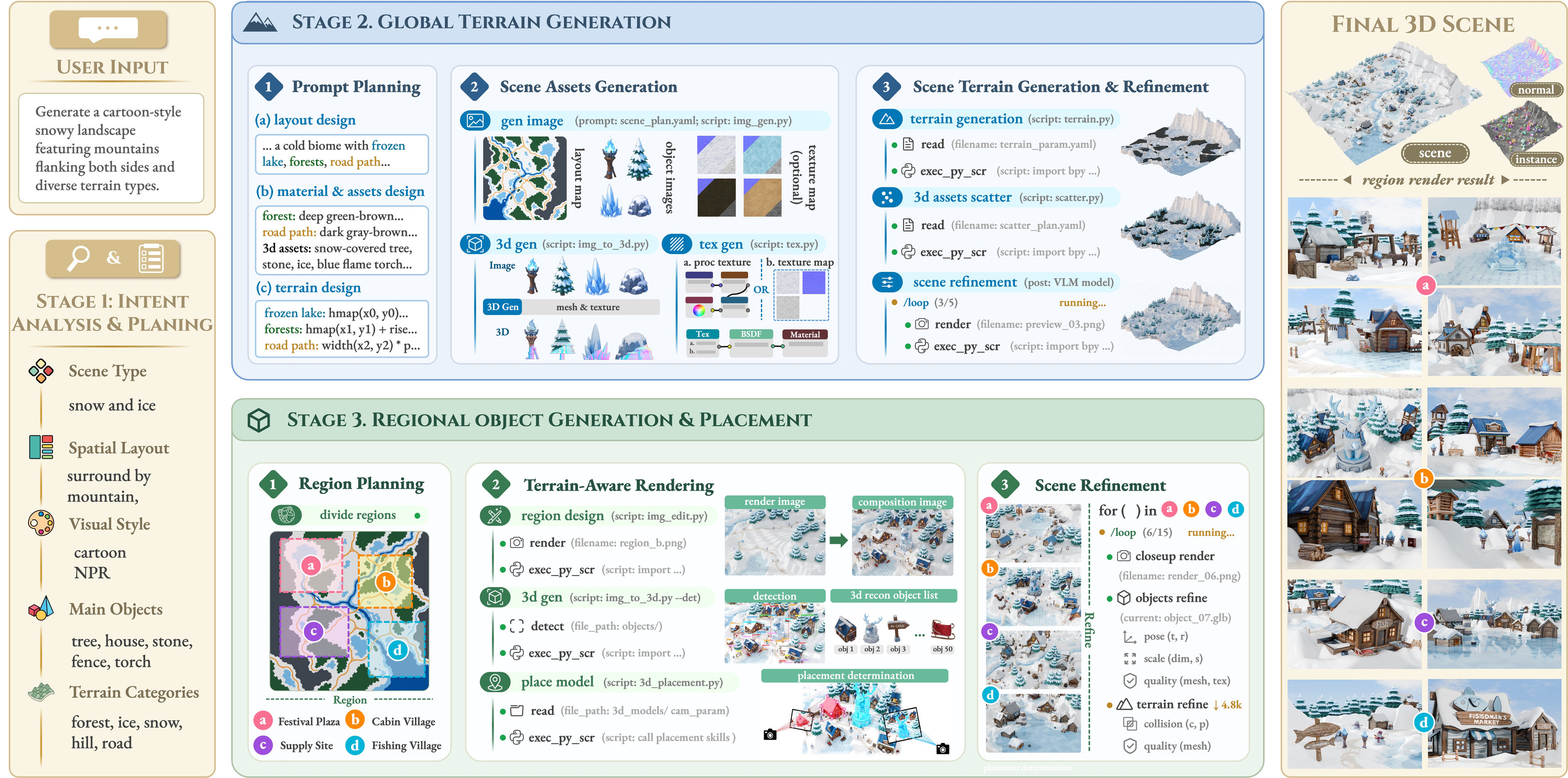
WorldClaw is an agent harness around a collection of planning, image, 3D reconstruction, procedural terrain, and rendering tools. Its useful idea is architectural: establish the world's broad structure first, then spend expensive generation work only where the scene needs detail. The less useful part is the gap between a polished research demo and a pipeline another team can actually run.
What the pipeline actually runs
The paper describes 3 stages. First, an intent-analysis agent turns the prompt into explicit constraints, while a scene-planning agent fills in the details that downstream tools need. The intermediate specification includes regions, terrain requirements, object categories, appearance, approximate density, and spatial relationships. That specification is the hand-off contract for everything that follows.
Second, a terrain stage builds the global foundation. WorldClaw uses a semantic layout map to divide the world into regions, then combines region-specific elevation, noise, geomorphic operators, materials, and scattered assets. The paper calls out mountains, dunes, terraces, and erosion rather than treating the ground as a flat plane. This is a sensible choice. A lot of generated 3D content fails before the first object appears because the scene has no scale or spatial hierarchy.
Third, the system works on selected regions. It renders local terrain to a 2D image, asks an image-editing model to compose objects into that view, reconstructs those objects as textured meshes, and recovers their placement on the terrain. A render-and-inspect loop then checks pose, scale, mesh quality, appearance, and object-to-ground contact. The result is meant to be a set of independently editable instances, not a video or a cloud of view-dependent points.
That distinction is the part worth keeping. A generated image can look finished while containing no reusable scene structure. WorldClaw at least aims at geometry you can move, replace, and export. The official page shows the same worlds through RGB, instance-mask, normal, and depth views. Those extra passes are not decoration. They are evidence that the system is tracking scene components rather than only producing a pretty camera path.
The design also explains why the outputs look coherent at a distance. Global terrain gives every later decision a coordinate system. Regional generation gives the expensive object work a smaller target. The system does not ask one model to hallucinate a complete world in one shot. It turns a vague prompt into a chain of constrained intermediate artifacts.
Where the demo breaks
The first problem is reproducibility. The public GitHub repository currently exposes the project website, its assets, and front-end files. GitHub shows five commits and zero stars at the time of checking, while the HN thread contains a blunt comment that the generation code is not there. The paper is detailed about the method but does not give an ordinary developer a complete install, model-download list, runtime estimate, or one-command reproduction path. That makes the project useful as a design document, not yet as a dependency.
The second problem is cost and latency. WorldClaw chains planning, image generation, 3D reconstruction, procedural modeling, rendering, and inspection. Every loop can call another model or trigger another render. The paper's own future-work section says the current implementation relies mainly on Blender and still needs runtime systems for navigation, physics, interaction, and procedural content generation in a real game engine. In other words, a mesh that can be edited is not the same thing as a game-ready level.
The HN discussion lands on the practical failure modes. One commenter noticed buildings apparently sitting on water in the published images. Another pointed out that generated assets can be far too dense for raycasts and real-time use. The useful response was not to decimate everything blindly, but to preserve a high-quality source and build lower-detail meshes, collision geometry, culling, and level-of-detail variants for the target engine. That is normal production work. WorldClaw does not remove it.
There is also a selection problem. The official page presents eleven worlds, but it does not publish a success rate across prompts, the number of failed runs, generation time per world, GPU-hours, mesh counts, triangle budgets, or an evaluation of navigation and collision. A gallery proves that the pipeline can produce attractive cases. It does not tell you how often the pipeline produces an asset a team can ship.
The model dependency is easy to miss. The paper names GPT-Image-2 for layout and asset-image generation, SAM3D for reconstruction, Hunyuan3D components, and Blender-based scripting. The language model is doing planning and tool orchestration, not directly creating a magical universal world representation. Swapping one component can change the whole result. An open model may be cheaper or easier to host and still fail at the scene specification or spatial layout step.
The decision for builders
Use WorldClaw as a reference architecture if your immediate question is how to combine an LLM with procedural terrain and generative assets. The global-to-regional split is strong. So is the insistence on explicit intermediate representations and inspection after rendering. Those are ideas you can borrow without adopting the whole stack.
Do not treat it as a production dependency yet. Before investing, ask for four things: the exact model and checkpoint list, a reproducible run script, a cost and latency report, and exported assets with triangle counts, collision meshes, texture sizes, and LODs. Then test more than a gallery prompt. Use a fixed set of scenes with awkward spatial requirements, water boundaries, narrow paths, repeated structures, and objects that must sit on slopes.
A reasonable prototype can be smaller. Use an LLM to write a structured scene specification, generate a semantic terrain mask, place a limited asset library with procedural rules, and run a render check that catches objects below or above the terrain. Add image-to-3D generation only for the regions where stock assets fail. This will give you a measurable baseline and make it obvious whether WorldClaw's extra model calls buy anything beyond better screenshots.
WorldClaw's best contribution is not the promise of instant open worlds. It is the admission, built into the pipeline, that world generation needs planning, structure, and repeated correction. The demo is convincing enough to justify copying that architecture. It is not yet transparent enough to justify copying the bill.
Sources
- WorldClaw official project page: eleven example worlds, method overview, editable-instance claim, and rendered passes
- WorldClaw paper on arXiv: three-stage architecture, terrain construction, regional reconstruction, limitations, and future work
- WorldClaw GitHub repository: public project repository and currently visible web assets
- Hacker News discussion: community questions about code availability, mesh density, placement errors, and cherry-picked examples