A model can look open in a launch post and still be closed to the person who has to run it. That is the awkward position GLM-5.3 occupies this week.
Z.ai released GLM-5.3 on August 14 as a coding and agent model built on the same base as GLM-5.2. The company says the gains came from more post-training on long-running executable tasks, not from a fresh pretraining run. The launch results are eye-catching: Terminal-Bench 3.0 moves from 4.6 for GLM-5.2 to 28.3 for GLM-5.3, while DeepSWE v1.1 rises from 46.2 to 66.9.
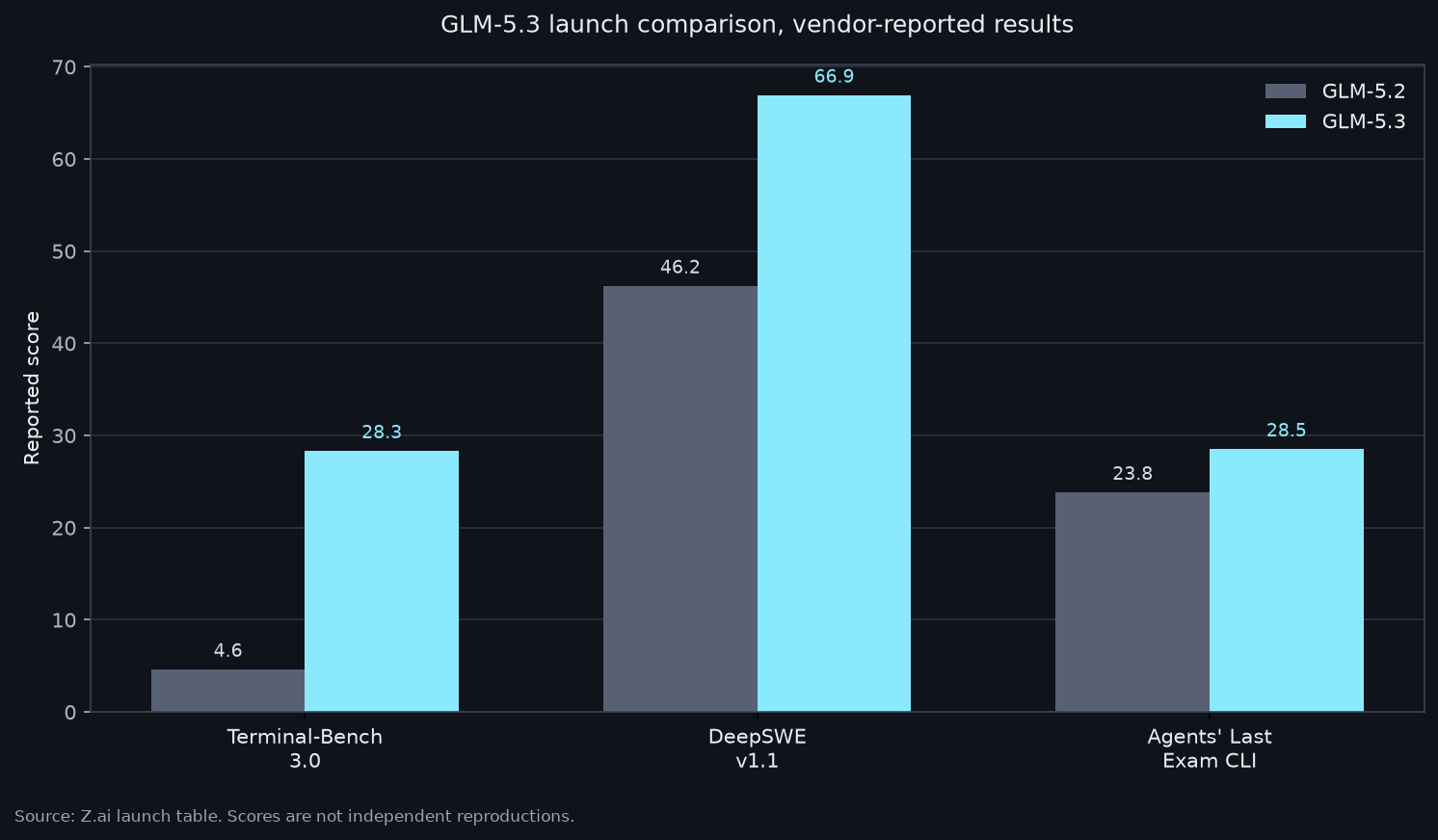
Those numbers answer one question, namely whether Z.ai got more out of the existing base model. They do not answer the question most developers need answered: can I put this model behind my own gateway, inspect its behavior, and keep using it if the hosted plan changes?
Where GLM-5.3 fits today
The access story is split into three different products, and calling all of them "the API" creates bad buying advice.
Coding Plan and ZCode: This is the route Z.ai is actively selling. GLM-5.3 is available through the GLM Coding Plan and the ZCode environment, with low, high, and max reasoning settings. The model is also exposed through coding tools that can use the plan. If you want to try its coding behavior today and you are comfortable with a subscription, this is the practical route.
General API: Z.ai's GLM-5.3 documentation labels general API access as coming soon. The official pricing table lists GLM-5.2 at $1.40 per million input tokens and $4.40 per million output tokens, but it does not list a GLM-5.3 row. That means you should not copy GLM-5.2's price into a GLM-5.3 integration guide and call it confirmed. Independent Artificial Analysis data currently lists GLM-5.3 (max) at $1.40 input and $4.40 output per million tokens, but its provider view should be treated as a current measurement, not a guarantee that every account has general access.
Local weights: Z.ai says it will release the weights about two weeks after launch, after more safety evaluation and hardening. Until the files, license, tokenizer details, model card, and inference requirements are public, GLM-5.3 is not a model you can honestly describe as locally deployable. A promised checkpoint is not a checkpoint.
That distinction matters because the headline benchmarks were run with long contexts and generous agent budgets. Z.ai reports 1M-token context and a 128K maximum output in the launch setup. Those limits are useful for long tasks, but they say nothing about VRAM requirements or whether a local inference stack will support the release without weeks of work.
What the numbers actually buy you
The most interesting claim is not that GLM-5.3 wins every table. It does not. Z.ai's own comparison shows GLM-5.3 at 28.3 on Terminal-Bench 3.0, behind GPT-5.6 Sol at 34.6 and Fable 5 at 33.7. On DeepSWE v1.1, GLM-5.3 scores 66.9, behind GPT-5.6 Sol at 72.7 and Fable 5 at 69.7.
The better reading is narrower. GLM-5.3 appears to be a large post-training upgrade for long-horizon agent work. Its Terminal-Bench 3.0 score is roughly six times GLM-5.2's 4.6, and its DeepSWE score gains 20.7 points. Agents' Last Exam CLI rises from 23.8 to 28.5. Those are the kinds of changes that could affect whether an agent keeps a task alive across many tool calls.
But the scores are mostly from Z.ai's evaluation pipeline. Z.ai describes its own environment generation and verification work, and the comparison settings are not identical across every model. A benchmark score is evidence for a task setup. It is not a warranty for your repository, your test suite, or your tool permissions.
That is why the model's access status is part of the result. If you can only use GLM-5.3 inside a paid coding plan, you can test its behavior but you cannot yet measure it against your own gateway, cache policy, logging stack, or local hardware. The model may be excellent and still be the wrong dependency for a team that needs portability.
For context, the current independent Artificial Analysis page gives GLM-5.3 an Intelligence Index score of 60 and reports a measured evaluation cost of $1,238.50 for the full index run. It also records 170 million output tokens during that evaluation. That is useful evidence about the evaluation workload and current provider pricing. It is not evidence that a small coding task will cost the same, especially when reasoning output can dominate the bill.
Who should wait
Wait for the weights if your decision depends on self-hosting, a stated license, or a reproducible deployment. You need the actual checkpoint size and memory behavior before buying hardware. You also need to know whether the promised release has the same inference behavior as the hosted model.
Use the Coding Plan now if you have a narrow experiment and the result can stay inside Z.ai's tooling. Give it a fixed repository, a small task set, and a human approval step. Record completion rate, tool errors, total output tokens, and time to a passing test. Do not judge it from a single impressive demo.
Stay with GLM-5.2 or another metered model if you need a stable API today, especially if your workload depends on routing, provider failover, or a known price. A slightly weaker model that you can actually measure and replace may beat a stronger model trapped behind a changing access policy. The same portability question came up in our earlier look at replaceable agent infrastructure, and GLM-5.3 makes the tradeoff visible again.
My current choice would be to test GLM-5.3 through the Coding Plan, but not to redesign a production stack around it. The upside is real enough to measure. The distribution story is not mature enough to trust. If the weights arrive with a clear license and a workable serving path around the end of August, the decision changes. Until then, GLM-5.3 is a promising hosted capability with an open-weight promise attached, not an open deployment target.
Sources
- Z.ai GLM-5.3 launch announcement: official description of the post-training approach, reported benchmark results, 1M context setup, and planned weights release
- Z.AI developer pricing: current official model price table, including GLM-5.2 and the absence of a GLM-5.3 row at research time
- Z.AI GLM-5.3 documentation: official access and capability documentation
- Artificial Analysis GLM-5.3: independent evaluation index, measured task cost, token use, and provider pricing data
- VentureBeat GLM-5.3 coverage: independent reporting on staged access and comparison results