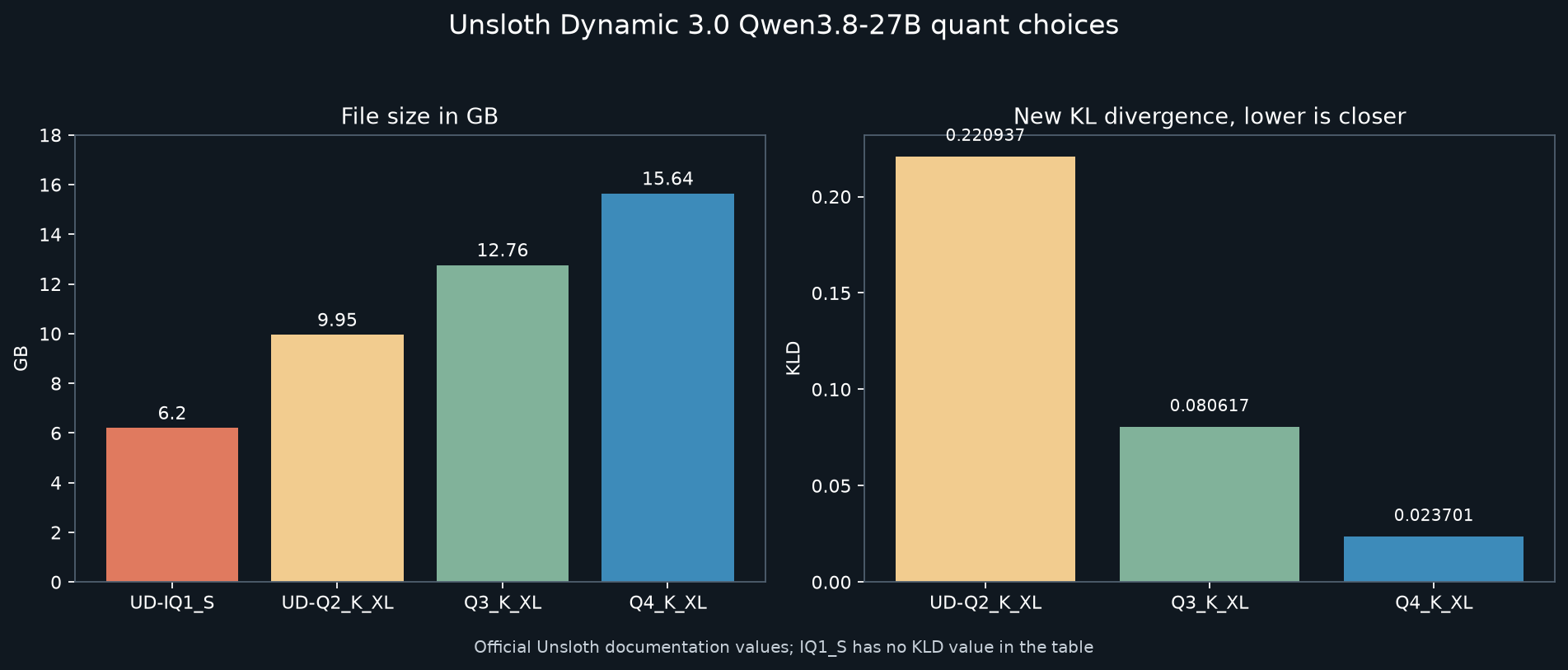
A 27B model that fits in 10GB sounds like a joke until you look at what got removed. Unsloth's Dynamic 3.0 GGUF release for Qwen3.8-27B puts the UD-Q2_K_XL file at 9.83GB in its headline discussion, with a 9.95GB value in the published comparison table. That leaves room on a 16GB machine for the runtime and a useful context window. The 15.64GB Q4_K_XL file does not. It fits on paper, then starts fighting the operating system for every extra token.
This is the useful part of the release. The interesting question is not whether Dynamic 3.0 beats another quantization method on one score. It is which file you should download when your machine has a fixed memory ceiling, and how much confidence to place in the numbers.
Unsloth says Dynamic 3.0 improves its layer selection and uses a larger calibration mix aimed at agentic coding, chat, and multilingual prompts. It is still post-training quantization. The company says it does not train on the calibration set and does not use QAT or QAD for these GGUFs. That distinction matters because a quantizer can look clever while quietly fitting its test material.
The release is also fresh enough that the community is doing the part the release page cannot. The announcement reached 214 points on Hacker News on August 19. People asked about 16GB RAM, 16GB GPUs, 64GB across four GPUs, Apple Silicon conversion, and whether low KLD predicts useful multi-step coding. One commenter said the new IQ4XS was working well on a 4090 with 16GB. Another pointed out that the same file name can now refer to an older download, a real operational problem when the repository updates in place.
That last complaint is easy to dismiss as housekeeping. It is not. If a quant changes under the same filename, your benchmark result is attached to a checksum and date, not to the pretty name on the file browser.
Pick the quant by memory, not the label
Here is the decision table I would use before downloading anything.
| Hardware budget | First file to test | Why | What to watch |
|---|---|---|---|
| 8GB system memory | UD-IQ1_S at 6.2GB | Leaves the most room for the runtime | Unsloth reports about 72% top-1% accuracy, so treat it as an experiment |
| 16GB system memory | UD-Q2_K_XL at about 9.9GB | Leaves several GB for context and the OS | Do not assume a long context will fit just because the file does |
| 24GB system memory | Q3_K_XL at 12.76GB or Q4_K_XL at 15.64GB | More quality headroom than the 2-bit files | Keep at least 5GB free before increasing context |
| 24GB GPU with CPU offload | Q3 or Q4, depending on the split | You can place some MoE layers in system memory | PCIe transfers can erase the benefit of a larger quant |
The smallest file is not automatically the best bargain. UD-IQ1_S is 6.2GB without the MTP module and Unsloth reports roughly 72% top-1% accuracy, while also calling it 89% smaller. That is a useful emergency option for a laptop. It is not the file I would choose for a coding agent that has to keep track of a project across multiple turns.
UD-Q2_K_XL is the interesting middle. Unsloth lists it at 9.83GB in the release text and 9.95GB in the table, with about 8% better top-1% accuracy than the next best result at that size. The small discrepancy is a reminder to inspect the actual repository file, not to copy a number into a deployment script. This file leaves enough memory for llama.cpp, a 16K context setting, and ordinary desktop overhead on a 16GB machine. It is the only option here I would call a sensible default for that constraint.
Q3_K_XL is 12.76GB. Q4_K_XL is 15.64GB. Those numbers look close to the memory budget, but the remaining space is not spare capacity. It is where the KV cache, allocator, runtime buffers, and your browser tabs go. A model that loads once and then slows to a crawl when the context grows is not a successful deployment.
The official KL divergence table tells a similar story. Lower is closer to the base model. Unsloth reports 0.220937 for the new Q2_K_XL, 0.080617 for Q3_K_XL, and 0.023701 for Q4_K_XL. The quality curve improves as the files grow, but the useful question is whether the extra quality survives the task you care about. If your choice is between a responsive 2-bit model with a 6K context and a nearly full 4-bit model that constantly offloads, the smaller file can produce the better experience.
There is an important trap in the phrase "top-1% accuracy." Unsloth itself says this is an argmax over one prediction and is not a good measure of full inference. Its Divergence-300 @32 test extends the comparison across 32 greedy tokens on 300 held-out examples drawn from Terminal-Bench 2.1, DeepSWE, Harbor, MathArena 2025-26, and prompts involving long documents and non-Latin text. That is a better signal for whether a quant follows the base model for a short trajectory. It is still not a coding benchmark with a real repository, tests, tool calls, and recovery from a bad first attempt.
A safer local test
Start with the exact file, record its SHA-256 checksum, and run a task that can fail visibly. Do not begin with a five-minute conversation about the weather. Give the model a small repository and ask it to add one function, write a test, run the test, and explain the diff. Then repeat the task with a second prompt that changes a requirement. Quantization errors show up faster when the model must preserve state and react to feedback.
The official Unsloth recipe uses llama.cpp. The basic shape is:
git clone https://github.com/ggml-org/llama.cpp
cmake llama.cpp -B llama.cpp/build \
  -DBUILD_SHARED_LIBS=OFF -DGGML_CUDA=ON -DLLAMA_CURL=ON
cmake --build llama.cpp/build --config Release -j \
  --clean-first --target llama-cli llama-gguf-split
For a first run, keep the context conservative. The documentation example uses --ctx-size 16384, but that is a setting, not a promise that every quant and machine can sustain it. Measure resident memory while the prompt grows. If the operating system starts swapping, lower context before you blame the model.
For Qwen3.8-27B, the Hugging Face repository reports a 262,144-token context length in its metadata. That number describes the model's supported context, not the context your laptop can hold. A 16GB machine with a 9.95GB file has a practical limit set by the cache and runtime, not by the model card. The difference between those two limits is where many local AI guides quietly stop being honest.
Use three checks in your smoke test:
- Does the model produce valid code on the first pass?
- Does it keep the requested constraint after a correction?
- Does it remain responsive without swapping when the context reaches your target size?
Save the prompt, output, runtime flags, file name, and checksum. If you compare another provider's Q4 file later, you want an experiment you can repeat, not a vague memory that one model "felt smarter."
The Hacker News discussion is already asking for TerminalHard and longer coding comparisons. That is the right pressure. KLD is useful for finding out whether a quant stays near the base model on a controlled token sequence. It cannot tell you whether the model will avoid a doom loop after the third tool call. The community's 4090 report is encouraging, but it is one user's result, not a guarantee for your GPU, backend, or chat template.
There is also a packaging caveat. Unsloth removed the MTP module from smaller quants under UD-Q2_K_XL, saving about 500MB, and says a separate Q4_0 MTP module can be used when needed. If you download the smallest file because every megabyte matters, check whether your intended runtime expects that module. A load failure is not a quality result.
My recommendation is simple. On 16GB, start with UD-Q2_K_XL and spend the saved memory on context and stability. On 24GB, test Q3_K_XL before jumping to Q4_K_XL. Use UD-IQ1_S only when the machine limit is the point of the experiment. If the task is private coding or document work, a smaller model that stays local and responsive may beat a larger quant that spends its time moving tensors across the bus.
For a broader look at what a 24GB local agent deployment needs before it gets credentials, see the earlier 24GB local agent deployment test. The lesson carries over: capacity is only the first gate. The second is whether the system stays predictable when the task stops being a toy.
Sources
- Unsloth Dynamic 3.0 GGUF documentation: release notes, quant sizes, calibration method, KLD table, and llama.cpp commands
- Qwen3.8-27B GGUF model repository: canonical files, downloads, checksum identity, model metadata, and context length
- llama.cpp repository: open source inference runtime used by the setup example
- Hacker News discussion of Dynamic 3.0: community questions about 16GB hardware, coding quality, MTP, and file naming