Open source just pulled even.
Moonshot AI dropped Kimi K3 yesterday, a 2.8-trillion-parameter model that matches or beats every proprietary system not named Fable 5 or GPT-5.6 Sol. The open weights land July 27. The implications land right now.
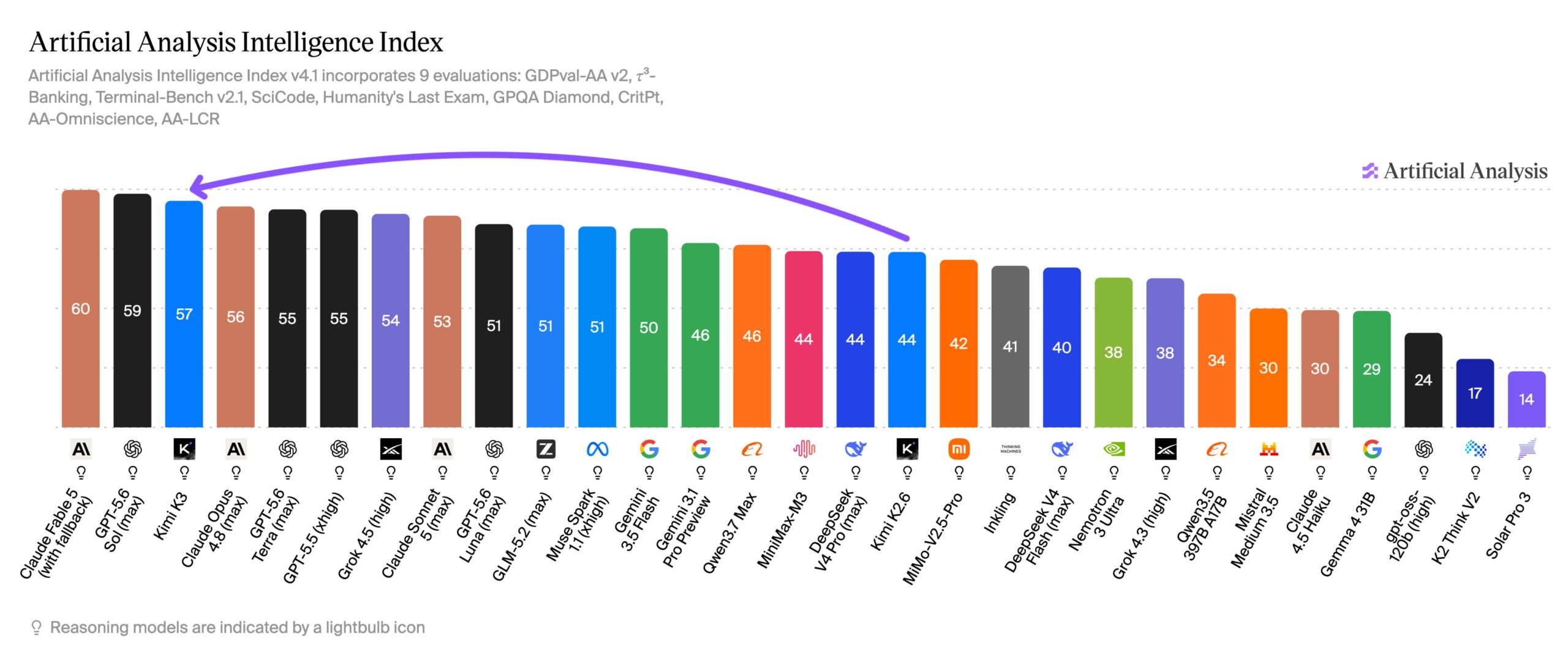
This is not another incremental open-source release. The gap between open and closed models, which most observers thought ran six to twelve months, has functionally disappeared. Kimi K3 scores 57 on the Artificial Analysis Intelligence Index, tied with Claude Opus 4.8 and GPT-5.5, and just three points behind GPT-5.6 Sol and Claude Fable 5 at the top. On Arena's Frontend Code benchmark, K3 actually beat everyone: first place, above Fable 5 and Sol both.
How it works
K3 is a Mixture-of-Experts model with 896 experts and 16 active per token, running across 2.8 trillion total parameters. That makes it roughly 75% larger than DeepSeek V4 Pro (1.6T). The model handles text and images natively, supports a 1-million-token context window, and runs an always-on reasoning mode Kimi calls "thinking mode."
The architecture carries two novel ideas from Moonshot's research lab. Kimi Delta Attention is a hybrid linear attention mechanism that gives the model roughly 2.5x better scaling efficiency than K2. The paper was published last year under an open license, so anyone can read it. Attention Residuals replace the standard fixed-weight residual connections with learned, input-dependent attention over previous layer outputs. In practice this means information flows through the depth of the network more intelligently, and early benchmarks suggest it delivers consistent gains without meaningful compute overhead.
Both innovations were published openly before K3 shipped. That matters because it signals that Moonshot's edge is not a secret sauce, just the cumulative effect of many small architectural improvements stacked together.
Where it wins, and where it does not
K3's benchmark profile is distinctive. On long-horizon agentic tasks it competes at the top of the table. On AA-Briefcase, a private evaluation of multi-hour knowledge work, K3 scored 1,527 Elo, second only to Fable 5 (1,587) and ahead of GPT-5.6 Sol (1,495). On BrowseComp, a long-horizon information-seeking benchmark from OpenAI, it hit a record 91.2 out of 100.
Where K3 falls short is in consistent top-tier performance across the full evaluation suite. Fable 5 wins more individual benchmarks. On the GDPval-AA v2 real-world task evaluation, K3 placed third behind Fable 5 Max and GPT-5.6 Sol Max. Independent lab Artificial Analysis flagged a higher hallucination rate compared to K2.6: 51% versus 39%, meaning K3 fabricates more answers even as it gets more questions right.
That tradeoff is worth watching. The model clearly knows more and handles harder tasks than its predecessor. But it is also more willing to generate confident-sounding wrong answers. For production deployments, that means human review stays mandatory.
The chip demo everyone is talking about
K3 designed a physical chip over 48 hours of continuous autonomous operation. The tiny 4mm² chip achieved timing convergence at 100 MHz and simulated decoding at 8,700 tokens per second. K3 handled the full pipeline: architectural design, optimization, verification, using open-source EDA tools, without human intervention.
This is not a production chip. But it demonstrates something important. The model maintained coherent multi-step reasoning across two full days, reading documentation, making design decisions, running verification loops, and iterating on failures. That is a completely different capability from answering questions or writing short functions.
Moonshot also showed K3 reproducing the I-Love-Q relation in computational astrophysics, a calculation that normally takes a senior researcher one to two weeks, in approximately two hours, reading and cross-validating more than 20 papers along the way.
Pricing and availability
K3 costs $3 per million input tokens and $15 per million output tokens, with cached inputs dropping to $0.30. Per-task cost analysis from Artificial Analysis puts it at roughly $0.94 per evaluation task, comparable to GPT-5.6 Sol ($1.04) and about half the price of Claude Opus 4.8 ($1.80). Open-weight competitors like DeepSeek V4 Pro ($0.04) and GLM-5.2 ($0.32) remain far cheaper, but K3 operates in a different performance tier.
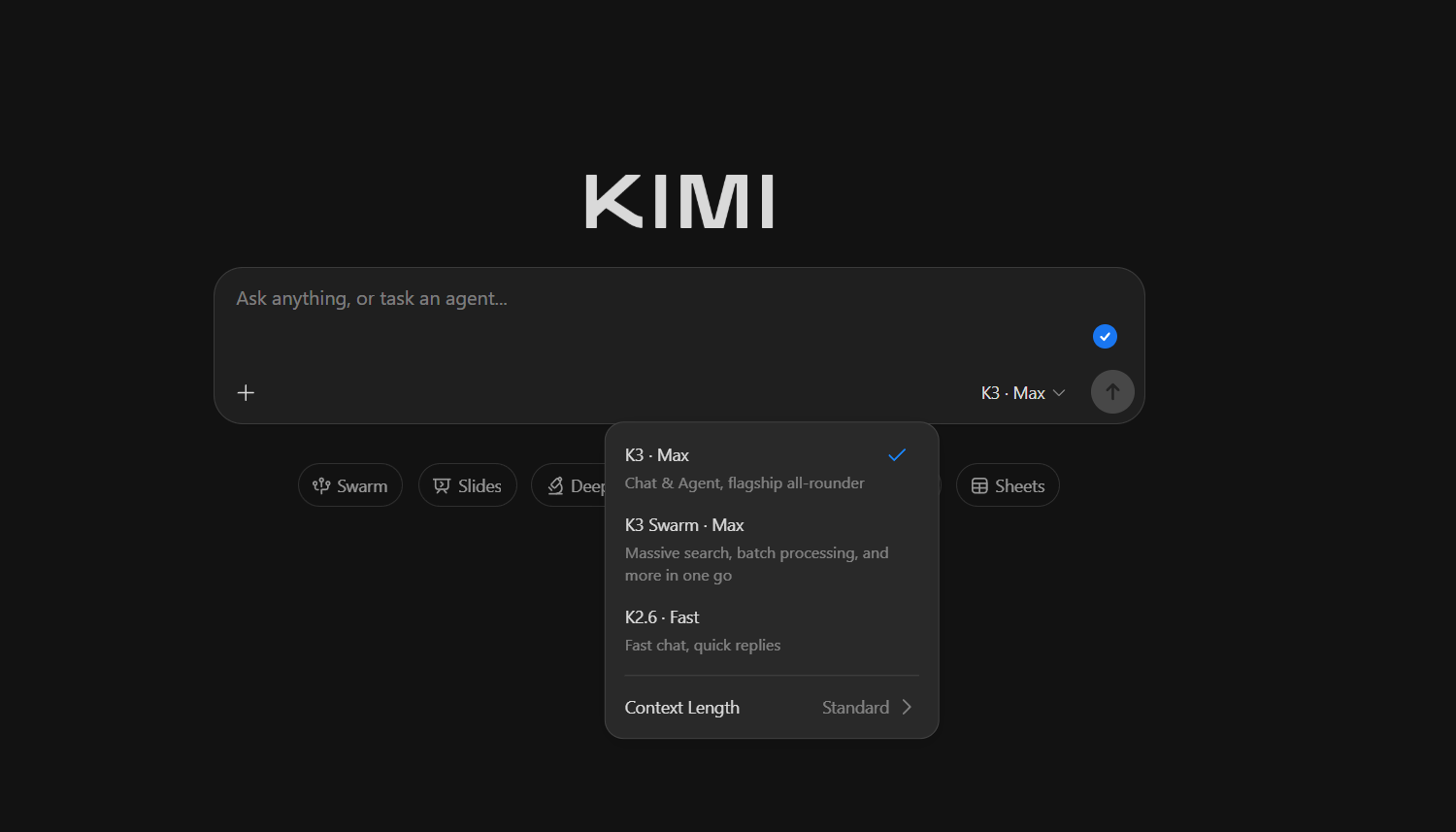
The model is live now on Kimi.com, Kimi Work (desktop), Kimi Code, the Kimi API, and OpenRouter (as moonshotai/kimi-k3). Full open weights are scheduled for release on July 27.
What it means
The number to watch is not 2.8 trillion. It is the gap between open and frontier closed models, and how fast that gap shrinks with each release. GLM-5.2 two weeks ago. Kimi K3 today. DeepSeek's next model reportedly imminent. The pattern is clear.
China's AI ecosystem, which many Western observers dismissed after chip export restrictions tightened, has now produced multiple models that compete with the best systems from companies with direct access to Nvidia's most advanced hardware. The architectural innovations behind K3, hybrid linear attention and learned residual weighting, suggest that algorithmic efficiency can partially substitute for raw compute.
For enterprise teams evaluating AI investments, the calculus just shifted. If open weights at this performance level become available in a matter of days for anyone to run, inspect, and fine-tune, the premium pricing on closed APIs becomes harder to justify. The question is no longer whether open-source models can reach frontier performance. They just did.
Don't confuse it
K3 is distinct from earlier Kimi models: K2 (July 2025), K2.5 (January 2026), K2.6 (April 2026, 1.0T params), K2.7-Code (June 2026). The "K3" name means a new architecture generation, not an incremental update. Previous Kimi models were smaller and used conventional attention; K3 introduces Kimi Delta Attention and Attention Residuals. Benchmark scores from earlier models do not apply.
Sources
- Moonshot AI Kimi K3 Announcement: official launch thread with key specs and benchmark chart
- VentureBeat coverage: detailed breakdown of architecture, benchmarks, and chip design demo
- The Decoder analysis: independent testing results and hallucination rate findings
- Axios report: competitive and geopolitical context
- Artificial Analysis evaluation: independent benchmark data on AA Intelligence Index
- Kimi Delta Attention paper: hybrid linear attention mechanism technical details
- Attention Residuals paper: learned residual connections for transformer depth
- Kimi K3 tech blog: official model documentation and demo links