Mira Murati's Thinking Machines Lab just released its first model. Inkling has 975 billion parameters, Apache 2.0 license, native multimodality, and a genuinely surprising feature: you can tell it how hard to think.
The controllable thinking effort thing is not a gimmick. You set a reasoning budget from 0.2 to 0.99 and the model adjusts how much compute it spends per token. Straightforward tasks burn fewer tokens. Hard problems get the full treatment. The company published continuous cost-performance curves so you can pick your exact point on the tradeoff. That level of granularity is rare in open-weight models and basically nonexistent in closed ones.
The 41 billion that do the work
Inkling is a Mixture-of-Experts transformer. 975 billion total parameters, 41 billion active per token. That 41:975 sparsity ratio means inference stays fast even though the raw parameter count sounds absurd. It supports 1 million tokens of context and was pretrained on 45 trillion tokens of text, images, audio, and video.
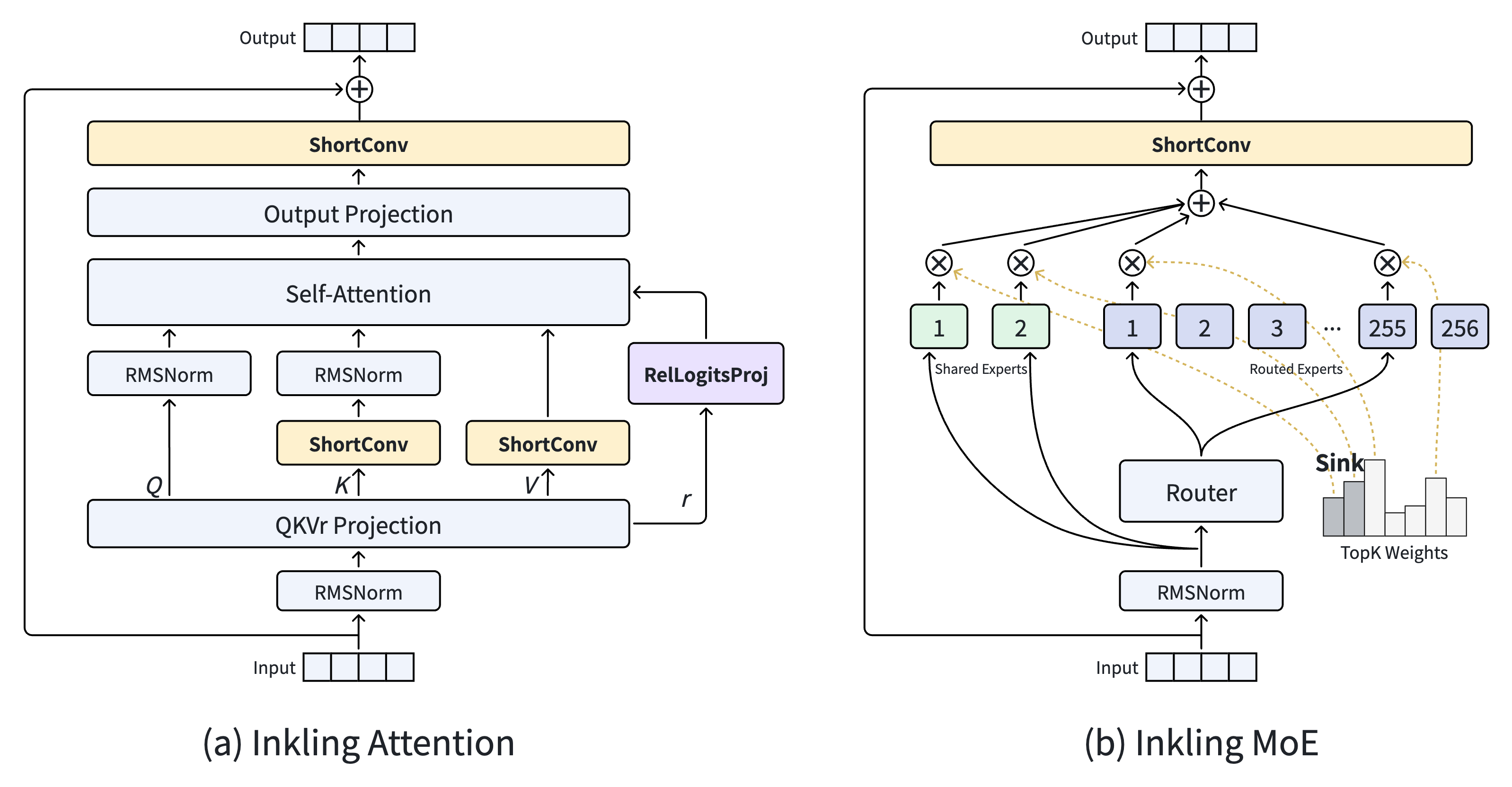
The architecture is worth a close look. Each decoder layer adds a short convolution (kernel size 4) before the residual connection, and attention uses learned relative-position biases instead of RoPE. The MoE router scores shared experts alongside routed ones from the same weight budget rather than adding a separate always-on path. The LMSYS team published a detailed architecture breakdown alongside SGLang day-zero support if you want the full technical picture.
The benchmarks worth caring about
Inkling does not win every leaderboard. The company says so itself. What it does well is balance.
On software engineering it scores 77.6% on SWE-bench Verified, which beats Nvidia's Nemotron 3 Ultra (71.9%) but trails DeepSeek V4 Pro (80.6%) and Claude Fable 5 (95.0%). On math it posts 97.1% on AIME 2026, edging out DeepSeek V4 Pro's 96.7%. Voice understanding hits 91.4% on VoiceBench, competitive with Gemini 3.1 Pro's 94.4%. The multimodal benchmarks hold up well too: 73.3% on MMMU Pro for vision and 77.2% on MMAU for audio.
Against Chinese open-weight rivals the picture is mixed. GLM 5.2 scores higher on agentic reasoning and Terminal Bench. Kimi K2.6 beats it on GPQA Diamond and BrowseComp. But Inkling leads on instruction following (79.8% on IFBench versus Kimi's 76.0%) and math. For a first-generation model trained from scratch by a new lab, landing in this territory is genuinely impressive.
The thing about the license
Apache 2.0 is the headline here. Most Western "open" models ship with restrictions: revenue caps, acceptable use policies, commercial licenses that require negotiation. Inkling's weights are genuinely free to download, modify, integrate, and sell. No royalties, no usage limits, no dual-use clauses.
That matters because it changes what enterprise teams can do. Run it on-premises. Fine-tune it on proprietary data. Distribute it inside a product without legal review. The model works with SGLang, vLLM, llama.cpp, and comes with a prebuilt NVFP4 checkpoint for Blackwell hardware. The Tinker platform handles the fine-tuning workflow, and the company showed a demo where Inkling fine-tuned itself through a chatbot interaction.
What the community is saying
The HN thread filled up fast. One commenter called it "the best western open weights model" and another noted that "America needs its own DeepSeek." John Schulman (Thinking Machines co-founder) posted that pretraining started last winter and a small team built the coding and reasoning capabilities from mid-January. Hugging Face's chief open source officer highlighted how swapping in FlashAttention-4 and optimized Conv1D kernels boosted throughput by 15 percent with no architectural changes.
The critical take is fair: it is not stronger than GLM 5.2 for agentic workflows despite being larger, and the coding benchmarks trail the frontier closed models by a wide margin. Switching costs for AI models are near zero, so Inkling needs to earn its place through the Tinker ecosystem and customization story rather than raw benchmark scores.
Why it might work anyway
The open-weight landscape is crowded but most models compete on the same axis: benchmark scores. Inkling competes on a different one: adaptability. The controllable thinking effort, the Apache 2.0 license, the native multimodality, the fine-tuning pipeline all point toward a model designed to be modified rather than consumed. That is a bet that customization beats raw capability for a large slice of enterprise use.
Whether that bet pays off depends on whether the Tinker platform delivers a genuinely better fine-tuning experience than existing tools and whether Inkling's next generation closes the gap on agentic reasoning. But as a first release from a new lab with a philosophical argument about how AI should be distributed, Inkling makes its case well.
Sources
- Inkling: Our Open-Weights Model: official announcement with architecture details and benchmark tables
- Thinking Machines Lab on HuggingFace: model weights and model card
- SGLang Day-0 Support for Inkling: technical architecture breakdown with ShortConv, RelLogitsProj, and shared-expert sink details
- VentureBeat Analysis: competitive benchmark comparisons and censorship resistance evaluation
- Fortune Coverage: business context and market positioning
- Baseten Blog: day-zero deployment guide
- vLLM Blog on Inkling: inference optimization details
- Hacker News Discussion: community reactions and critical takes