The interesting part of GLM-5.3 is not that Z.ai says it is better at coding. Every model launch says that. The useful signal is what happened after the weights appeared on Hugging Face: people immediately started asking how to run it, how much memory it needs, and whether a serious local setup is possible without turning a server rack into a hobby project.
The short answer is uncomfortable. GLM-5.3 is open weight, but open weight does not mean laptop-friendly. The repository currently exposes 141 safetensors shards and an FP8 quantization configuration. Its published config has 78 layers, a 6,144-wide hidden state, eight routed experts per token, and a maximum position embedding of 1,048,576 tokens. Those numbers describe a powerful agent model. They do not describe an easy download.
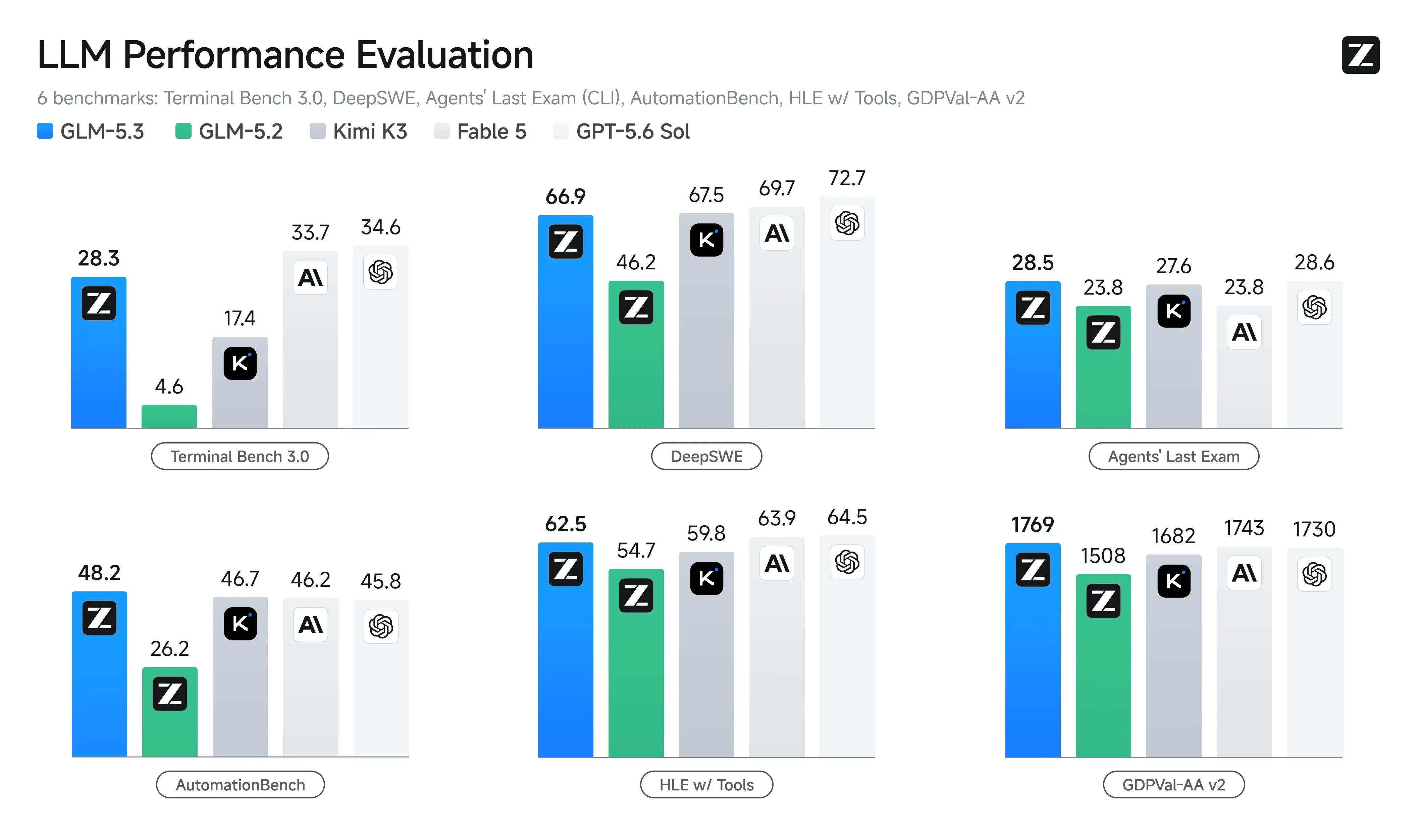
There is a second wrinkle. The official card says GLM-5.3 uses the same base model as GLM-5.2 and attributes the gains to post-training. On the published Terminal Bench 3.0 result, GLM-5.3 scores 28.3 while GLM-5.2 scores 4.6. CyberGym moves from 77.2 to 84.5. That is a large jump without a new base model, but it also means the model is tuned around long tool interactions and evaluation environments. A single leaderboard number is not a promise that it will calmly repair your production repository.
The local reality
The first decision is whether “local” means owning the weights or serving them on a workstation. Those are different things. Owning the weights means the model is downloadable without a gate. Serving the model means holding enough of it in accelerator memory, loading the right kernels, leaving room for the KV cache, and accepting that a million-token context window is a ceiling rather than a sensible default.
The 141-shard layout is the warning label. It tells you that this is a very large checkpoint, even before accounting for runtime memory, caches, framework overhead, and the operating system. Community discussion around the release commonly estimates a total model size in the hundreds of billions of parameters, roughly 730B for the mixture-of-experts configuration. That estimate is useful for planning, but it is not an official parameter-count statement in the model card, so treat it as a hardware conversation starter rather than a specification.
The practical consequence is simple: a normal 16 GB or 24 GB developer GPU is not a realistic target for the full checkpoint. A quantized build may lower the weight footprint, but it does not eliminate the need for memory bandwidth and cache capacity. You also cannot solve the whole problem by setting the context window to one million tokens. Long context consumes memory as the conversation grows, and an agent that spends hours reading a repository can hit the cache wall long before it reaches the advertised maximum.
That is where the new release differs from the GLM-5.3-Flash article already on NestFrontier. Flash is the hosted, cost-oriented option. The open-weight GLM-5.3 is the control-oriented option. Choose the latter when data residency, custom tool routing, reproducibility, or offline operation matters enough to justify infrastructure. If the requirement is simply “give my coding agent a strong model this afternoon,” hosted Flash is the less romantic and more sensible choice. The earlier GLM-5.3-Flash hardware analysis covers that alternative in detail: the earlier GLM-5.3-Flash hardware analysis.
There is a capability limitation that matters more than the parameter argument for some teams. Hacker News commenters repeatedly pointed out that GLM-5.3 is not multimodal. It cannot inspect a screenshot in the way a vision-enabled coding model can. One commenter demonstrated an impressive image-to-HTML reconstruction by having the model write a script to inspect the image, but that is a workaround, not native visual input. If your debugging workflow starts with screenshots from a browser, simulator, or design file, keep a vision model in the loop.
A safer serving setup
The official model card names SGLang, vLLM, TokenSpeed, Transformers, KTransformers, and Unsloth as supported routes. Start with vLLM or SGLang if you need a conventional OpenAI-compatible endpoint and have the hardware those frameworks expect. Start with Transformers only when you are testing the model code or need a custom integration. The framework choice will not make the checkpoint small, but it will decide whether you get working kernels, batching, and a maintainable service.
Use the model's reasoning controls deliberately. GLM-5.3 defaults to maximum thinking when reasoning_effort is missing or invalid. The supported explicit levels are low, high, and max. For interactive coding, begin with high, measure completion quality and latency, then reserve max for tasks that genuinely need long planning. “Max everywhere” is how a model turns a quick function edit into a queue-management problem.
The chat template has another sharp edge. clear_thinking defaults to false, and the model card recommends explicitly passing clear_thinking=true for chat scenarios. That setting is easy to overlook because the model will still produce output without it. The resulting transcript can retain internal reasoning where your application expected a clean assistant turn, which complicates logging, token accounting, and downstream tool parsing.
A minimal rollout should therefore look like this:
- Pin the exact model revision instead of tracking a moving
mainbranch. - Confirm that the serving framework supports
glm_moe_dsabefore downloading hundreds of gigabytes. - Load a quantized checkpoint only after checking that its kernels are supported by your accelerator.
- Set a finite context limit for the first test. Do not begin at 1,048,576 tokens.
- Pass
reasoning_effortexplicitly and setclear_thinking=truein chat requests. - Put the endpoint behind authentication and a network policy. An agent with shell tools should not have unrestricted access to your production network.
- Test on a fixed repository task, not a toy coding prompt. Record time to completion, tool errors, cache growth, and whether the agent changes files outside the task.
The benchmark details reinforce why the last step matters. Terminal Bench 3.0 was run with the Claude Code harness, maximum reasoning effort, a 400K context, up to 128K output, isolated task containers, and a 10-hour timeout. CyberGym used a Claude Code environment, no web tools, a domain whitelist, and 1,507 tasks. Those results tell us something about the model under controlled agent conditions. They do not tell us how it behaves inside your IDE with a 24 GB card and an unrestricted shell.
The release is still important because the gap between “frontier capability” and “weights you can inspect” keeps shrinking. But the operational gap remains. GLM-5.3 is best understood as a serious inference project with an open checkpoint, not as a giant download that magically becomes a local assistant. If you have multi-accelerator capacity and a reason to own the service, test it with strict limits. If you have one developer GPU, use the open release to study the stack, try a smaller derivative when one appears, or call the hosted alternative until the memory math changes.
The most revealing line in the launch is that post-training produced the gain. The next question is not whether another lab can add more parameters. It is whether serving systems can make this much agent behavior affordable, inspectable, and boring to operate.
Sources
- GLM-5.3 Hugging Face model card: official weights, benchmark table, serving integrations, and reasoning controls
- GLM-5.3 configuration file: published layer, hidden-size, routing, and context configuration
- Z.ai GLM-5.3 announcement: official release discussion and post-training claims
- GLM-5 technical report on arXiv: model lineage and training-system background
- Hacker News GLM-5.3 discussion: community questions about local deployment, multimodality, licensing, and benchmark interpretation