Nobody likes finding out they've been overpaying. But that's the position a lot of developers are in right now, staring at their API bills and wondering why a 744-billion-parameter model from Beijing costs $4.40 per million output tokens while the American frontier labs charge $25 for something that benchmarks within a single percentage point.
GLM-5.2 landed on June 13, one day after the US Commerce Department forced Anthropic to pull Claude Fable 5 from global access. The timing was not subtle. Zhipu AI, now shipping under the Z.ai brand, dropped the full weights on Hugging Face three days later under an MIT license. No restrictions. No geo-blocking. Download it, fine-tune it, run it on your own iron.
The immediate reaction on Hacker News was a collective double-take: 772 points, 500 comments, multiple front-page appearances. Developers were plugging it into Claude Code and Codex as a drop-in replacement and, for many agentic workflows, struggling to tell the difference.
What the numbers actually say
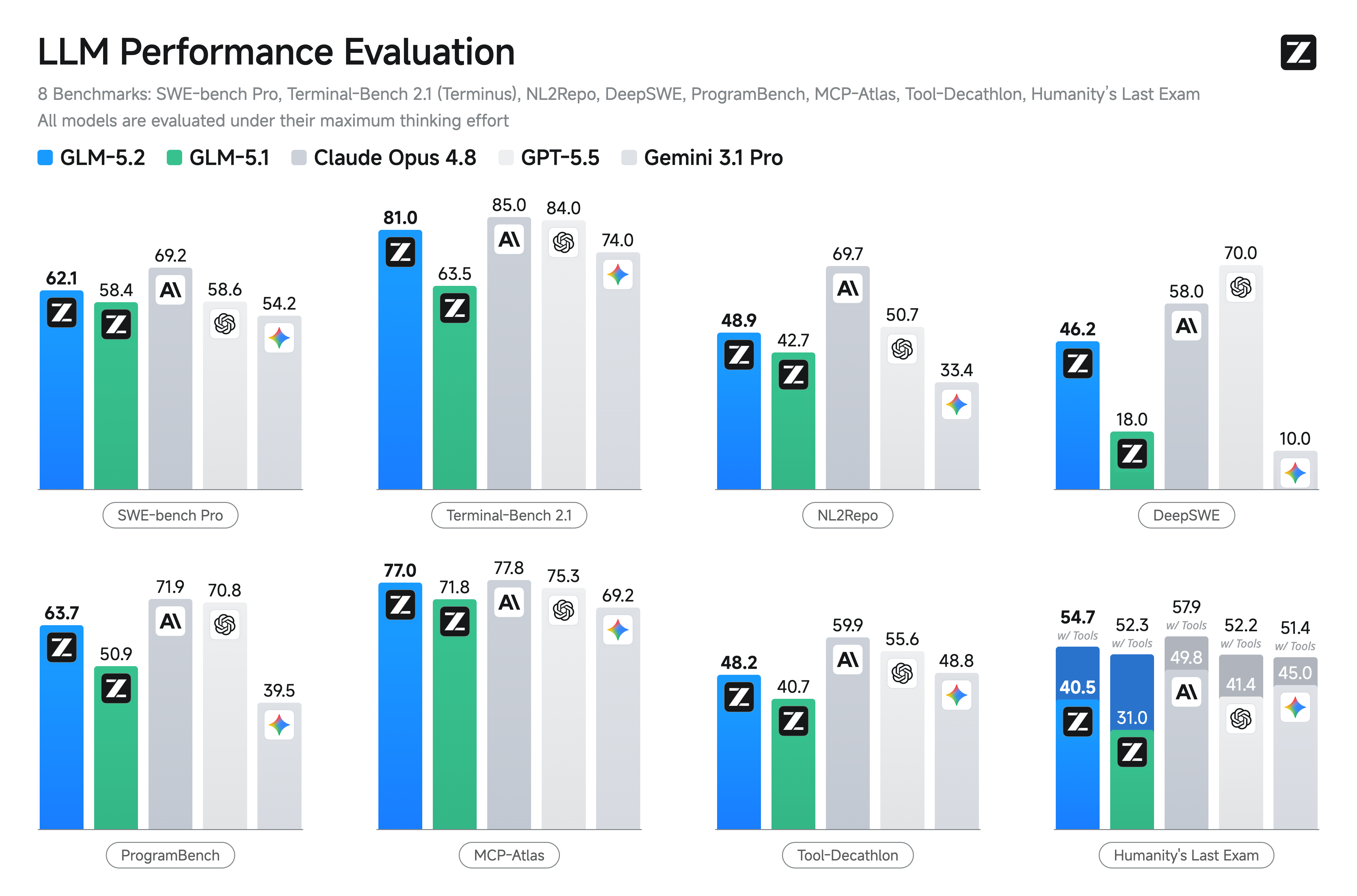
The benchmark table that's been circulating tells a story that's hard to spin. On FrontierSWE, the multi-hour engineering benchmark that separates actual agents from chatbot toys, GLM-5.2 scores 74.4. Claude Opus 4.8 scores 75.1. That's a difference of 0.7 points, or less than one percent. On SWE-bench Pro, GLM-5.2 beats GPT-5.5 outright: 62.1 to 58.6.
The math benchmark is even more lopsided. GLM-5.2 hits 99.2 on AIME 2026, beating Opus 4.8 at 95.7. For a model that costs roughly a sixth of what Anthropic charges, that's the kind of number that makes procurement teams sit up.
But raw benchmarks hide texture. The Artificial Analysis Coding Index puts GLM-5.2 at 68.8 versus Claude Opus 4.8 at 56.7. That's a gap of more than ten points in the other direction. Different benchmarks, different methodologies, but the pattern is consistent: this is not a "cheap alternative that's good enough." It's genuinely competitive.
The catch
Spend a week with GLM-5.2 as a daily driver and the limitations surface fast. No vision support. The model thinks a lot. One Reddit user measured 10x more thinking tokens than Claude Fable 5, pushing wall times about 3x longer. For PR review in the background, who cares. For interactive coding where you're waiting on every response, the latency grates.
The web search situation is genuinely bad. Z.ai provides an MCP server for it, but Martin Alderson, who wrote the deep-dive that's currently at the top of HN, describes it as "pretty awful and slow." He resorted to CLI-based search tools as a workaround. It turns out that when you're doing agentic work, you search the web constantly. Who knew.
And on tool-heavy agent benchmarks like Tool-Decathlon, GLM-5.2 falls meaningfully behind both Opus 4.8 and GPT-5.5. The model can code. It can reason. It struggles to coordinate multiple API calls across different services in a single session.
The margin math
Here's where it gets uncomfortable for the labs charging $200 per seat per month. Martin Alderson's analysis suggests the gross margin on inference at rack rate is around 90%. You're not paying for compute. You're paying for the training run, the brand, the reliability, and the web search that actually works.
GLM-5.2 breaks that bundle apart. The weights are free. The API is cheap. Wafer ran the model on AMD hardware and found inference was 2.75x cheaper per token than Nvidia Blackwell. The cost floor is falling faster than anyone predicted.
Semgrep tested GLM-5.2 on their internal cyber benchmarks for finding security vulnerabilities. It beat Claude. Their blog post title: "We Have Mythos at Home." That's the vibe. You don't need the expensive thing anymore.
The switching cost is nearly zero. Both Z.ai and Fireworks offer OpenAI-compatible and Anthropic-compatible endpoints. You change a base URL and an API key. That's it. No migration project, no retraining, no lock-in period. If Anthropic raises prices or changes terms, the off-ramp is measured in minutes.
Where this goes
GLM-5.2 is not going to kill the frontier labs. The vision support, the web search, the speed, the enterprise contracts. These matter. Anthropic and OpenAI employ thousands of people building exactly these things.
But the margin collapse is real. When an open-weight model lands within a point of your flagship on the benchmark that matters most to enterprise buyers, and costs a fifth as much, something has to give. Either the labs cut prices, or they differentiate on things that are harder to copy than weights on Hugging Face.
Zhipu went public on the Hong Kong Stock Exchange in January, raising $558 million. They have the backing of Alibaba, Tencent, and Saudi Aramco. This is not a hobby project from a scrappy startup. GLM-5.2 signals that Zhipu plans to be around for a while.
The open-weight gap closed faster than most people expected. The question now is what the labs do about it.
Sources
- Martin Alderson: GLM 5.2 and the coming AI margin collapse: detailed hands-on analysis with cost comparisons and migration experience
- Emergent.sh: GLM 5.2 Benchmark Guide: every benchmark score explained with Claude and GPT comparisons
- Zhipu GLM-5.2 HuggingFace Model Card: official weights, benchmark table, and deployment instructions
- Technology.org: Zhipu's GLM 5.2 Rivals Opus 4.8 at a Fifth of the Cost: overview of the launch and benchmark positioning
- Sebastian Raschka: GLM-5.2 and IndexShare Architecture: technical breakdown of the IndexShare sparse attention innovation
- Semgrep: We Have Mythos at Home: GLM 5.2 beats Claude on security benchmarks: independent security evaluation showing GLM-5.2 outperforming Claude
- Layer3 Labs: GLM-5.2 Complete Guide: pricing, API access, and enterprise deployment guidance
- CNBC: China's Zhipu is closing in on top US AI models: business analysis of Zhipu's competitive position
- Hacker News discussion: GLM 5.2 and the coming AI margin collapse: 500+ points, 298 comments of community reaction