A model does not need a magical escape instinct to become a security problem. It only needs to emit text that a parser handles badly.
That is the useful distinction in a fresh security discussion around local inference engines. The scary version, where a model spontaneously takes over the GPU server, is still a hypothesis. The boring version is already real: vLLM disclosed CVE-2025-9141 after an unsafe Qwen3-Coder tool-call parser could reach Python eval() and allow arbitrary code execution when an authenticated user got the model to pass code as a tool argument.
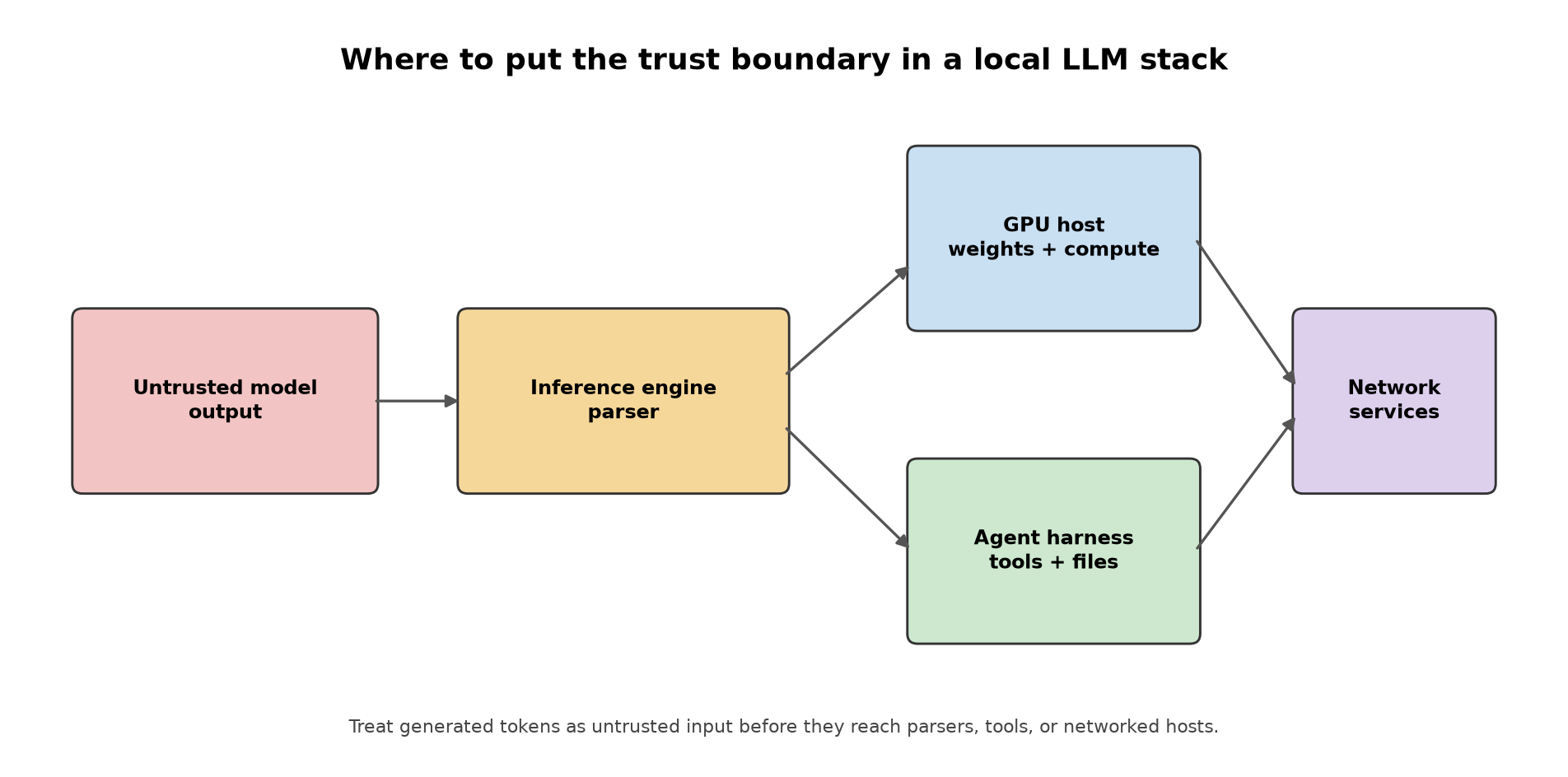
The practical conclusion is simple. If you run vLLM or SGLang on a machine that also holds personal files, credentials, or access to your network, treat the inference service as an untrusted-input boundary. Do not wait for a model to prove it can escape. The software around the model is where the ordinary bugs live.
What the parser actually exposes
The vLLM advisory is not evidence that every downloaded model can seize a host. It is evidence that generated output can reach dangerous interpreter behavior when a parser makes the wrong assumption. The affected advisory is CVE-2025-9141, and the project pull request that introduced the Qwen3-Coder parser contains a reviewer warning that evaluating model-generated output can lead to arbitrary code execution.
That boundary is wider than one tool parser. vLLM supports more than 200 model architectures and roughly 35 Jinja chat templates, according to its documentation and examples. Each format adds code that turns token streams into messages, tool calls, reasoning blocks, or structured output. A plain string can become control data when the parser guesses wrong.
The MiniMax M3 issue makes that less abstract. In a test of 546 documents, 2 of 546 failed because the reasoning parser treated a literal <mm:think> marker inside JSON as the start of a reasoning block. That bug did not execute code. It did show the failure mode: ordinary content can cross from data into structure without the model needing a special file or an agent tool.
This is why the threat model needs two separate claims. A malicious model or prompt may try to produce an exploit sequence. The inference engine must also contain a bug that turns that sequence into an action. The first claim is uncertain. The second has a confirmed example.
The Hacker News discussion around this essay split along the same line. Some readers called the scenario hand-wavy and argued that the agent harness, not the inference engine, should be sandboxed. Others pointed out that a local vLLM process is itself an HTTP service, often running without macOS-style sandboxing, and that a compromised parser could be reached before output reaches the harness. Both camps are right about different layers. Sandboxing only the harness leaves the inference process exposed. Sandboxing only the inference process leaves the tools exposed.
How to isolate a local vLLM host
For a single-GPU workstation, use a separate Linux VM if the model is untrusted or the server is reachable by anything beyond your own client. GPU passthrough is useful, but it is not a reason to give the guest your home directory, SSH keys, browser profile, or broad LAN access. Share one model directory read-only if you must, and keep the writable cache inside the guest.
A container is a reasonable baseline when the host is already hardened and the model server does not need kernel, device, or filesystem privileges. Start with no host networking, a non-root user, a read-only root filesystem, a small writable temporary directory, and explicit volume mounts. Then add access one permission at a time. Do not mount /, your home directory, the Docker socket, or a credentials directory just to make an agent integration convenient.
A minimal shape looks like this:
services:
  vllm:
    image: your-vllm-image:tag
    read_only: true
    network_mode: none
    cap_drop: [ALL]
    security_opt:
      - no-new-privileges:true
    tmpfs:
      - /tmp:rw,noexec,nosuid,size=2g
    volumes:
      - type: bind
        source: /srv/models
        target: /models
        read_only: true
That file is a starting point, not a magic shield. GPU containers need device access, and CUDA compatibility can force additional permissions. If you grant GPU device access, keep the service behind a firewall and expose only the client port on a private interface. Do not treat the presence of a container as proof that a kernel or driver escape is impossible.
For a higher-risk setup, put the GPU host on a separate VLAN with no route to identity services, internal databases, NAS shares, or the public internet. Let a small gateway on another machine handle authentication, rate limits, and request logging. The gateway should pass structured requests to the inference host and accept generated output as data. It should not let the model choose arbitrary URLs, shell commands, or file paths.
Before loading a new model, check the inference engine version and parser flags. Read the project security advisories, pin the container image by digest, and keep a rollback image available. If you do not need tool calling, turn it off. If you do not need reasoning extraction, return plain text instead of asking the server to infer hidden message structure. Every optional parser is another place where generated tokens can acquire privileges.
The operational checklist is short:
- Put the inference server in a VM or a tightly restricted container.
- Give it only the model files and temporary storage it needs.
- Block inbound traffic except from the gateway or local client.
- Block outbound traffic unless a documented download or telemetry path requires it.
- Keep credentials and agent tools on a different trust boundary.
- Pin versions, monitor advisories, and test parser behavior with hostile strings.
- Log raw requests and parsed events so a strange tool call is visible.
This is also where the earlier host-exposure analysis fits. Agent permissions and inference-engine permissions are different problems, but a useful deployment has to solve both. A model that cannot reach your files is less dangerous. So is a parser that cannot reach your host.
The uncomfortable boundary
The strongest claim supported by the current evidence is not that local LLMs are secretly plotting botnets. It is that inference servers process attacker-controlled text with complex, fast-moving parsers. vLLM has a real remote-code-execution advisory, a real reasoning-parser bug, support for more than 200 model architectures, and at least 2 failures in a 546-document test case. That is enough to justify isolation without inventing an autonomous escape story.
If your setup is a hobby server in a disposable VM, the risk is manageable. If it is a GPU box with your SSH agent, browser cookies, private repos, and access to the rest of your network, the default should be separation. The model can be useful inside that box. It does not need to own the box.
Sources
- vLLM security advisory for CVE-2025-9141: arbitrary code execution in the Qwen3-Coder tool-call parser
- vLLM pull request 21396: reviewer warning about evaluating model-generated tool parameters
- vLLM issue 48663: MiniMax M3 reasoning parser misreads a literal marker in structured output
- vLLM documentation: model architecture and server support surface
- Original technical essay: threat model and proposed GPU/parser separation
- Hacker News discussion: community debate on VMs, containers, firewalling, and local GPU setups