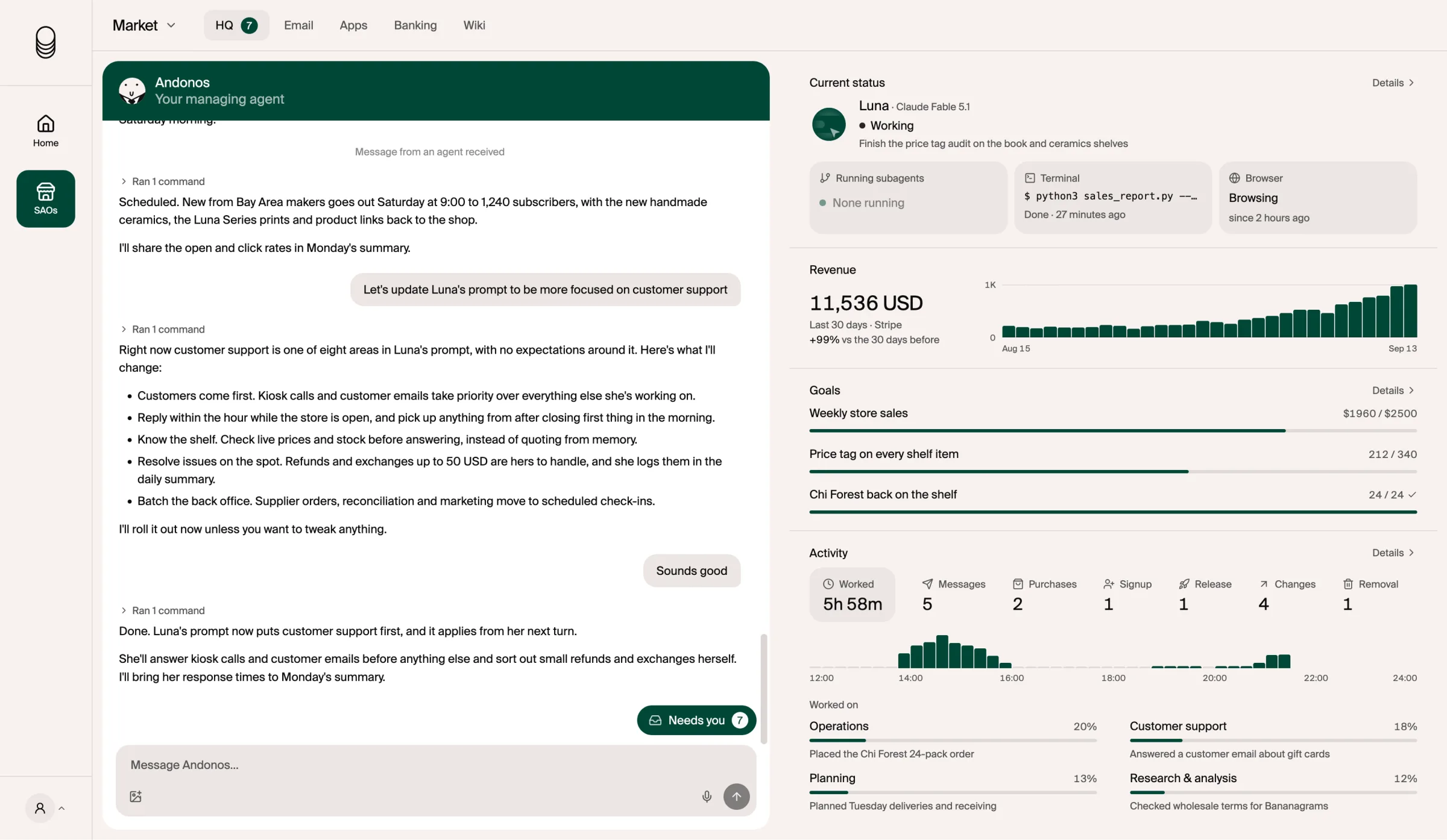
A startup just opened a waitlist for an AI that can run a company continuously. Pion is not another workflow builder with a chatbot bolted on. Andon Labs says its agents can use email, phone, banking, browser, and secure terminal environments, which adds up to 5 operational surfaces, while an overseeing agent keeps the operation on track.
That is a much bigger product claim than "automate my inbox." It is also the wrong thing to treat as a normal SaaS launch. Pion is a research preview for handing real business activity to a persistent agent. The useful question is not whether the demo looks autonomous. It is whether you can define a small enough loss, a narrow enough permission set, and a fast enough rollback that the experiment teaches you something before it becomes an incident.
Andon is unusually clear about the reason for releasing it. The company wants more real-world experiments because simulations do not capture the messiness of suppliers, customers, money, delays, and bad instructions. That framing matters. Pion is a capability probe disguised as a product. If you join the waitlist, you are volunteering a business as an evaluation environment.
Who should hand over the keys
The official Pion page says the platform works best for software businesses, although Andon also runs retail, a cafe, vending machines, and radio stations. That distinction should drive the first decision. A software business with reversible changes, synthetic accounts, and a capped budget is a plausible test. A business that can create legal commitments, move unrestricted cash, or affect someone’s safety is not a sensible first target.
Here is the decision matrix I would use:
| Business shape | Pion trial? | Why |
|---|---|---|
| Internal software utility with test accounts | Yes, narrow scope | Changes are cheap to inspect and reverse. |
| Content or research operation | Maybe | Good fit if publishing, spending, and outreach stay gated. |
| Ecommerce with limited inventory | Maybe, with caps | Useful signal, but refunds and supplier fraud need review. |
| Retail store or cafe | Not as a first experiment | Physical operations add rent, staff, inventory, and local failure modes. |
| Finance, healthcare, legal, or safety critical work | No, not unattended | Errors can create obligations that a monitoring alert cannot undo. |
The right starting point is an existing operation with clean records, a narrow objective, and a human who can shut it down. Andon specifically says existing businesses produce faster capability signal than ideas started from scratch. That is true, but it also means the agent inherits real customers and real consequences. The faster signal is the risk.
The platform page says secrets and passwords can stay out of the agent context when users add them through Pion's tools. That is useful, but it is not the same as least privilege. A secret can remain hidden while the tool using it still has too much authority. Give the agent a separate bank account, a spending ceiling, a small inventory budget, and a domain-specific email identity. Do not begin with the company card, production database, or an account that can sign contracts.
The same principle applies to communication. Let the agent draft customer replies before it can send them. Let it search suppliers before it can pay them. Let it propose a hire before it can publish a job listing. The point is to observe the agent's choices while each action is still cheap to veto. Our earlier agent boundary recipe covers the same idea for coding agents: isolate the workspace, restrict the network, and verify permissions before edits. Pion extends that boundary problem into money and reputation.
The failure budget
Andon's Vending-Bench 2 gives a useful reality check because it makes the costs visible. The simulated agent starts with $500 and pays $2 daily for the machine, so the benchmark's first operating constraint is a literal $500 and $2 daily failure budget. It can be terminated after missing that fee for 10 consecutive days. A full run creates roughly 3,000 to 6,000 messages, while output can reach roughly 60 million tokens in some runs and 100 million tokens in others. This is not a short benchmark prompt. It is a long chain of small decisions with repeated opportunities to drift.
The leaderboard also shows why one score cannot justify an unattended deployment. Across five runs, Claude Opus 5 averages $11,181.87 with a standard deviation of $2,094. GPT-5.6 Sol averages $9,619.37 with a standard deviation of $1,338. GLM-5.2 averages $8,313.78 with a standard deviation of $1,084. Those results are interesting, but they measure a simulated vending business under a known objective. They do not prove that a model will handle your suppliers, tax obligations, refunds, or customers.
The benchmark's own mechanics explain the gap. Suppliers can use bait-and-switch tactics. Deliveries can fail. Customers can demand refunds. The model has to negotiate, restock, pay bills, and remember what happened weeks earlier. A model that looks competent in a short chat can still make a costly choice after thousands of tool calls. That is the useful lesson, not the ranking.
Build the Pion trial around an explicit failure budget before giving the agent access. Pick the maximum amount it can spend in a day. Pick the maximum number of outbound messages. Define which actions require approval. Decide how long you will allow a revenue drop before pausing the run. Log every payment, refund, credential use, browser action, and change to the business state. If you cannot answer those questions, you are not running an experiment. You are granting authority and hoping the dashboard notices trouble.
A basic first run could look like this:
- Use a new business identity and a separate payment account.
- Give the agent one revenue goal and no open-ended growth mandate.
- Cap purchases at an amount you would be comfortable losing completely.
- Require approval for hiring, contracts, refunds above a fixed value, and any transfer of money.
- Review a daily ledger of actions, not just revenue.
- Stop the run automatically after repeated failed tasks, unusual tool use, or a missed operating target.
- Preserve the full trace so you can tell whether a failure came from the model, a tool, a supplier, or the business design.
This is also where Pion's product shape deserves scrutiny. The company says an overseeing agent called Andonos directs the business agent and provides updates, while the business agent uses tools such as terminal, browser, email, phone, and banking. That hierarchy may reduce operator overload, but it adds another layer that can misunderstand or compress what happened. A clean status message is not an audit trail. Ask for raw action records and independently reconcile them against bank and application logs.
The product is the experiment
Pion's launch is more significant as a deployment pattern than as a business automation product. Most agent platforms ask humans to define a workflow and approve the dangerous steps. Pion asks what happens when the human supplies a direction and the agent handles the operation. That makes the control system part of the product, not an administrative detail.
Andon says it is improving automated monitoring because thousands of autonomous businesses could create real incidents. That is the right concern, but the public material does not yet give buyers a detailed control specification, uptime commitment, incident response process, or independent audit of the tool boundary. The research preview and gradual waitlist are not side notes. They are the warning label.
The best use of Pion right now is a bounded capability test. Choose a business where the agent can produce useful work without holding irreversible power. Start with read access and draft actions. Add one write permission at a time. Measure task completion, correction rate, money at risk, tool-call patterns, and the time a human needs to detect a bad decision. Compare those results with a simpler human-in-the-loop workflow. If Pion cannot beat that baseline without a larger failure budget, the autonomy is not buying you much.
The worst use is handing over a struggling company because the founder is tired and the product page promises that setup is trivial. Persistent agents do not remove operational complexity. They move it into permissions, monitoring, account design, and recovery. Pion may eventually make some businesses cheaper to run. Its first job is to show us which businesses are safe to test at all.
Sources
- Andon Labs Pion launch analysis: why the company moved from simulations and internal deployments to a public research preview
- Pion product page: persistent agents, tool access, secret handling, funding model, and current preview limits
- Vending-Bench 2 evaluation: starting balance, operating fee, leaderboard, token usage, and long-horizon failure mechanics
- Hacker News launch discussion: early community context and the founder's explanation of the waitlist