Somewhere at Uber, a spreadsheet went red in April. The company's CTO, Praveen Neppalli Naga, told The Information that Uber had exhausted its entire 2026 AI coding tools budget. Not by year-end, not by Q3. By April. Four months in.
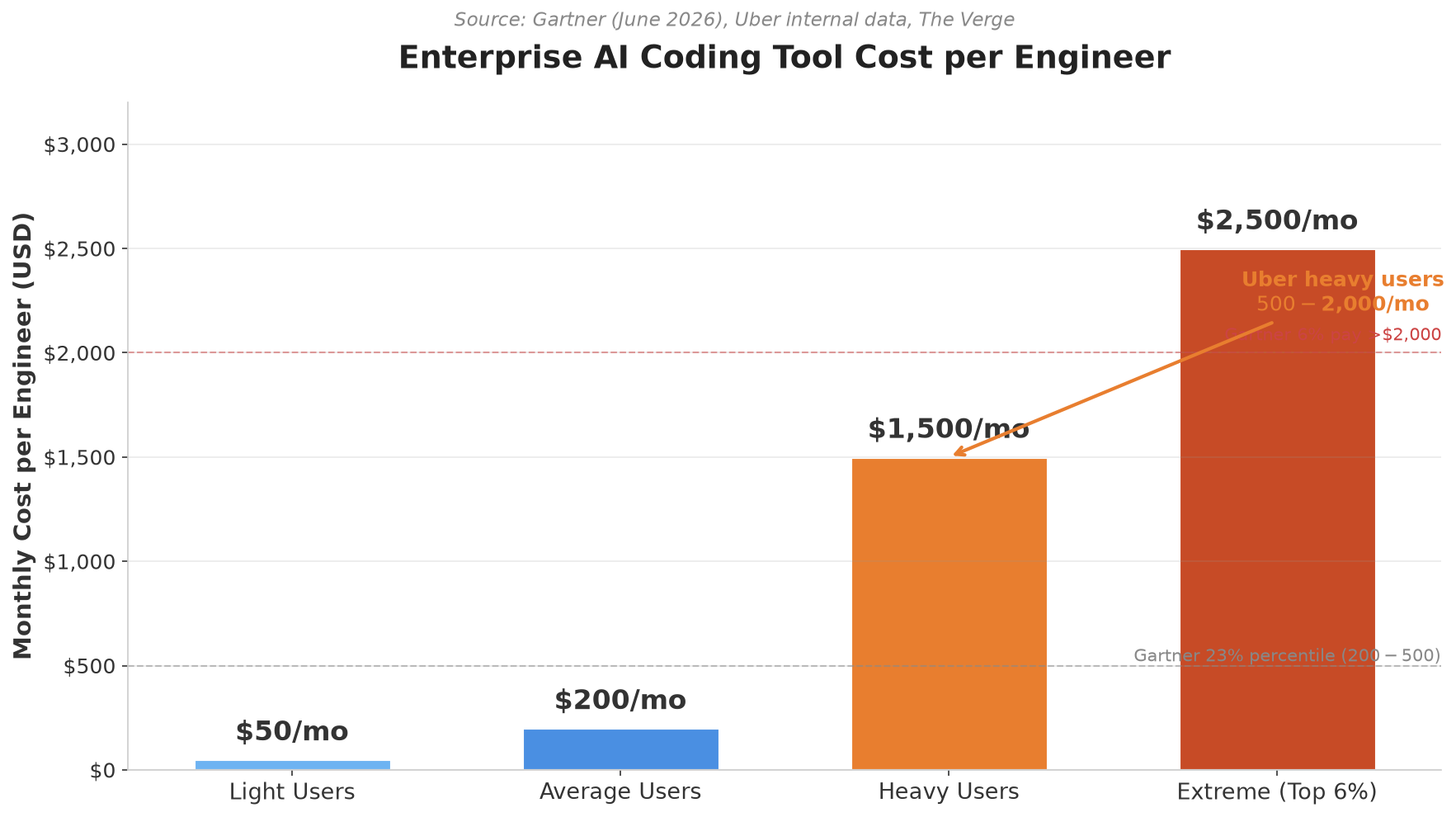
The numbers behind that are staggering. Uber had roughly 5,000 engineers, and 84 percent of them were classified as agentic coding users by March. Monthly per-engineer costs ranged from $500 to $2,000 for heavy users. At those rates, a full-year budget line evaporates before summer starts.
Uber's COO Andrew Macdonald gave the most honest account of the resulting discomfort in a Fortune interview on May 26. "That link is not there yet," he said, when asked whether rising AI spend was translating into consumer features. "Maybe implicitly there's more that is getting shipped, but it's very hard to draw a line between one of those stats and 'Okay now we're actually producing like 25 percent more useful consumer features.'" Uber had incentivized AI tool usage with an internal leaderboard ranking teams by consumption volume. The incentive worked exactly as designed. The company just had not designed a budget for what success would look like.
The Microsoft story is different but also about money
Two weeks before the Uber story broke, The Verge reported that Microsoft was pulling Claude Code licenses from its Experiences + Devices division, the group building Windows, Microsoft 365, Outlook, Teams, and Surface. Engineers were told to transition to GitHub Copilot CLI by June 30, the last day of Microsoft's fiscal year.
Claude Code had become popular inside Microsoft. Too popular. Engineers adopted it at a rate that started displacing GitHub's own Copilot CLI in daily use. Rajesh Jha, Microsoft's EVP for the division, sent an internal memo framing the decision as toolchain convergence. "Claude Code was an important part of that learning," he wrote. "At the same time, Copilot CLI has given us something especially important: a product we can help shape directly with GitHub."
The official framing is platform control. Microsoft sells Copilot to the world. Having its own engineers prefer a competitor's tool is an optics problem. But the June 30 cutoff is also the fiscal year boundary, and killing Claude Code licenses in that window is an easy line item to zero out when the next year's books open.
What token billing does to enterprise budgets
Both stories trace back to the same structural shift. Traditional software licensing is predictable: a fixed number of seats at a fixed price. Agentic AI tools priced on token consumption are not. An engineer running a multi-step refactor across a large codebase generates vastly more tokens than one asking for a function suggestion. When agentic workflows become standard and developers run tasks in parallel, per-user costs swing wildly.
Anthropic moved Claude Code from flat-fee pricing to usage-based billing for autonomous agents earlier this year. That shift reflects the same math from the vendor side: agents use far more compute per task than chat, and flat fees priced for chat do not sustain the infrastructure. Gartner senior principal analyst Nitish Tyagi warned in June that IT leaders will see AI coding costs increase tenfold or even a hundredfold. The firm projects that by 2028, AI coding costs will overtake the average developer's salary. Right now, 23 percent of organizations already spend $200 to $500 per developer per month on tokens. Six percent pay more than $2,000.
Opus 4.8 launched into this exact moment on May 28. Anthropic held pricing flat at $5 per million input tokens and $25 per million output tokens, and introduced a new Fast mode at $10/$50. The model became available on GitHub Copilot too, which means Microsoft engineers being pushed toward Copilot CLI can still access Claude's best model through the tool they are being directed toward. The timing was coincidental, but the proximity matters for how the launch is being received by enterprise buyers.
What neither story actually settles
Microsoft's move is about platform lock-in as much as cost. GitHub owns the CI pipeline, the code review, the pull requests. Copilot CLI sits inside that ecosystem in ways Claude Code cannot replicate. The internal signal, however, points the other way: engineers preferred Claude Code by enough that management had to reverse the policy. Copilot CLI now inherits a comparison it did not ask for.
Uber's situation is genuinely different. The company is not pulling back for platform reasons. It ran out of money because adoption worked exactly as intended and the ROI case had not been made in terms that connect to actual shipped features. Neppalli Naga described the company as "back to the drawing board" on AI budgeting. Uber also plans to test OpenAI's Codex alongside Claude Code, which suggests the problem is being treated as a forecasting failure, not a reason to stop.
The broader pattern is not that enterprise AI coding tools are failing. It is that organizations incentivized adoption without building the financial infrastructure to manage what successful adoption looks like at scale. That is a solvable problem. Both Uber and Microsoft are solving it in different ways. The question is whether the next wave of enterprises will learn from those examples or make the same mistake.
Sources
- The Verge - Microsoft starts canceling Claude Code licenses: Tom Warren's original reporting on the internal Microsoft decision
- Space Daily analysis: comprehensive coverage with Uber comparison and Opus 4.8 context
- Fortune - Uber COO on AI tool spending disconnect: COO Andrew Macdonald's May 26 interview
- The Information - Uber CTO shows Claude Code can blow AI budgets: original reporting on the Uber budget blowout
- Gartner press release: AI coding costs will surpass average developer salary by 2028
- Computer Weekly coverage: detailed breakdown of the Gartner findings
- DecodeTheFuture - Claude Opus 4.8 explained: 7 changes and dynamic workflows
- Anthropic - Claude Opus 4.8 announcement: official release notes