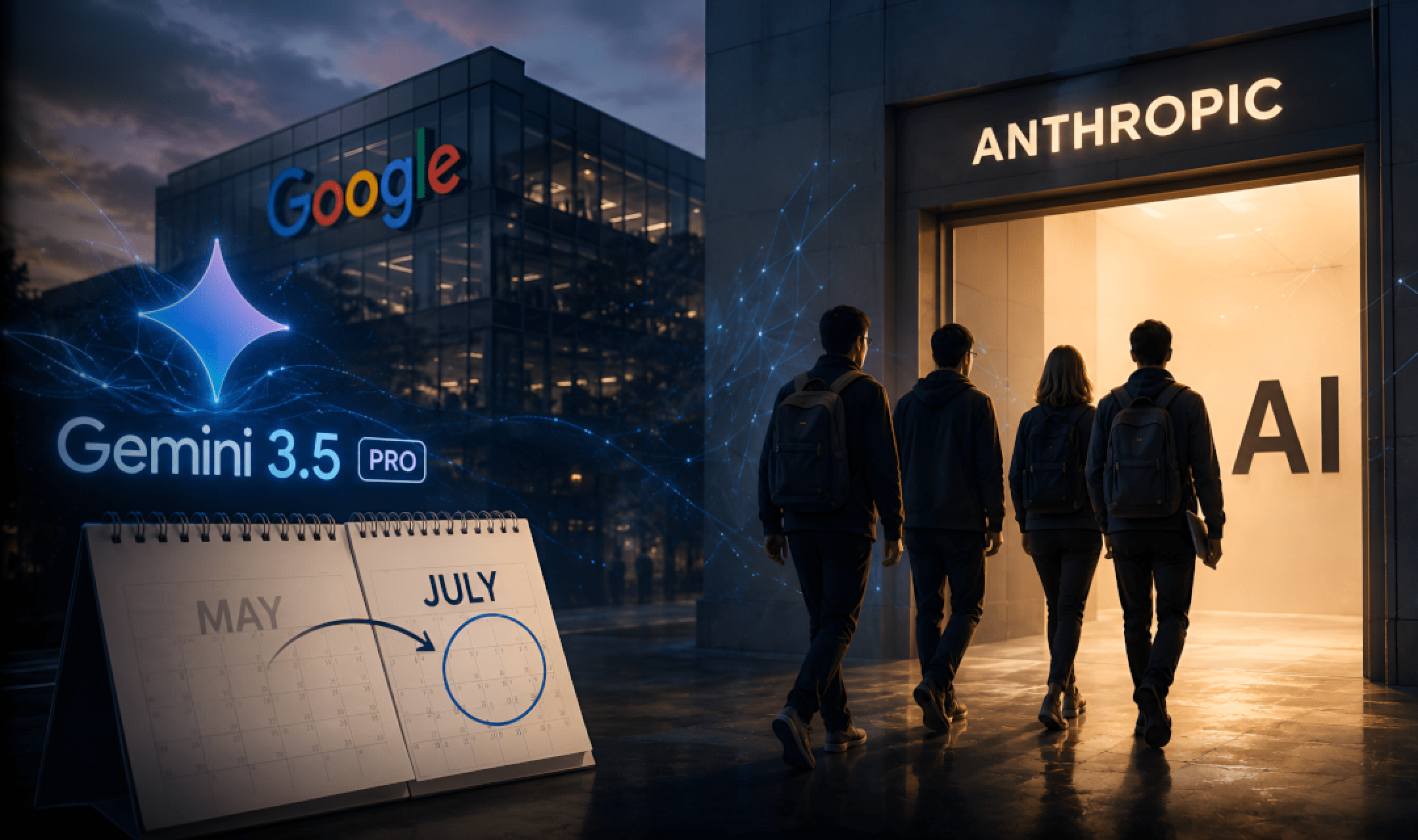
At Google I/O on May 19, Sundar Pichai stood on stage and told developers Gemini 3.5 Pro would ship in June. He was specific. "Give us until next month," he said, and the audience groaned. They had heard this before. Gemini Ultra 1.5 had slipped by three months earlier in the year.
What happened next is worth tracking not because it's rare, but because it reveals something about how fragile the AI market's confidence in any single company actually is.
Between June 18 and June 24, four senior researchers from Google DeepMind announced they were leaving. Noam Shazeer, co-author of the Transformer paper that powers every major LLM today and the person Google paid $2.7 billion to bring back from Character.AI, joined OpenAI. John Jumper, a Nobel laureate for AlphaFold and one of two Google-affiliated scientists to win that prize, went to Anthropic. Jonas Adler, a Gemini coding lead who also contributed to AlphaFold, and Alexander Pritzel, a pretraining specialist, both followed Jumper. Four departures in six days. Two to the company's primary rival, two more to the lab eating Google's lunch on coding all year.
The market did not ignore it. On June 22, Alphabet fell 5% in a single session and wiped $225 billion off its market cap. That was Google's largest one-day drop in over a year. Investors looked at a flagship model that missed its publicly stated launch window while the team building it walked out the door, did the math, and repriced the stock in hours.
Then came July 16. Bloomberg reported, citing ten current and former employees, that Gemini 3.5 Pro is months behind internal targets on coding. Google had updated the training data in late June specifically to improve coding performance, and the results fell short. Disappointing was the word that circulated. Alphabet dropped another 4.4 percent. That is roughly $200 billion more in market value, gone in a single afternoon.
Combined across two selloffs, investor reaction to the delay and the talent exodus has erased $425 billion in market value. That is more than the entire market cap of Netflix or AMD. It is roughly equal to the GDP of Finland. All from a model that has not even shipped yet.
The coding shortfall is specific and revealing. Coding is the hottest competitive axis of 2026. It is where enterprise budgets are won and lost. OpenAI's Codex has over 7 million weekly users. Anthropic's Claude Code has developer adoption Google cannot match because Google does not have a comparable product. Pichai himself has acknowledged Google trails on agentic coding tooling. When your flagship model cannot clear the internal bar on the one dimension every buyer evaluates, the delay stops being about quality assurance and starts being about competitive position.
Meanwhile the field is not waiting. Claude Sonnet 5 launched June 30 with agentic performance approaching Opus 4.8 at Sonnet pricing. GPT-5.6 Sol is shipping. DeepSeek V4 Flash, an open-weight model, has been dominating coding benchmarks for months at one-ninth the output token price of Claude Opus. The 2-million-token context window and Deep Think reasoning mode that Gemini 3.5 Pro was supposed to deliver are genuinely differentiated capabilities, but every week the model does not ship, the gap narrows as competitors push their own windows wider and their reasoning deeper.
None of this means Gemini 3.5 Pro will be bad when it arrives. Google has a track record of shipping technically strong models late. Gemini Ultra 1.5 proved that. But the trust dynamic has shifted. Enterprise buyers evaluating long-term platform bets now have to weigh not just whether the model is good, but whether the people building the next one will still be at Google when they need it.
The $425 billion question is not whether Gemini 3.5 Pro ships in July. It is whether the team that ships it can keep the team that builds the next one.
Sources
- Bloomberg Google Gemini Launch Delayed as Tech Falls Short: the July 16 report that triggered the $200B selloff, citing 10 current and former employees
- Reuters Google Gemini launch delayed as tech falls short of internal goals: confirmed the Bloomberg reporting with Google's official statement
- MarketWatch Alphabet sees $225 billion market-cap wipeout: the June 22 selloff analysis after Shazeer and Jumper departures
- The Agent Report $225B Wiped Off Alphabet as DeepMind Talent Exodus Deepens: comprehensive timeline of all four departures and market impact
- Bind AI Gemini 3.5 Pro Slips to July and Four Senior Researchers Left for Anthropic: confirmed specs, pricing estimates, and developer guidance
- CNBC Google Gemini Co-Lead Noam Shazeer Leaves for OpenAI: first departure on June 18
- CNBC John Jumper to Leave Google DeepMind for Anthropic: second departure on June 19
- Digital Applied Gemini 3.5 Pro Slips Again and Alphabet Sheds $200B: detailed selloff anatomy and roadmap risk analysis
- TechCrunch Anthropic Launches Claude Sonnet 5: competitive context, launched June 30
- Reddit r slash GeminiAI Gemini 3.5 Pro appears to have been delayed again: community reaction, 315 upvotes and 119 comments