A video model can draw a plausible next frame and still steer a maze-solving agent into a dead end. ProAR is built around that gap. Its authors add a predicted goal frame and a training-time signal about the next transition to an autoregressive video model, then report that it beats its standard baseline after 2,500 training steps instead of 10,000. That is worth a controlled reproduction. It is not a production-readiness certificate, and the step count alone does not tell you how much GPU time or money you will save.
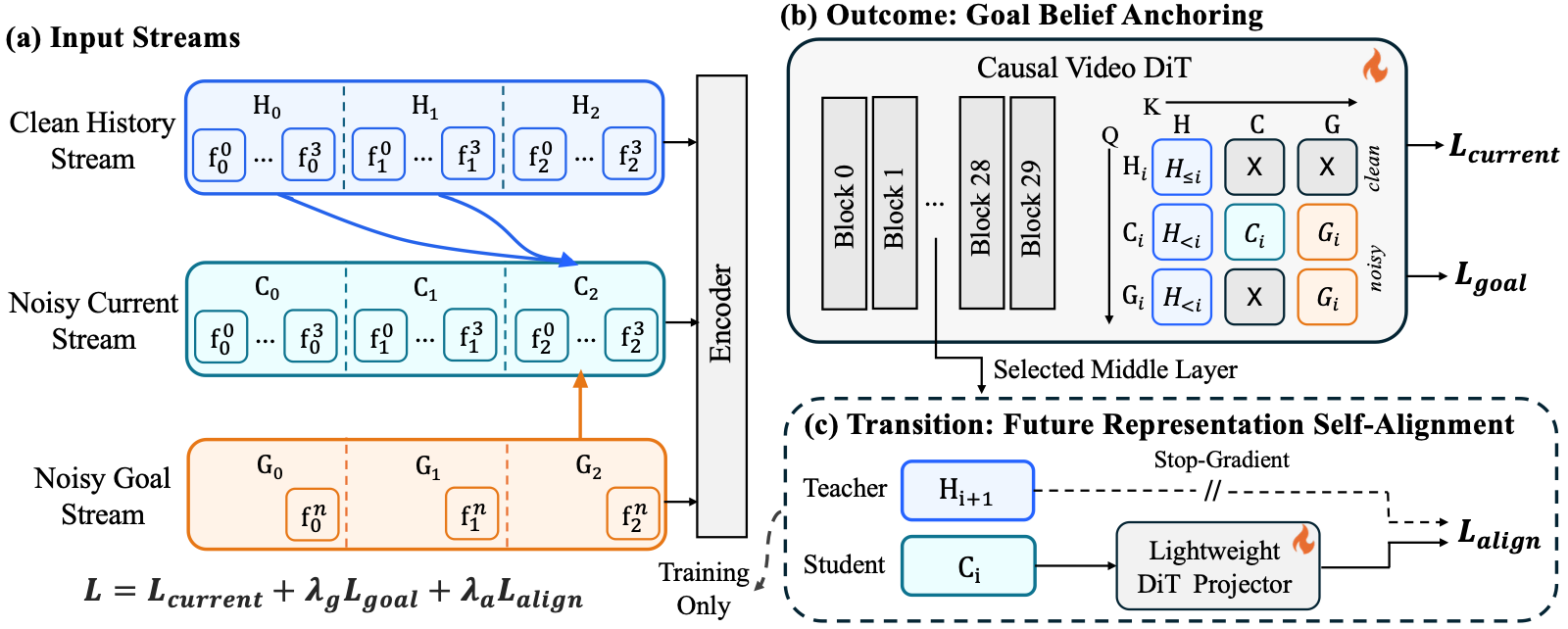
ProAR targets video-native reasoning: the model generates a sequence of visual states to solve a task, such as moving through a maze or arranging objects. A conventional autoregressive model predicts the next chunk using the history so far. Once it generates a bad step, later chunks inherit that mistake. The rollout is causal, and earlier chunks are not revised.
The paper adds two kinds of foresight. Outcome guidance predicts a goal frame alongside the current chunk. An asymmetric attention mask lets the current chunk use that predicted goal, while stopping its noisier state from changing the goal estimate. Transition guidance trains the current hidden representation to anticipate the next chunk. It uses teacher-forced representations already computed in the same pass, so the method does not need a separate representation encoder or another backbone pass. The extra alignment predictor is removed at inference.
What the result shows
On the authors’ 10-task VBVR subset, the reported mean score moves from 0.663 for standard autoregressive generation to 0.801 for ProAR. The project page’s training curve says ProAR passes the fully trained baseline at 2,500 steps, while that baseline runs for 10,000. That is the useful result for a research team: the proposed objective may reach a better task score earlier on this test set.
There is a second practical number, and it cuts against the easy “cheaper” headline. The authors report about 10% more inference time than standard AR. Training steps and inference latency are different budgets. Fewer optimizer updates could reduce training compute, but wall-clock savings depend on batch size, GPU count, data loading, checkpointing, and the speed of each step. A 25% step count is not evidence of a 75% bill reduction. The project’s own commands use two GPUs for training with a global batch size of 16; the repository does not turn that into a general hardware guarantee.
The method’s implementation is unusually testable for a new paper. The repository provides the AR and ProAR checkpoints, evaluation commands, configs, and dataset preparation scripts. Its stated backbone is Wan2.2-TI2V-5B, and the released environment specifies Python 3.10 and PyTorch 2.8.0. That means a team can start with checkpoint evaluation before paying the cost of reproducing training from scratch.
When ProAR is worth reproducing
Try it when your experiment has a visible target state and intermediate visual transitions matter. Examples include maze navigation, visual puzzles, and simulated manipulation. The question should be whether goal and transition guidance improve your task, not whether the paper’s headline score transfers automatically. Pick a task close to the released VBVR or VideoRLVR setup, define a success metric before running anything, and keep the standard AR checkpoint as the control.
A sensible first pass is:
- Read the paper’s evaluation protocol and choose one task family that matches your use case.
- Download both AR and ProAR checkpoints, then run the repository’s evaluation scripts on the same samples and seed.
- Compare task success and relevant quality measures, not only the paper’s aggregate score.
- If the checkpoint gap matters, reproduce training using the matching config and data split. Record GPU model, GPU count, batch size, elapsed time, and failed runs.
- Measure inference latency on your own hardware. The paper’s roughly 10% overhead is a reported comparison, not a service-level guarantee.
This staged route can reject a poor fit before a multi-GPU training run. It also gives you a local baseline for debugging. If either model fails on the same examples, the problem may be in task setup or evaluation rather than ProAR’s extra guidance.
What the 25% result does not prove
First, “2,500 steps” is one point on a task-specific training curve, not a universal convergence threshold. The project page notes that transition guidance begins after a warm-up: its VBVR recipe trains Outcome through step 7,500, then enables Transition and continues to step 10,000. The headline does not mean every ProAR run can stop at 2,500 and keep improving across other datasets.
Second, the 0.801 mean is not a promise that a video agent will reliably operate a real robot. The paper evaluates visual reasoning tasks and a WorldArena simulation test. Simulation and puzzle results say something about generated trajectories under those protocols. They do not establish safe control, robustness to camera changes, or useful behavior in an untested environment.
There is a method-specific caveat too. Outcome guidance treats the final frame as the target state. The authors acknowledge this can be a weak target when the last frame is an idle state or when the task is process-driven rather than defined by a clear final image. In those cases, milestone frames or intermediate subgoals may be a better design, but that is future work rather than a feature this release already provides.
My call: reproduce the checkpoint comparison if your work already uses autoregressive video for goal-directed tasks. Do not replace a production video stack on the strength of a training-step chart. The paper gives a credible experiment to run, plus enough public code to make the run concrete. It does not remove the need to measure the task you actually care about.
Sources
- ProAR paper on arXiv: method, benchmark results, inference overhead, and stated limitation.
- ProAR author project page: training curve, 2,500-step comparison, and runtime summary.
- ProAR implementation on GitHub: environment, Wan2.2 backbone, checkpoints, configs, and reproduction commands.