A coding model can be impressive and still be a bad deal. Grok 4.5 is interesting because it tries to solve both problems at once: xAI says it can handle frontier-level software work at 80 tokens per second, while charging $2 per million input tokens and $6 per million output tokens.
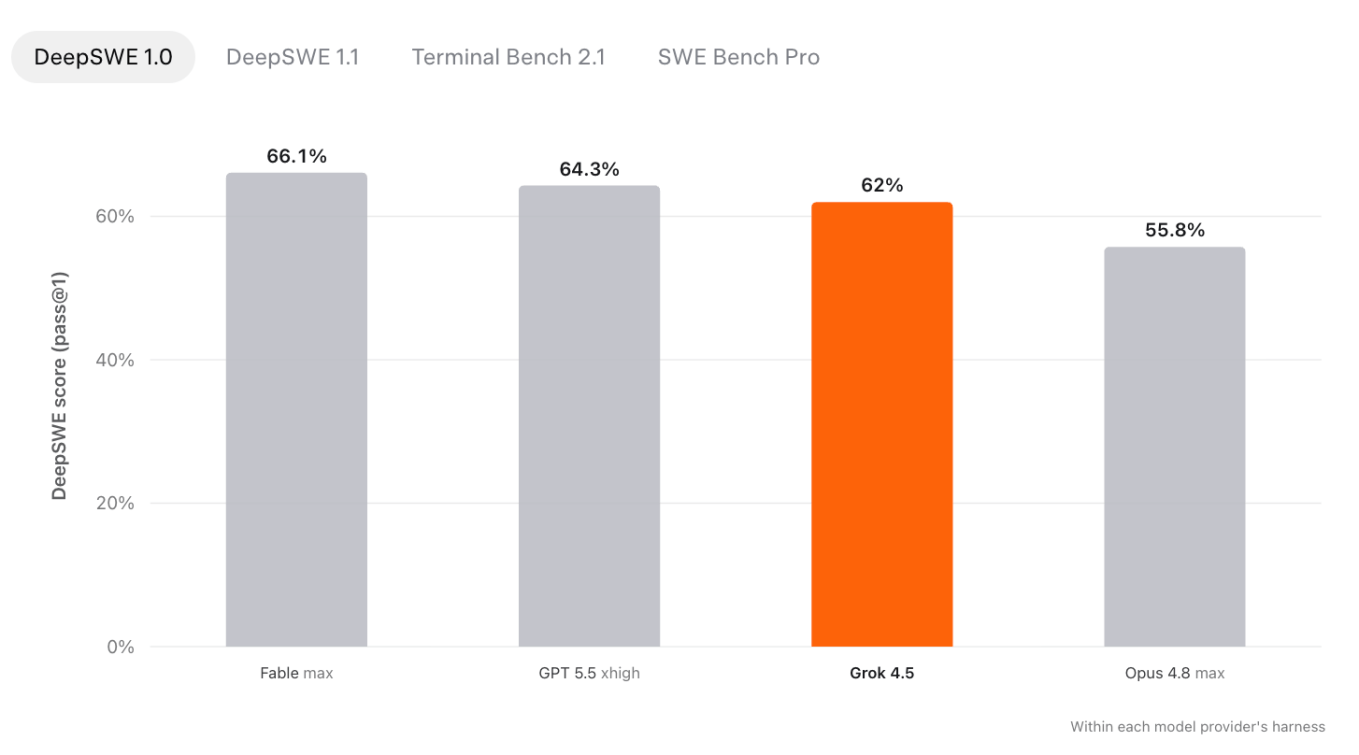
That price matters more than another leaderboard victory. Coding agents burn tokens while reading a repository, running tests, revising a patch, and checking their own work. A model that needs half as many steps can change the bill even when its per-token price looks ordinary. xAI says Grok 4.5 is about twice as token efficient as comparable leading models on the tasks it tested. That is a company claim, not an independent result, but it points at the right metric.
The release is really about the loop
The launch page describes Grok 4.5 as a single model for coding, agentic tasks, office work, research, and writing. The more revealing detail is how xAI trained it. The company says the run used tens of thousands of NVIDIA GB300 GPUs, with data filtering, deduplication, quality scoring, and domain-focused selection. Reinforcement learning used hundreds of thousands of tasks, with a heavy concentration on multi-step software engineering. Rollouts could run for hours while asynchronous training continued.
That recipe is aimed at the part of coding agents that autocomplete demos hide. A useful agent needs to maintain a plan across tool calls, recover after a failed test, and avoid throwing away good context. The model has to make progress after the first answer. It has to know when the first answer was wrong.
Grok 4.5 is also the default model inside Grok Build, xAI's coding agent and terminal interface. xAI open sourced the Grok Build harness on July 16, giving developers a look at context assembly, tool dispatch, skills, plugins, hooks, MCP servers, and subagents. That release may be more useful than another polished web demo. The harness shows how xAI expects the model to be used, and it gives other developers something concrete to inspect or fork.
The open-source harness does not make the model open source. Grok 4.5 remains a hosted model reached through Grok Build, Cursor, or the xAI API. You get the orchestration code, not the weights.
What the numbers say, and what they do not
TechCrunch reported that xAI's launch benchmarks put Grok 4.5 close to the leading models, though not consistently at the top. A later analysis from Artificial Analysis placed Grok 4.5 in the same general tier as GPT-5.5 in a coding-agent index built from DeepSWE, Terminal-Bench v2, and SWE-Atlas QnA. The reported cost per completed task was $2.49 for Grok Build, compared with $5.07 for GPT-5.5 in Codex and $11.80 for Fable 5 in Claude Code.
Those figures are more useful than a single SWE score because they combine capability and spend. They also need a big asterisk. Different harnesses, prompts, retry rules, context policies, and tool permissions can move the result. A cheap agent that quietly retries ten times is not cheap. A high score produced with a generous budget may not match what a developer sees on a fixed monthly plan.
The public benchmark story is mixed. One launch report cited 29% on SWE Marathon, ahead of 26% for Claude Opus 4.8 and 24% for another competitor. The result has not been independently reproduced in a way that makes it safe to treat as a final ranking. xAI's own page gives detailed claims about coding ability but does not publish a complete methods appendix for every number. That leaves the model in the familiar frontier-model position: promising enough to test, not proven enough to trust blindly.
The practical comparison is simpler. Anthropic's expensive models still have a strong reputation for careful code changes and long tasks. OpenAI's coding stack has a mature product surface and deep integration with its own tools. Grok 4.5 is attacking the gap with speed, lower API prices, and a public agent harness. That is a sensible strategy. It gives developers a reason to try the model even if it does not win every task.
The catch is still the evaluator
The launch language is full of claims such as 'highest intelligence per unit of time and cost.' Nobody should accept that sentence without running their own workload. The right test is not a toy repository. Take twenty issues from your own backlog, freeze the prompts and tools, set a token budget, and record successful patches, review time, retries, latency, and cost. Then run the same suite against the model you already pay for.
Grok 4.5 is available in Grok Build, Cursor, and the xAI console. Cursor access lowers the switching cost because developers can try it inside a familiar editor. The $2 input and $6 output rates make API experiments cheap enough for a weekend. The main risk is operational rather than financial: a fast agent can make a wrong change faster, and a polished app built from one prompt can hide weak tests underneath.
My read is that Grok 4.5 is less important as a supposed model-ranking upset than as a pricing and tooling challenge to the incumbents. If xAI's token-efficiency claim survives independent testing, coding agents will be judged less by raw benchmark scores and more by how much useful work they finish per dollar. That is a better contest. It is also one that users can measure themselves.
Sources
- xAI's Grok 4.5 announcement: training details, speed, pricing, availability, and product examples
- xAI's open-source Grok Build announcement: coding harness and local-first runtime details
- TechCrunch coverage: launch benchmarks, pricing comparison, and independent context
- Artificial Analysis review: coding-agent index and reported cost per task
- Grok Build repository: source code for the agent harness