Rust GPU offload is having a very specific moment: the kernels are close enough to CUDA and HIP that a serious team can test the idea, but the data movement is still capable of ruining the whole experiment. That is a much more useful story than "Rust can run on a GPU now."
The fresh paper, GPU Offload in Rust: Portable, Safe, and Fast, describes a rustc and LLVM Offload path that targets NVIDIA and AMD accelerators. The implementation was evaluated on 3 accelerators, an AMD MI250X, an NVIDIA H100, and an NVIDIA RTX A2000. The authors also point to Intel support as a future extension once the relevant LLVM pieces mature. That makes this a compiler project, not another Rust wrapper around CUDA.
The design starts with Rust's useful property for this problem: ownership and mutability already say something about who may read or write a value. An immutable &T can be copied to a device as read-only input. A mutable &mut T can be treated as data that may need to return to the host. The compiler then lowers those boundaries into LLVM Offload operations. In the convenient interface, the programmer writes an ordinary Rust kernel and lets the compiler arrange allocation, copies, launch, and synchronization. There are also library-oriented and explicit interfaces for people who need more control.
That last sentence is where the marketing version ends. The actual question is whether the runtime can keep data on the GPU long enough to make the kernel work worthwhile.
The transfer trap
Automatic movement is friendly during a first prototype, but a host-side read can force a device-to-host synchronization. If the next kernel needs the same value, the runtime may then copy it back to the device. A log statement, a debug assertion, or an innocent-looking use of a value can therefore turn a chain of GPU kernels into a ping-pong loop across the PCIe boundary.
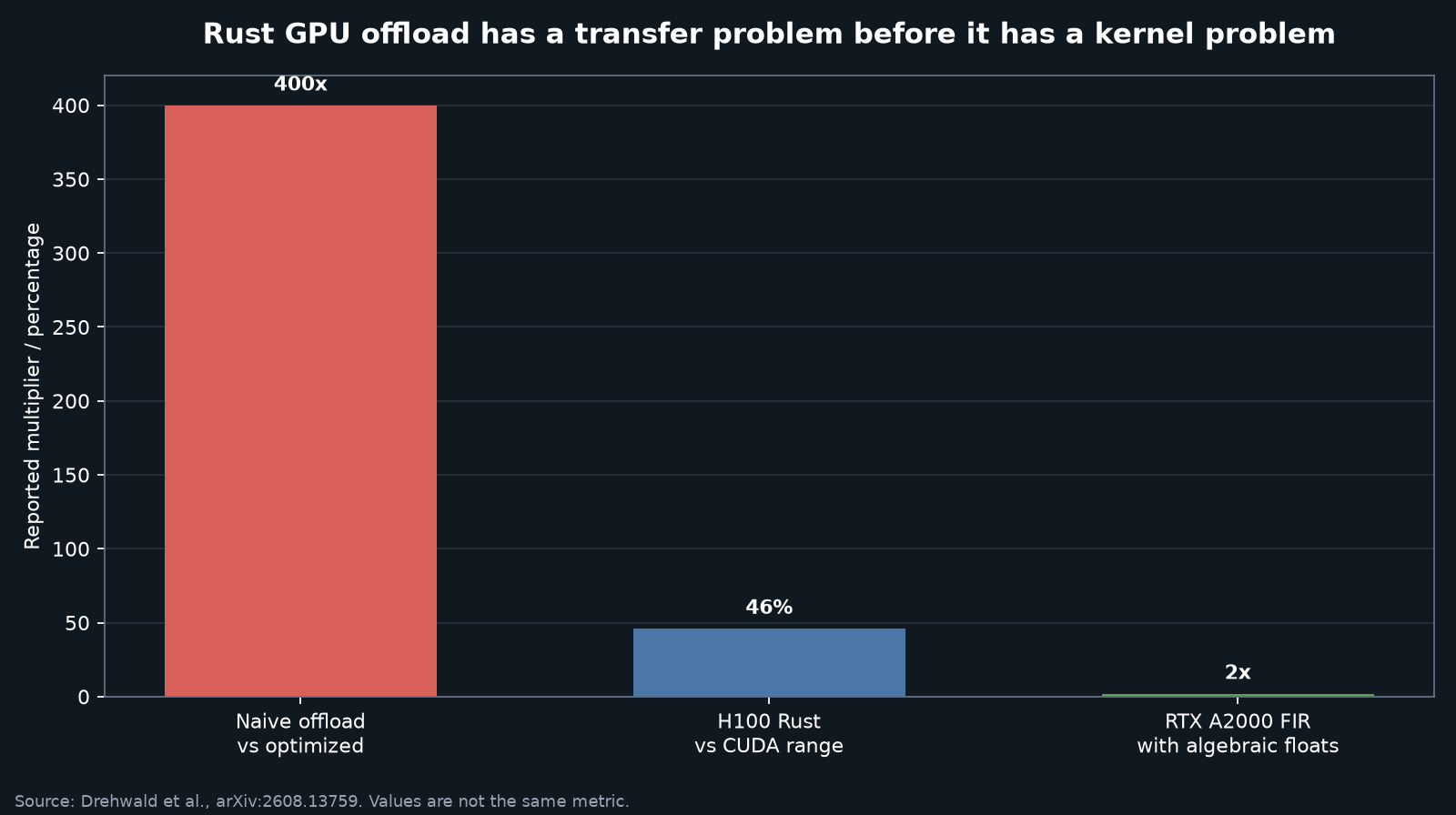
The paper gives a brutal smoke test. A naive implementation that transfers data once per kernel launch was more than 400x slower on the MI250X than the optimized Rust implementation. That number is not a minor tuning note. It is the difference between an accelerator and an expensive way to move arrays around.
The optimized implementation did better by removing redundant movement. On the H100, the Rust version made 53 host-to-device transfers totaling 423 MB, while the RAJA comparison made 55 transfers totaling 468 MB. Rust also made fewer device-to-host transfers, 69 MB versus 99 MB. Yet Rust's transfers took 46 ms, compared with 16 ms for RAJA. Moving fewer bytes did not automatically mean moving them faster. The authors suspect memory kinds and asynchronous-transfer choices.
This is why the paper's kernel numbers need careful reading. On the MI250X, whole-program runtime for Rust ranged from 32% faster to 43% slower than the comparison. On the H100, Rust ranged from 11% faster to 46% slower than base CUDA. The worst cases were FIR and LTIMES, tiny loops where unrolling decisions dominate. The result is neither "Rust matches CUDA" nor "Rust is too slow." It is a warning that kernel parity and application parity are different measurements.
The RTX A2000 result adds another useful detail. Rust's algebraic floating-point operations produced a 2x speedup on FIR and roughly 20% improvements on three other kernels. That is promising, but it is also narrow. The same option did not produce meaningful gains on the MI250X. A compiler flag that helps a small kernel on one GPU is not a general performance guarantee.
The decision matrix
Here is the decision I would make today.
| Situation | Best choice | Why |
|---|---|---|
| You need one NVIDIA production backend now | CUDA or a mature safe binding | The Rust offload path is still an active compiler effort, and its synchronization behavior needs profiling. |
| You need NVIDIA and AMD portability and can tolerate nightly tooling | Prototype rustc LLVM Offload | The paper reports competitive kernels across both vendors and gives you a route that is not tied to one device API. |
| You want safe NVIDIA kernels without cross-vendor support | Compare cuda-oxide directly | It targets safety, but the paper's Rust offload approach is broader. |
| You need Vulkan-style portability or graphics integration | Evaluate rust-gpu or wgpu | Those projects solve a different portability problem and should not be judged only against HPC offload. |
| Your workload is many tiny kernels with host code between them | Stay conservative | The automatic interface can expose transfer and synchronization costs quickly. |
The practical split is simple. Use this compiler work for a bounded experiment when portability and memory-safety guarantees matter more than a stable deployment contract. Do not make it the default backend for a latency-sensitive service just because a table says the individual kernels are competitive.
A sensible prototype has a narrow shape. Pick one kernel with enough arithmetic to amortize launch and transfer overhead. Keep the input and output buffers alive across a sequence of launches. Compare three versions: the existing CUDA or HIP path, explicit Rust data movement, and compiler-managed Rust offload. Measure end-to-end wall time, kernel time, host-to-device bytes, device-to-host bytes, synchronization count, and peak memory. The paper's own evaluation separates those concerns, and your test should too.
Then add an intentionally bad test. Read the output on the host after every kernel. Print a value inside the loop. Put a mutable borrow across a boundary that forces visibility. If the runtime slows down sharply, you have learned where the convenience interface stops being convenient. That failure is more valuable than a hand-picked happy-path benchmark.
There is also a compiler maturity issue. The Rust tracking issue and compiler development guide describe automatic offload as active work. The paper's pipeline still involves distinct host metadata collection, device compilation, and host-side embedding stages. That is powerful infrastructure, but it is not yet the same thing as installing a stable crate and adding one line to a Cargo manifest. The community reaction on Hacker News landed on the same question: where is the code, and how does someone actually try it? A commenter pointed to the Rust compiler development guide and the upstream tracking issue, which is encouraging, but it also confirms that the project lives close to the compiler rather than in a polished application library.
The comparison with existing Rust GPU options matters because "Rust GPU" is not one technology. rust-gpu uses SPIR-V and has different pointer constraints. rust-cuda is NVIDIA-specific and leans on raw pointers. cuda-oxide focuses on safe NVIDIA programming. LLVM Offload aims to use the same compiler infrastructure for NVIDIA and AMD, with Intel on the roadmap. Those are different tradeoffs, not versions of the same product.
My verdict is deliberately narrow. If you own a mixed NVIDIA and AMD fleet, or you are building research software where memory-safety bugs are expensive, this is worth a disposable prototype now. Use explicit data movement once the benchmark gets serious. If you need stable packaging, predictable latency, and a vendor-supported deployment path, keep CUDA or HIP underneath Rust for now. The paper shows that safe Rust is no longer disqualified by kernel speed. It does not show that the host-device boundary has stopped being the hard part.
Sources
- GPU Offload in Rust paper: primary paper with compiler design, transfer measurements, and MI250X, H100, and RTX A2000 results
- Rust GPU offload internals: current compiler development documentation for automatic data movement and offload stages
- Rust GPU offload tracking issue: upstream implementation status and linked compiler work
- Hacker News discussion: community questions about code availability and practical adoption
- Rust GPU offload coverage: independent summary of the performance comparison with CUDA and HIP