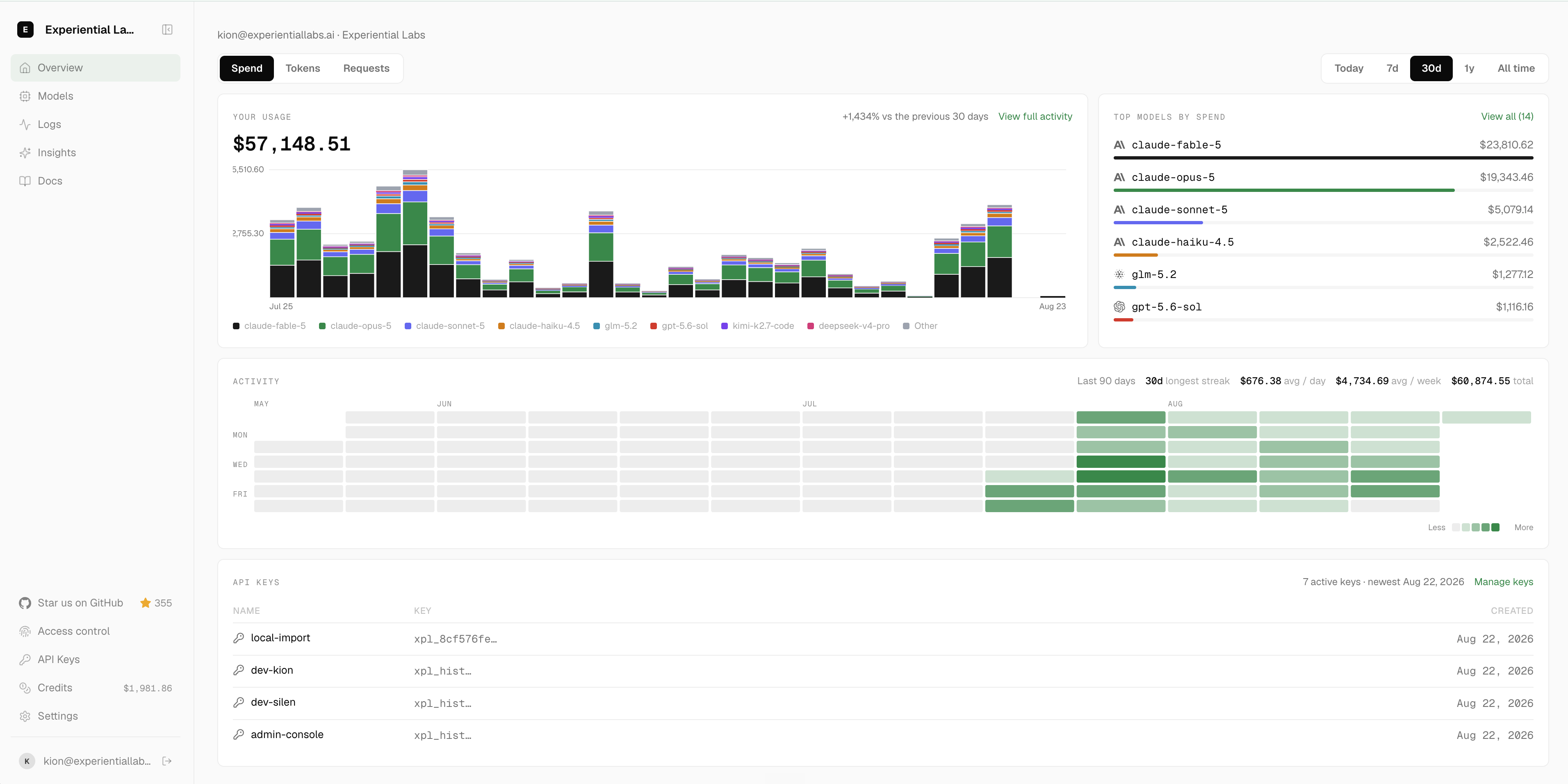
I used to treat model spend as a reporting problem. Add a dashboard, glance at the total, promise to be more careful next month. That approach fails the moment an agent can choose a model, retry a request, or run while nobody is watching.
A gateway changes the control point. Instead of teaching every script, coding agent, and cron job how to talk to every provider, you give them one endpoint. Policies, model aliases, budgets, and telemetry live in the layer between the agent and the provider.
Experiential is a new open source option for that layer. The useful question is not whether it can route a request. Most gateways can. The useful question is whether it gives you enough control to test the idea without turning your whole stack into a migration project.
When a gateway is worth it
A gateway earns its place when you have a coordination problem, not merely a high bill.
If one small script calls OpenAI directly and another uses Anthropic, a gateway may be unnecessary. Direct calls are easier to debug, and you avoid another service that can fail. Keep that setup if your provider count is one, your traffic is predictable, and you already have a reliable way to stop runaway jobs.
The case gets stronger when several agents need different rules. A production support agent might be allowed to call a fast, inexpensive model. A research agent may need a slower model with a larger context window. A nightly batch should have a hard ceiling. Experiential's README describes a single OpenAI-compatible API for hosted, BYOK, local, and custom models, plus controls for which users and agents can use which models, use cases, and spend levels.
That is the part a dashboard cannot do. A dashboard tells you that the money is gone. A gateway can reject the next request before the bill gets larger.
The local setup wizard starts with a default command budget of $50.00. Treat that as a guardrail to inspect, not as a promise that every workflow will stay under fifty dollars. The number matters because a budget attached to a command is closer to an operational control than a monthly chart. You can test an agent against a known ceiling, then decide whether the ceiling belongs in production.
There is also a useful middle ground. You do not need to route every workload on day one. Put one non-critical agent behind the gateway, keep a direct-provider version available, and compare failures rather than chasing a perfect migration.
Our earlier agent-harness cost experiment looked at reducing unnecessary frontier calls inside the agent itself. A gateway handles the next boundary: it gives different callers a common policy even when they are written by different tools.
The five minute local test
The fastest honest test is local. Do not start by uploading traces or connecting every provider. First find out whether an existing OpenAI client can reach a model through the loopback endpoint.
Install the package in a disposable environment:
python -m venv .venv
. .venv/bin/activate
pip install experiential
exp
The setup wizard asks you to choose a provider and model, creates a public alias such as opus-5, and prints a one-time gateway key. The README says the local service listens on 127.0.0.1:8000. That is a good default for a first test because the gateway is not exposed to the network while you learn its behavior.
Then send one request through the OpenAI-compatible route:
export EXP_GATEWAY_KEY='paste-the-key-here'
curl http://127.0.0.1:8000/v1/chat/completions \
  -H "Authorization: Bearer $EXP_GATEWAY_KEY" \
  -H 'Content-Type: application/json' \
  -d '{"model":"opus-5","messages":[{"role":"user","content":"Return the word ready"}]}'
This test answers three practical questions quickly. Does your client accept the base URL change? Does the selected alias reach the provider? Can you see the request in the gateway's local accounting or logs?
Change one variable at a time. Run the same prompt through the direct provider and the gateway. Check the response, error body, latency, and token accounting. The project discussion claims that BYOK requests add under 1 ms of gateway overhead. That is a claim worth measuring in your own environment, especially if your agent makes many short calls where network time dominates.
Do not call the platform's paid models just to prove that authentication works. The shipped setup instructions say that a GET request to /v1/models confirms the key without spending credits. For the local smoke test, your goal is routing, not a surprise invoice.
What to check before switching
The first check is caching. One Hacker News commenter asked the question that should stop a rushed migration: if a router moves requests between models, what happens to cached input-token savings? A model switch can improve task success while making repeated context more expensive. Ask the gateway which provider receives each request, whether cache-related usage is preserved, and whether the answer appears in the usage record. If you cannot answer those questions, keep the gateway in a test lane.
The second check is budget semantics. A displayed budget is not the same thing as an enforced limit. Run a deliberately tiny limit against a loop that would normally retry. Confirm whether the gateway blocks the next call, stops after a completed request, or only reports the overage later. Test failure behavior too. A timeout followed by a retry can spend twice unless the caller and gateway agree about idempotency.
The third check is credential scope. BYOK means the gateway can use your provider keys, but that does not make the keys harmless. Give the gateway a dedicated key with a provider-side limit. Do not paste a powerful account key into a new service and assume the local process is trusted. The project supports model and use-case controls, but your provider account should remain the final backstop.
The fourth check is telemetry. Experiential enables anonymous aggregate PostHog product telemetry by default, according to its README. The project says that prompts, traces, actions, observations, paths, model names, credentials, and raw customer content are not included. That is a specific claim, and it is better than vague privacy language, but you still need to decide whether the default fits your environment. The README documents exp config telemetry status and exp config telemetry disable. Run the status command during installation and record the result in your deployment notes.
The fifth check is escape velocity. A gateway becomes expensive to own when every tool depends on its private aliases and undocumented behavior. Keep the client configuration boring. Most applications should only know an OpenAI-compatible base URL, a key, and a model alias. Keep a direct-provider configuration beside it. Export request IDs and usage data in a format you can read without the gateway. If you cannot remove the gateway in an afternoon, you have coupled the application to it too early.
Here is the decision I would use:
- Stay with direct provider calls if you have one provider, one or two scripts, and predictable traffic.
- Try a local gateway if several agents need different model permissions or if retries and batch jobs make spending hard to see.
- Use BYOK first when you need a common endpoint but do not want platform credits in the path.
- Consider hosted credits only after you understand the budget, caching, telemetry, and failure behavior.
- Keep the gateway out of the critical path until the direct fallback has passed the same test suite.
Experiential also has a trace-driven path. Its README points to an OpenTelemetry dataset and an exp build support-agent command that can fit a router against recorded agent traffic. That is a more interesting idea than blind model roulette because it lets you evaluate routing against work you actually perform. It is also a later step. First capture a small, representative trace set and decide what “better” means: lower cost, fewer retries, higher task success, or a combination you can measure.
The project is young, and the Hacker News discussion shows exactly where the unanswered questions are. People asked about caching, semantic routing, provider switching, and how the system differs from LiteLLM. Those are not nitpicks. They are the questions that determine whether a gateway is a control plane or just another hop in the request path.
The sensible move is small. Install it locally, send one safe workload through 127.0.0.1:8000, put a provider-side spending limit behind it, and compare the logs with a direct run. If the gateway gives you clearer boundaries without hiding the bill, keep going. If it only adds a dashboard and another failure mode, remove it.
Sources
- Experiential repository and README: open source gateway capabilities, local setup, budget, routing, telemetry, and trace workflow
- Experiential GitHub project: repository, license, current source, and installation entry point
- Experiential setup prompts: provider connection,
/v1/modelsverification, trace ingestion, and hosted gateway details - Experiential Show HN discussion: community questions about caching, latency, model routing, and alternatives
- Experiential workflow image: official traffic and spend dashboard visual