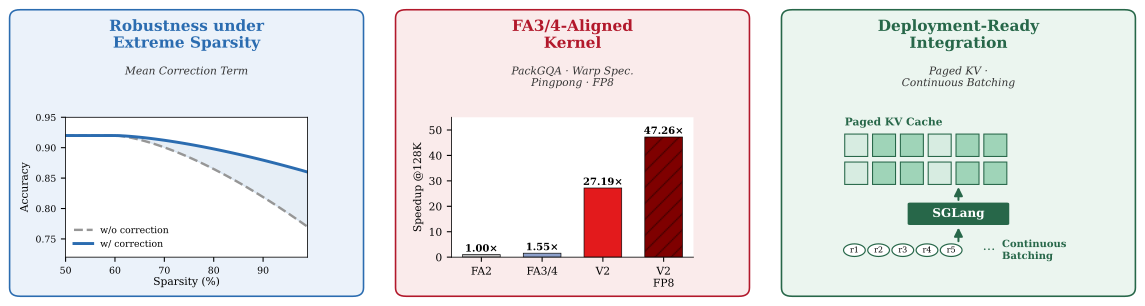
A 128K context window can be a software feature on the product page and a hardware problem in production. FlashPrefill V2, released as an arXiv paper on August 20, makes that mismatch hard to ignore. Its authors report a 47.26x prefill speedup over FlashAttention-2 at 128K tokens in FP8 on an NVIDIA H20. In BF16, the reported number is 27.19x. Those are large numbers. They are also numbers from one narrow hardware and serving setup.
The useful question is not whether sparse attention is faster in a paper. It is whether your serving stack matches the paper closely enough to justify testing it. If you do not have a Hopper GPU, the answer is already no. If you do, FlashPrefill V2 gives you a concrete SGLang path to measure instead of another abstract kernel proposal.
FlashPrefill V2 is a prefill optimization. That distinction matters. Prefill is the pass that processes the prompt before the model starts generating tokens. Long prompts make this phase expensive because dense attention compares a large set of query and key positions. Decode has a different shape and often different bottlenecks. The project therefore leaves decode on FlashAttention-3 while replacing only the prefill backend.
The paper combines block selection with a custom attention operator. The first stage estimates which key blocks matter, packs grouped queries, pools mean key and value statistics, and writes a compressed sparse index. The second stage computes exact attention for the selected blocks. The mean correction term gives pruned blocks a pooled contribution instead of pretending they do not exist. That is the part that makes aggressive sparsity less reckless, at least on the paper's tests.
The implementation is not a generic PyTorch optimization. The repository targets NVIDIA Hopper, specifically SM90, with CUDA 12.x, a matching PyTorch build, and Triton. The custom operator is written around CUDA and CuTe, with PackGQA memory access, warp specialization, and pingpong pipelining. It supports BF16 and FP8, but the headline FP8 result assumes the operator's intended environment. A consumer RTX card or an older data-center GPU is not an interchangeable test platform.
When sparse prefill is worth the hardware
The decision gets easier if you separate three cases.
If your traffic is mostly short prompts, do not start here. The published result is for 128K context, and the value of skipping attention work grows with sequence length. The repository exposes a minimum sparse query length flag because sparsity is not automatically useful for every request. A short prompt can pay index-selection overhead without saving enough work.
If you serve long documents or agent histories on H100 or H20 hardware, this is a reasonable experiment. The paper evaluates Llama-3.1-8B-Instruct, Qwen3-4B-Instruct-2507, and Qwen3-30B-A3B-Instruct-2507 on H20. It compares FlashPrefill V2 with full attention, MInference, FlexPrefill, XAttention, FlashAttention-2, and an FA3/4-aligned dense kernel. The 47.26x figure is not a general model-speed claim. It is an attention-operator result under a 128K setup, with pattern discovery, thresholding, and mean correction included in the reported end-to-end operator measurement.
That last detail is good news, but it does not turn the result into a service-level guarantee. A real endpoint also pays for tokenization, queueing, tensor parallel communication, model layers outside attention, network transfer, and decode. If attention is only 25 percent of your request latency, a 47.26x attention improvement cannot make the whole request 47.26x faster. Measure time to first token and prefill throughput, not only a kernel trace.
The precision comparison also needs care. FP8 reaches the larger reported speedup, while BF16 reaches 27.19x against FlashAttention-2. FP8 can change accuracy and calibration behavior, especially when the workload includes retrieval or code where a small attention error can alter the next generation. The paper uses RULER and LongBench, which is better than reporting latency alone, but those suites still do not represent every production prompt. Keep a dense route available until your own task set passes.
This is where a runtime preflight helps. Before blaming the attention backend, debug your local LLM runtime first. A wrong chat template, an undersized context window, or a sampler issue can look like a model or kernel failure. The same discipline applies here: establish a dense baseline, record quality and latency, then change one serving component.
A serving setup you can actually test
The repository includes an SGLang 0.5.10 source tree with the FlashPrefill V2 backend integrated. The documented sequence is deliberately hardware-specific:
cd FlashPrefillv2
bash install_ops.sh
python eval_install.py

export PYTHONPATH=$PWD/sglang_int/python:$PYTHONPATH
python -m sglang.launch_server --model-path <MODEL> \
  --tensor-parallel-size 4 \
  --prefill-attention-backend flashprefill \
  --decode-attention-backend fa3 \
  --flashprefill-attention-sink 2 \
  --flashprefill-window 4 \
  --flashprefill-abs-threshold 0.1 \
  --flashprefill-full-attention-layers 4 \
  --flashprefill-last-n-blocks 8 \
  --flashprefill-k-block-n 128 \
  --flashprefill-min-sparse-q-len 0 \
  --flashprefill-use-mean-correction
Do not skip the smoke test. eval_install.py checks dense and sparse calls on a paged KV cache, index selection, the full sparse pipeline, mean correction, and FP8 execution. For numerical checks, the repository points to test_compare_fa3.py, test_mean_correction.py, and test_block_sparse.py. Those tests are more valuable than immediately launching a model and staring at a throughput number.
The build has two traps that are easy to miss. The installer uses --no-build-isolation because the build imports Torch. It also sets FLASH_ATTENTION_FORCE_BUILD=TRUE; without that setting, the setup can fall back to an upstream FlashAttention-3 wheel instead of compiling the intended operator. The repository also documents a fallback toolchain download when the installed CUDA version does not match its preferred 12.8 or 13.x path. On an offline machine, that cache has to exist already.
Start with a fixed prompt set at 32K, 64K, and 128K. Run the same model with dense FA3 and with FlashPrefill V2. Record prefill tokens per second, time to first token, peak memory, output agreement, and error rate. Then vary the sparse threshold. The abs_threshold flag controls how aggressively blocks are pruned. A higher threshold should select fewer blocks, but the useful threshold is the one that survives your retrieval and coding tests, not the one that wins a single latency chart.
Keep the first few layers dense. The SGLang example uses --flashprefill-full-attention-layers 4, which gives you a practical fallback boundary while you test. Keep mean correction enabled for the initial run. Turn it off only as an ablation, because the correction is part of the method's attempt to retain information from pruned blocks.
The most important failure mode is a false positive. A benchmark can improve while the service gets worse if the request mix is too short, if index selection consumes the saved time, or if tensor parallel communication dominates. Another is a quality regression that appears only on long retrieval prompts. Store the prompt, selected threshold, precision, model revision, GPU type, and backend commit with every run. Otherwise a later speedup will be impossible to reproduce.
What the 128K number really buys you
The paper's result is strong enough to earn a test, not strong enough to justify replacing dense attention everywhere. On matching H20 hardware, 128K prompts, and the tested models, the result suggests that prefill has a lot of avoidable work. It also suggests that the engineering gap between a sparse-attention idea and a usable serving backend is closing. Paged KV cache, continuous batching, a compiled operator, and an SGLang integration are the practical pieces.
The cost is a hard hardware boundary and a larger operational surface. You need Hopper, a compatible CUDA toolchain, a custom build, a modified SGLang tree, and a quality gate. That is a fair trade for a service whose prompts regularly reach tens of thousands of tokens. It is a bad trade for a small deployment that serves short chats on mixed GPUs.
My default recommendation is simple. Test FlashPrefill V2 when long-context prefill is a measured bottleneck and the fleet is already Hopper-based. Keep dense FA3 as the reference path. Do not buy Hopper hardware solely because a 47.26x operator result looks good in an abstract. First prove that your own time to first token, memory use, and answer quality move in the same direction.
Sources
- FlashPrefill V2 on arXiv: paper, evaluation setup, 128K speedups, baselines, and limitations
- FlashPrefill V2 paper HTML: method figures, benchmark tables, and experiment details
- FlashPrefill V2 GitHub repository: Hopper requirements, build flags, tests, and SGLang launch configuration
- FlashPrefill V2 Hugging Face paper page: paper listing and project links