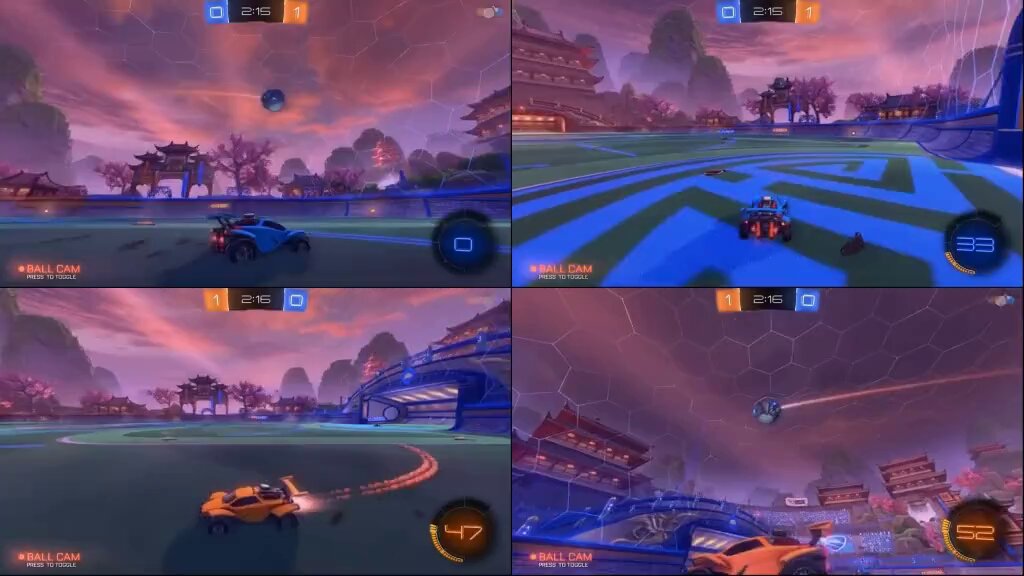
Most "world models" in AI today are impressive demos that crumble after a few seconds of interactive rollout. MIRA, a collaboration between General Intuition, Kyutai, and Epic Games, just changed that. It runs four-player Rocket League at 20 frames per second on a single GPU, stays stable for five minutes or more, and has no physics engine, no rendering pipeline, and no explicit 3D representation at all. It is 5 billion parameters of pure learned dynamics, watching video and spitting out the next frame based on what four players do with their keyboards.
The team trained it on 10,000 hours of 2v2 Rocket League matches generated entirely by bots. No human gameplay. No replays scraped from Twitch. Just bots playing bots in a controlled distribution, which turns out to be exactly the kind of clean signal you need when you are trying to learn physics from pixels alone.
How a model learns to dream of car soccer
MIRA uses a diffusion transformer paired with a 600-million-parameter video representation codec. The codec is where the real trick lives. Most latent diffusion models use a standard VAE encoder to compress video into a latent space, but the MIRA team replaced that with DINO, a self-supervised vision model that already understands objects, shapes, and spatial relationships from pre-training on millions of natural images.
The result is a latent space that preserves object permanence. When a car drives behind the goal and reappears on the other side, the model does not hallucinate a new vehicle or forget the old one. This is a problem that has plagued every interactive world model before MIRA, where single-view models would lose track of objects the moment they left the camera frame.
MIRA sidesteps that entirely by conditioning on all four player views simultaneously. Every frame, the model receives the keyboard actions from all four players and their respective camera perspectives. There is no "theory of mind" problem because the model sees everything. It does not need to imagine what the other players are doing. It knows.
The training uses something called Diffusion Forcing in the latent space, which means the model generates each frame conditioned on the previous frames and the current action inputs. It is autoregressive in time but parallel across the four views. Action dropout during training means certain player inputs are randomly hidden, which lets the model run in an autopilot mode when a human player is absent, predicting what the bot would have done.
The auto-recovery nobody expected
One of the more surprising findings from the MIRA team is what happens when the model goes off-distribution. Push it into scenarios it has never seen, like asking a car to ignore the ball entirely, and the simulation starts to degrade. But then it fixes itself. The model snaps back to plausible gameplay without any external correction.
This auto-recovery behavior is unusual. Most generative models, once they drift out of their training distribution, stay drifted. They compound errors frame after frame until the output is unrecognizable. MIRA does not do that. The DINO-based codec appears to create a latent space with enough structure that the model can pull itself back toward the training manifold even after temporary divergence.
The team ran the model for extended sessions and found it continues for hours with no sign of collapse. That is a qualitative leap from prior work, where interactive world models typically fell apart after a few seconds of autonomous rollout.
Why this matters beyond car soccer
The stated goal of MIRA is not to build a better Rocket League simulator. It is to demonstrate that world models can learn complex, multi-agent, physics-rich environments from video alone, and that those models can run fast enough to be useful.
For robotics, this matters because the real bottleneck is not building better robot controllers. It is evaluating them safely and at scale. If you could run a learned world model of a warehouse floor or a kitchen, you could test thousands of action sequences without risking a single physical robot. MIRA shows that this kind of simulation is technically feasible at interactive speeds.
For game development, MIRA suggests a future where game content is generated by models rather than hand-crafted in engines. Not replacing Unreal or Unity tomorrow, but providing a path toward procedurally generated worlds that actually understand their own physics.
For the broader AI research community, the open-source release is the real prize. The team published the full codebase under Apache 2.0, the training dataset on HuggingFace, and a technical report on arXiv. Anyone with a B200 and enough patience can reproduce the results. The dataset alone, called Rocket Science, contains 4,000 hours of synchronized 720p gameplay with action streams and physics states for every frame.
The honest limitations
MIRA requires a single NVIDIA B200 to run at 20 FPS. That is a $15,000+ accelerator, not a consumer GPU. The model cannot run on a laptop, a desktop with a 4090, or anything in between. For the "interactive world model as infrastructure" vision to work, the inference cost needs to come down by an order of magnitude or more.
The training distribution is bots, not humans. Human Rocket League players do weird things. They fake challenges, go for aerials that defy physics intuition, and tilt in ways that no bot would replicate. MIRA has never seen any of that. Whether the model generalizes to human gameplay is an open question the paper does not answer.
There is also the question of scale. MIRA was trained on Rocket League, a game with relatively simple physics compared to, say, a full open-world game or a real-world environment. The team is careful to call this a stepping stone, not a destination. Generalizing to messier, more complex environments is the hard part that comes next.
What the team is building toward
General Intuition raised a $320 million Series A to build models that can perceive, predict, and act in both virtual and physical environments. The company's thesis is that video games provide a scalable pathway to world models that eventually transfer to robotics. MIRA is the first public proof of concept.
At ICML 2026, where the team is presenting at booth 111, they are positioning MIRA as the beginning of a category, not a one-off demo. The combination of multiplayer conditioning, DINO-based latent representations, and real-time performance creates a template that other teams can apply to different games, different physics, and eventually different real-world domains.
Michael Black, a computer vision researcher who contributed to the project, put it bluntly: "The term 'world model' is tossed around a lot but this is the real deal." Given what MIRA can do, that claim is harder to dismiss than it was a week ago.
Sources
- MIRA Project Page: official demo, blog post, and technical report
- GitHub Repository: Apache 2.0 codebase with training and inference code
- HuggingFace Dataset: 4,000-hour Rocket Science dataset with action streams
- arXiv Technical Report: full architecture details and ablation studies
- General Intuition: company behind the $320M Series A for world models
- Hacker News Discussion: community reactions and technical questions