The world's largest hedge fund just published the clearest evidence yet that frontier models are not always the answer. Bridgewater Associates, working with Mira Murati's Thinking Machines Lab, fine-tuned an open-weight model on proprietary expert-labeled data and beat every frontier model they tested (GPT, Claude, and Gemini) on six real financial document tasks. The custom model made 29.8% fewer mistakes than the best frontier model, and it cost 13.8 times less per task to run.
The numbers are striking, but the real story is simpler than the headline suggests. The problem Bridgewater was trying to solve is mundane: triage. Every investor is buried in documents (news articles, central bank releases, research reports, internal memos). The actual work isn't reading. It's the constant, low-level judgment of deciding what's worth reading in the first place. These micro-decisions happen thousands of times a week across any major fund, and they eat enormous amounts of analyst time.
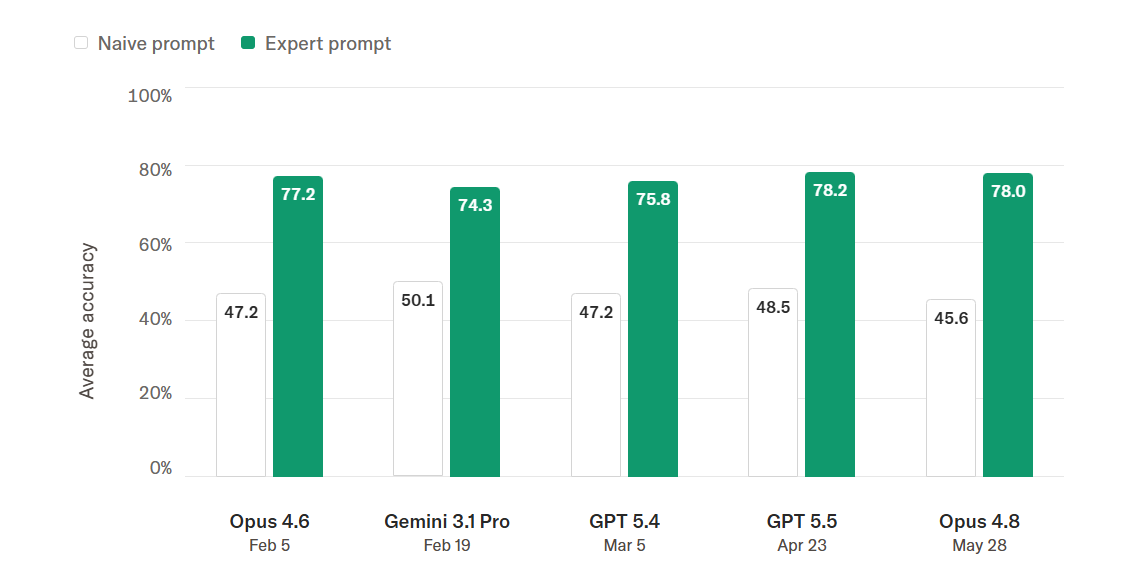
When Bridgewater tested frontier models on six concrete tasks drawn from their investors' daily workflows, the results were sobering. Variants of Gemini, Claude, and GPT averaged roughly 50% accuracy with naive prompting, essentially a coin flip. Their experts then wrote detailed task descriptions, reframed certain problems, and pushed accuracy into the mid-70s. Automatic prompt optimization methods added nothing on top of that. The 80% threshold, the line where investors say they'd actually trust a system in daily use, remained out of reach.
So they stopped prompting and started training.
The data problem nobody talks about
The team hit a wall early that most fine-tuning efforts never confront. They hired non-expert contractors to label financial documents. The labels were wrong. Not subtly wrong, wrong in ways that would poison any training run. The researchers' insight was to train a preliminary model on the noisy contractor data, then route every instance where the model disagreed with the labeler to human experts for final adjudication. This gave them a high-quality dataset without paying expert rates for every single label.
The technical stack that followed was equally deliberate. Using Qwen3-235B as the base model, the team made three key modifications that collectively moved accuracy from 44.8% (base model) to 84.7%. Interleaved batching, presenting tasks in round-robin order rather than fully mixed batches, improved accuracy by 12.1%. A custom loss function called CISPO with asymmetric clipping added another 10.1%. And on-policy distillation, where a teacher model is dynamically promoted only when validation accuracy hits a new high, contributed the final 3.1%.
The training was conducted on Thinking Machines' Tinker platform, which gives researchers Python-level control over training loops, loss functions, and optimization while handling distributed GPU infrastructure in the background. It's the kind of thing that would have required a dedicated ML engineering team to build from scratch two years ago.
What this means for the "bigger is better" narrative
The prevailing assumption in enterprise AI has been straightforward: rent the biggest generalist model, prompt it well, and you're done. Bridgewater's results challenge that assumption directly. The fine-tuned model didn't just match frontier performance, it exceeded it on tasks that matter for their specific workflow. And it did so at a cost that makes scaling practical.
The economics are hard to ignore. Running 1,000 document-filtering tasks on the best frontier model costs somewhere between $20 and $92. The custom model does the same work for about $5. For a firm that runs tens of thousands of these judgments weekly, the difference isn't marginal. It's the difference between an automation project that pencils out and one that doesn't.
What makes this result more than a cost story is the concept the team calls "differentiated intelligence." The claim is that an organization's proprietary expert-labeled data is not just an input to someone else's model. It is the model. The judgment that Bridgewater's investors have accumulated over decades, the taste, the prioritization, the pattern recognition, can be encoded into a fine-tuned system in ways that general-purpose frontier models cannot replicate, regardless of parameter count.
That's a bold claim. But the benchmark data supports it. Frontier models with expert prompting topped out at 78.2%. The fine-tuned model hit 84.7%. The gap isn't about scale. It's about specificity.
The uncomfortable footnote for API providers
If Bridgewater's approach generalizes, and the researchers argue it should, across legal, healthcare, government, and any domain with accumulated expert judgment, the implications for frontier API providers are significant. Every enterprise that builds internal fine-tuning infrastructure is a customer that stops paying per-token to OpenAI, Google, or Anthropic.
The counter-argument is obvious: most organizations don't have Bridgewater's data or Thinking Machines' infrastructure. Fine-tuning still requires expert-labeled datasets, which are expensive and scarce. The Tinker platform lowers the infrastructure barrier, but the data barrier remains.
Still, the pattern is worth watching. A hedge fund with deep pockets and decades of institutional knowledge just demonstrated that a smaller, specialized model beats the biggest general-purpose models at the tasks that matter most to them. The "differentiated intelligence" thesis suggests this isn't an edge case. It's a playbook.
The question isn't whether fine-tuning can beat frontier models. Bridgewater already answered that. The question is whether the rest of us can replicate the approach without Bridgewater's resources. And whether the frontier labs will adapt their pricing before the enterprise migration starts.
Sources
- Thinking Machines Lab: Learning to Replicate Expert Judgment in Financial Tasks: primary research paper with full benchmark tables, training methodology, and mathematical formulations
- FourWeekMBA: Thinking Machines Lab and Bridgewater Prove a Small Custom Model Beats Frontier Models: detailed analysis of the "differentiated intelligence" thesis and strategic implications
- AlphaSignal: Bridgewater's Fine-Tuned Model Beats GPT, Claude, and Gemini at 13.8x Lower Cost: community-facing breakdown with cost analysis and task descriptions
- The Decoder: GPT and Claude Failed Bridgewater's Finance Tests: critical perspective on data labeling challenges and expert judgment
- HedgeFundAlpha: Bridgewater Teams Up With Ex-OpenAI CEO: financial industry coverage and context on Bridgewater's scale