A year of sporadic work. Three failed attempts with earlier models. Then a two and a half hour session with one carefully crafted prompt closed a gap in mathematical optimization that had stood since 1996.
Phillip Kerger, a teaching professor at UC Berkeley, had been chipping away at a question about the fundamental limits of optimization when you can only observe the output of a function, not its gradient. He tried GPT-5.4. Nothing. GPT-5.5. Same result. Then last week, after studying the prompting methodology OpenAI used for the Cycle Double Cover conjecture proof, he wrote a ten page prompt and let GPT-5.6 Sol Pro run.
One hundred forty eight minutes later, the model returned a proof.
I had some ideas for this problem. I worked on it sporadically over the last year. Nothing ever panned out. After Sol 5.6, without any intervention from my end, it solved the problem in one shot.
What the problem was
Here is the setting in plain language. You are trying to minimize a convex function of d variables. The catch? You cannot compute its gradient. You cannot compute subgradients. You pick a point, and the only thing you learn is the function value at that point. Nothing else.
This is not an exotic corner case. Simulation based engineering design works exactly this way. Hyperparameter tuning in machine learning. Any optimization that relies on physical measurements or human feedback. You set the knobs, you read the meter, you try again.
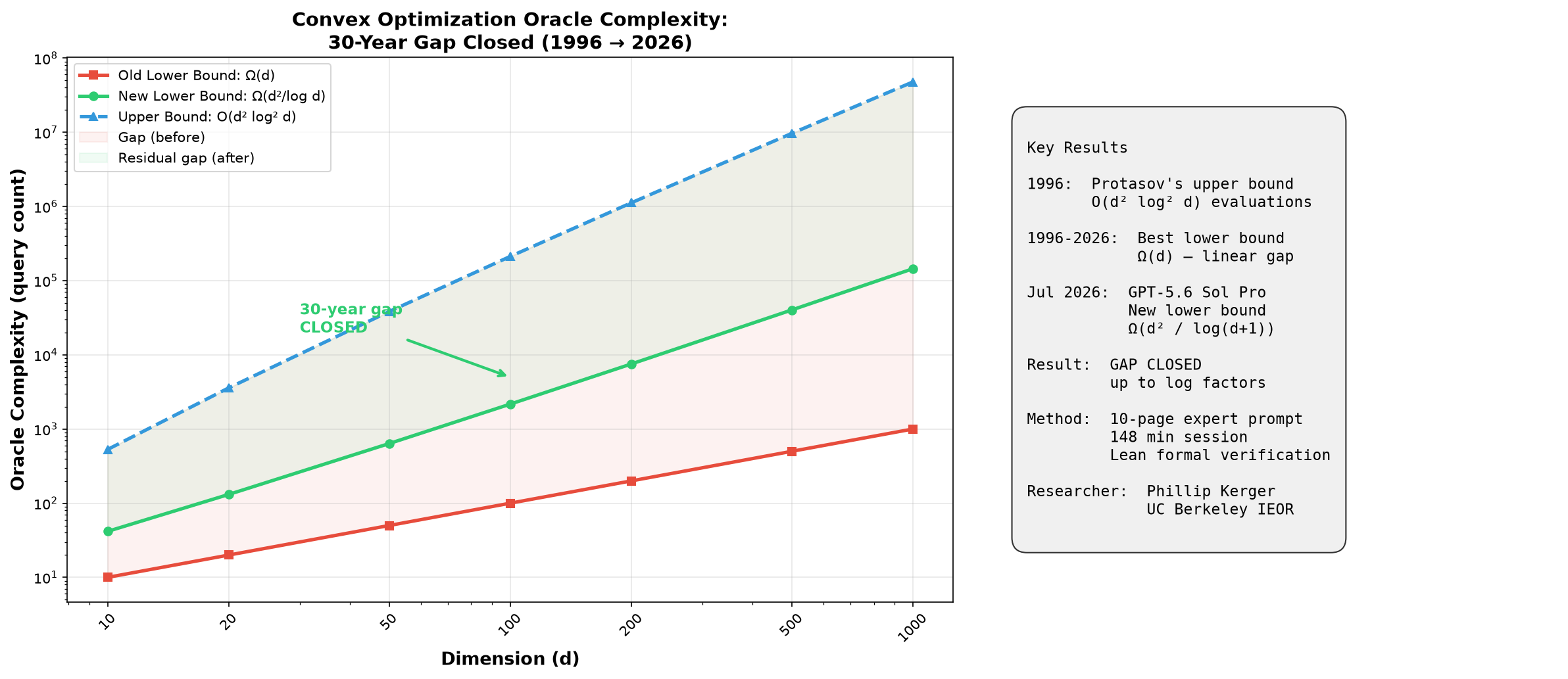
An algorithm from 1996 by a researcher named Protasov showed that roughly d-squared function evaluations are always enough to find a good solution. That was the upper bound. The question was: could there be a better algorithm? One that needs only d evaluations?
For thirty years, nobody knew.
The best lower bound before this work was just Omega(d). That meant we could only prove that at least a linear number of evaluations were necessary. The gap between "at least d" and "at most d-squared" was wide open.
Kerger's new result establishes a lower bound of Omega(d-squared / log(d+1)). Up to logarithmic factors, that matches Protasov's upper bound. The gap is closed. Gradients do help in optimization, and Protasov's algorithm is essentially the best possible for these problems.
How the model did it
This is where the story gets interesting for the AI community. The proof did not come from a simple prompt like "solve this open problem." Kerger's prompt is ten pages of densely packed mathematical reasoning.
The prompt specified the exact function class to consider. It laid out possible construction strategies. It told the model which directions were worth exploring and which had already been tried. It essentially encoded a year of domain expertise into a structured research brief.
The model then spent 148 minutes exploring combinatorial possibilities, guided by that prompt. What is striking is not that GPT-5.6 produced something plausible. What is striking is that it produced something correct.
Kerger verified the proof himself first, then formalized it in Lean. The theorem prover checked every logical step and confirmed the argument was sound. This matters. The Cycle Double Cover proof from OpenAI is still under peer review. This one has been machine verified.
We are entering the era where formal verification in Lean is becoming much, much more valuable to identify real results quickly.
The HN reaction: cautious but constructive
The Hacker News discussion landed at over 150 comments, and the tone was notably more measured than the usual AI hype cycle.
One commenter nailed the metaphor: "If knowledge is a Swiss cheese, LLMs can help fill the holes, but not make the cheese bigger." The consensus was that LLMs excel at connecting existing techniques but have not yet demonstrated genuinely novel mathematical insight.
The prompt expertise question came up repeatedly. Multiple people pointed out this was not "ChatGPT, solve this problem." A year of prior research and deep domain expertise went into those ten pages. As one HN user put it: "The prompt is on page 27. It is ten pages of advanced mathematics priming the model in the right direction."
Kerger himself made the same point: the techniques to solve this problem already existed in the literature. What GPT-5.6 provided was the capacity to systematically explore combinatorial possibilities. The mechanical work of checking which constructions work and which do not.
What this means for math research
The most honest assessment came from Kerger himself in his Reddit post:
I don't think researchers in math/TCS will be made obsolete, but I think it will instead no longer make sense to work on any low-hanging, or even medium-hanging fruit.
This is the real signal. Not that AI can solve open problems, but that the bar for what counts as "hard" just moved. Problems solvable through systematic application of existing techniques are now vulnerable. Problems requiring genuinely new approaches remain human territory. For now.
The practical implication for working mathematicians is uncomfortable. The question is not whether to use these tools. The question is how many of the problems you are working on are one good prompt away from a solution.
Sources
- arXiv: Closing the Oracle-Complexity Gap: the preprint with full proof, Lean code, and complete 10-page prompt in appendix
- GitHub: zero-order-bounds-lean-verification: formalization in Lean 4, build instructions, proof map
- Medium: An AI-Assisted Breakthrough: Kerger's accessible account of the result
- Reddit r/math discussion: 599 upvotes, 128 comments with author responding
- Hacker News discussion: 150+ comments with debate on AI math capability
- Developers Digest analysis: accessible writeup with community reaction summary