Here's a sentence you probably didn't expect to read this year: Microsoft is about to ship an AI security tool that uses Anthropic's best models to compete with Anthropic's best security product.
The product is called Project Perception. It debuts this month. And the story of how it exists at all is a case study in how export controls reshape markets, not by stopping technology. It redirected where it flows.
The gap that export controls carved open
In mid-June, the US government ordered Anthropic to disable Fable 5 and Mythos 5 for all foreign nationals. The trigger was a reported jailbreak that could turn the models into unrestricted cyber weapons. Amazon CEO Andy Jassy reportedly told Treasury officials his researchers had used Fable 5 to obtain information that could aid cyberattacks. Within hours, both models were offline worldwide.
The shutdown lasted 20 days. Export controls were lifted on July 1, but the damage to Anthropic's market position was already done. European governments and financial institutions that had been courting Mythos 5 access suddenly had no timeline for when or if they could get it. Enterprise security buyers who needed frontier AI vulnerability scanning today, not after a diplomatic resolution, started looking for alternatives.
Microsoft saw the opening before it closed.
Three models, one routing layer
Project Perception uses a smart routing system that matches each security query to the best-fitting model from three different providers: Claude (via Azure AI Foundry) for long-horizon code analysis where Anthropic's models excel, GPT-5.6 Sol (via Azure OpenAI Service) for broad software engineering tasks where OpenAI benchmarks highest, and Microsoft's own Phi and MAI models for Microsoft-stack-specific use cases.
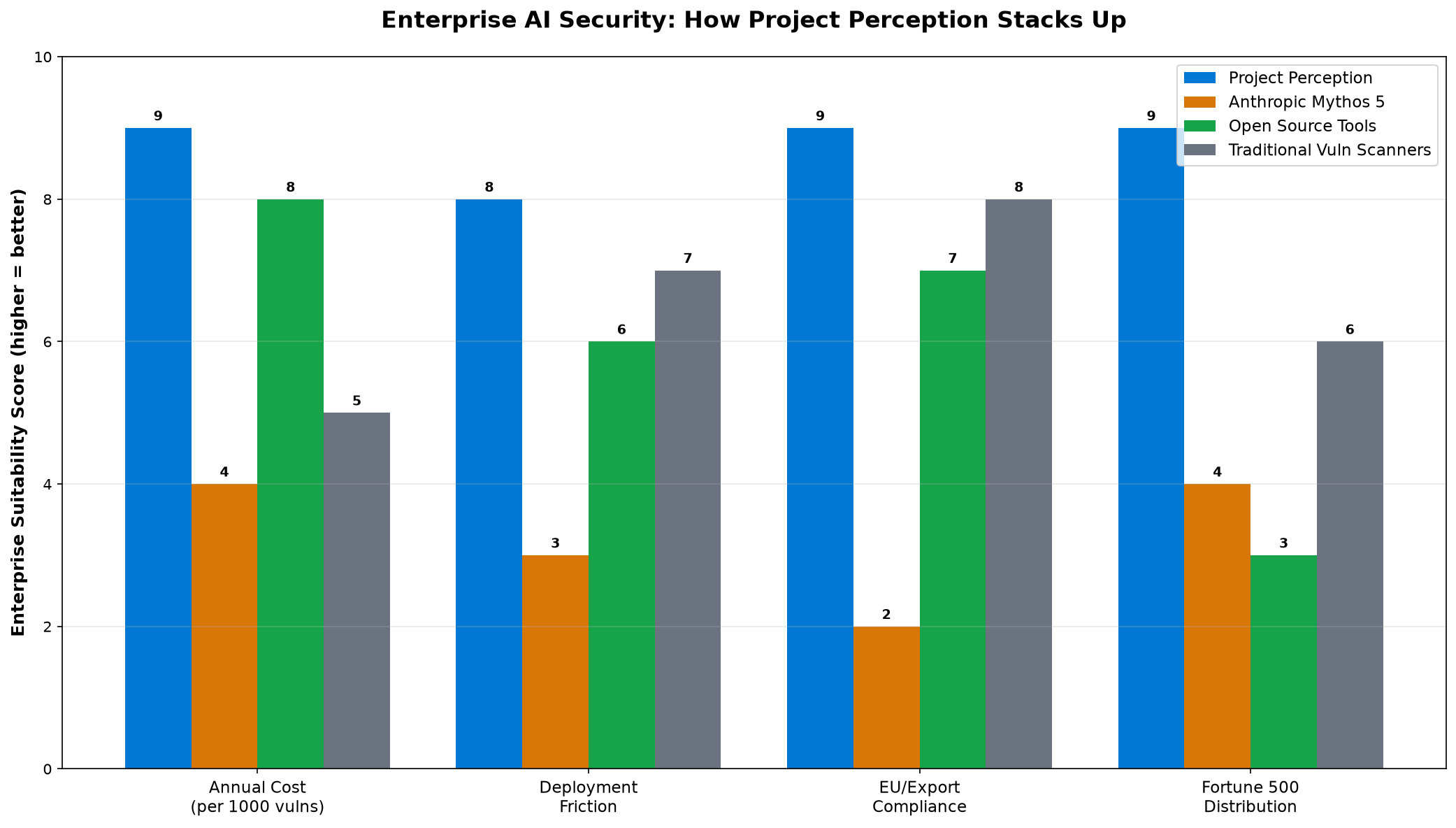
The cost advantage comes from this routing. Instead of paying Mythos 5 pricing (reportedly 100% higher than Opus and 82% higher than GPT). Perception routes simple queries to cheaper models and reserves the expensive inference for tasks that actually need it. TechRepublic reports the tool is being positioned as a lower-cost alternative to Mythos 5 for enterprise vulnerability detection.
The strategic logic is hard to argue with. Microsoft keeps both Anthropic and OpenAI as dependent partners for this product line. Neither can offer equivalent distribution. Azure infrastructure sits inside 90% of Fortune 500 companies. Project Perception doesn't need to win a procurement process. It lives inside the security stack enterprises already have.
What this means for Anthropic's flagship product
Mythos 5 is genuinely impressive. It was trained specifically for defensive cybersecurity. Anthropic made it available through Project Glasswing to about 40 approved partner organizations including Amazon, Apple, and Palo Alto Networks. Several US agencies continue using it despite the government designating Anthropic a supply risk.
But enterprise security isn't a technology competition. It's a distribution competition. The best vulnerability scanner in the world doesn't help you if you can't buy it. And right now, most enterprises can't buy Mythos 5 even if they wanted to.
If Project Perception captures the broader enterprise security market, Mythos 5 becomes a premium product for government and highest-stakes use cases rather than the default enterprise security AI. That's a dramatic narrowing of Anthropic's addressable market in a category where it had a genuine technological lead.
The irony is that the export control situation (which the government justified on national security grounds) has created a market vacuum that will be filled by a product with fewer safeguards, because Microsoft faces no export restrictions. Project Perception relies on the same Anthropic models that the government deemed too risky for foreign access. The difference is distribution politics, not model safety.
A market being rewritten in real time
Enterprise cybersecurity spending is projected to exceed $200 billion in 2026. Microsoft's move into this space with a multi-model security AI product is not a side project, just a direct consequence of the export control regime that made Mythos 5 scarce. The 20-day Fable 5 suspension and ongoing distribution restrictions created a vacuum, and Microsoft moved to fill it faster than anyone expected.
The question now is whether Project Perception's capability gap relative to Mythos 5 matters enough to enterprises who can't get Mythos anyway. My bet: for 90% of vulnerability scanning use cases, good enough and available today beats excellent and unobtainable. That's not a critique of the technology. It's just how enterprise procurement works.
Sources
- TechRepublic: Microsoft's 'Project Perception' Could Challenge Anthropic's Mythos: full breakdown of the multi-model architecture and cost positioning
- The Information: Microsoft Preps Mythos-Like AI Bug Finder: original report that broke the Project Perception story
- Forbes Timeline: Anthropic Disabled Fable 5 After US Export Control Order: detailed timeline of the June 2026 export control shutdown
- The Guardian: US Lifts Export Controls on Fable and Mythos: July 1 announcement of lifted restrictions
- NewsBytes: Project Perception Smart Routing: confirms three-model architecture, smart routing, and Hayete Gallot's role
- Microsoft Security Blog: Multi-Model Agentic Security: Microsoft's earlier work on multi-model security AI
- PYMNTS: Microsoft Security Chief AI Overhaul: Hayete Gallot restructuring Microsoft security around AI products