EEBench V1 gives Claude Opus 5 a 61.6% score across 13 electrical-engineering tasks. That sounds like a model that can design a board. It is not. The score says something narrower and more useful: an agent can now solve a meaningful slice of requirements, component selection, circuit design, and simulation when the work is expressed as code and judged by a deterministic harness.
That distinction matters if you are about to let an AI touch a real PCB. The question is not whether a model can produce a schematic that looks plausible. The question is whether its result has cleared enough independent checks to justify the next expensive step.
What the score actually proves
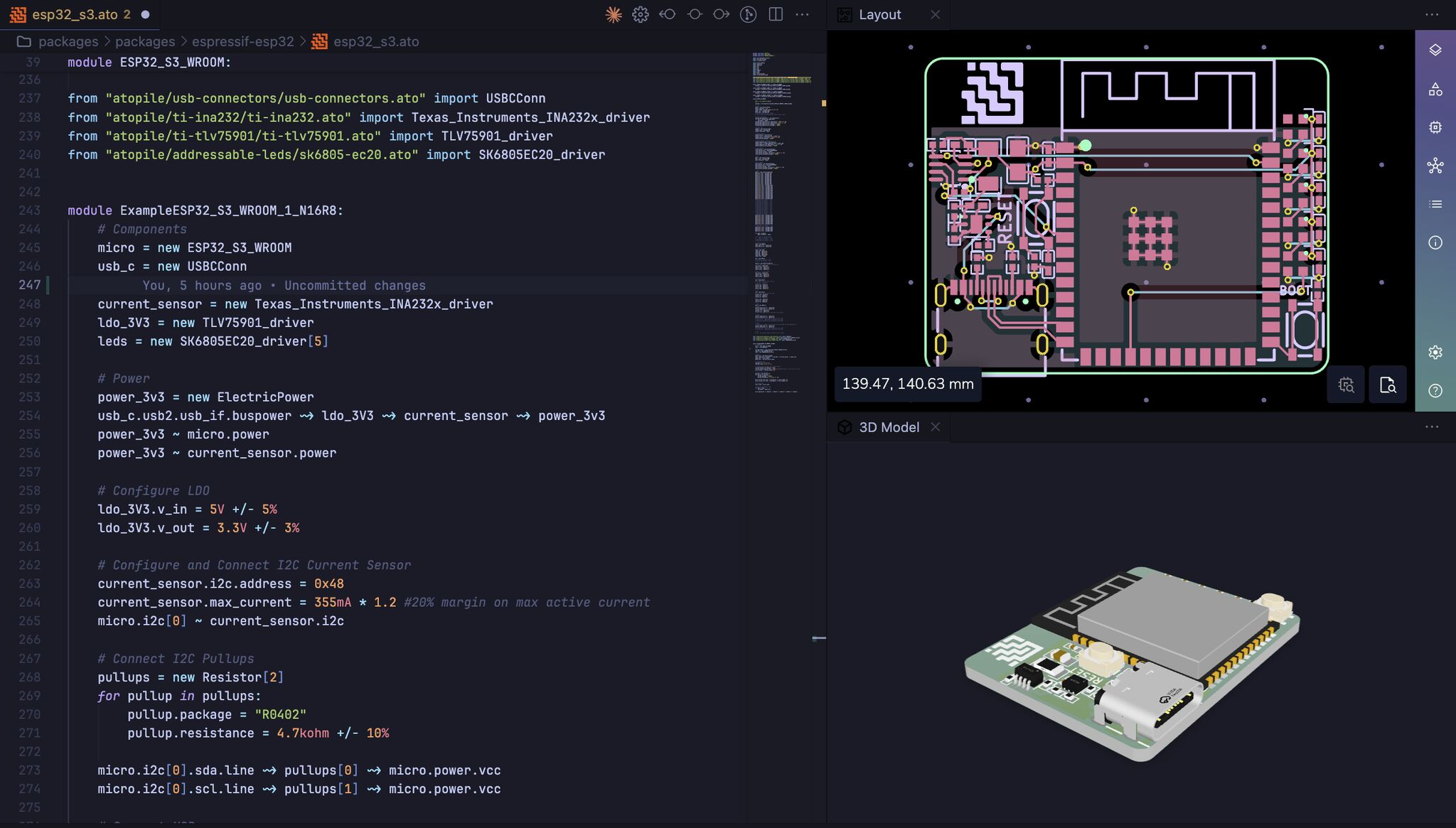
EEBench's design choice is the interesting part. Agents submit atopile design bundles instead of dragging wires around a graphical CAD interface. The circuit lives in declarative code. Components, connections, units, tolerances, and constraints are visible to the agent and to the test harness. The harness can build the circuit graph, construct the bill of materials, generate SPICE decks, run simulations, and inspect named measurements without asking a model to remember which toolbar button it clicked three minutes ago.
This is a better test of engineering reasoning than a screenshot-based demo. It also makes the result less magical. The agent gets a fast feedback loop, and the benchmark checks the artifact rather than trusting a reviewer to decide whether the drawing looks right.
The V1 score combines two things: 65% technical and 35% cost, measured against a reference bill of materials. Cost credit only arrives after the design works. That is a sensible ordering. A cheap circuit that misses its voltage or timing limit is not a bargain. It is scrap with a low invoice.
The tasks cover analog and digital design through simulation. Checks measure gain, thresholds, ripple, transient behavior, margins, tolerance corners, and other specified limits. The benchmark reports Claude Opus 5 at 61.6%, Grok 4.6 at 57.1%, and Claude Fable 5.1 at 56.4%. The leaderboard is useful as a capability signal, but it is not a probability that your next board will work. A score aggregates tasks. Your board is one specific topology, one set of parts, one layout, one supplier batch, and one physical environment.
The failure that should change how you test
EEBench describes an energy-meter task with a 5 V supply, a 20 ms brownout window, and a protected rail that must stay above a 3.0 V processor threshold. The obvious move is to add a capacitor. The engineering problem is choosing one that still provides enough energy at its actual bias, tolerance, package, dielectric, voltage rating, cost, and recharge conditions.
One submitted design used a 22 µF nominal capacitor. At 4.7 V bias, the simulated part delivered only 11.4 µF of effective capacitance against a 545 µF requirement, or 11.4 µF vs 545 µF. The source built successfully. The circuit still failed. Its protected rail dropped below 3 V after 0.85 ms.
That is a good failure because it exposes the gap between code validity and engineering validity. A compiler can accept the component declaration. A nominal simulation can look clean. The real operating point can still make the part inadequate by a factor of roughly 48.
This is where AI-generated hardware needs a different review habit from AI-generated application code. Do not stop at build success. Do not stop at a nominal waveform. Push the design through the ugly corners first: voltage bias, temperature, tolerance, load variation, startup, recovery, and the exact part you can buy. Ask the agent to state which assumptions came from a datasheet and which came from a generic model. Make it show the failing waveform, not just a sentence saying the design passes.
The Hacker News discussion around EEBench landed in roughly the same place. One engineer said current models can produce competent schematics for familiar parts when given datasheets and errata, but PCB layout remains poor. Another said AI had caught errors during review of human designs while failing when asked to create a complex board from scratch. A third described a fabricated board that worked after a few solder fixes, which is a useful reminder that "it worked" can hide a manual rescue operation.
Those reports are not a controlled experiment. They are still valuable because they describe the failure surface the benchmark does not yet cover. Engineers worry about stale or incomplete datasheets, undocumented component behavior, bad footprints, power return paths, RF layout, sourcing substitutions, and the cost of another board spin. SPICE can catch an electrical requirement. It cannot guarantee that a footprint matches the package you ordered.
The prototype gate AI still fails
EEBench V1 deliberately stops before layout, fabrication, and physical bring-up. Its methodology says later versions may add those stages. That boundary is the reason to use the score carefully, not a reason to dismiss it.
For a real project, treat an AI result as moving through gates:
- Simulation candidate: The requirements are explicit, the design builds, and nominal plus worst-case simulations pass. The artifact is safe to iterate on. It is not ready to order.
- Engineering review candidate: A human checks every datasheet assumption, pin assignment, footprint, polarity, power path, clock, protection device, and tolerance. A second model can act as an adversarial reviewer, but it should not be the final authority.
- Prototype candidate: The schematic and layout pass deterministic design checks, the BOM uses orderable parts with checked alternates, and the team has a bring-up plan with current limits, test points, expected waveforms, and a recovery path.
- Release candidate: The assembled article passes the tests that matter in the product's actual operating envelope. Thermal behavior, noise, mechanical fit, firmware interaction, and manufacturing variation belong here.
The practical implication is blunt. Use AI earlier in the loop than you might have six months ago, but keep the physical gate exactly where it was. The model can help translate requirements into constraints, explore component choices, generate a test plan, inspect a netlist, and repair a failing simulation. It can also create a neat, confident mistake that survives until the board arrives.
If you want to reproduce the useful part of the EEBench workflow, start with a text representation and a real solver. Atopile's repository documents a two-minute quickstart: install the editor extension, open an example, build with the editor button or ato build, and add KiCad when you are ready for layout. In your own project, put assertions and units next to the design, keep the BOM generated from the source, and save simulation outputs as artifacts. Then ask an agent to change one constraint at a time and explain the measured effect.
That workflow beats asking a chatbot to "design me a PCB" because it gives the model something it can test. It also gives you something you can diff, review, and reject. The best use of a high scoring circuit model today is not autonomous board shipping. It is fast iteration inside a harness that makes failure visible.
EEBench is a meaningful step because it measures that loop with real constraints instead of a visual demo. The 61.6% result is impressive. It is also a warning label. A model that can solve 61.6% of simulated tasks may be ready to shorten the path to a prototype, but the prototype still has to earn its way onto the bench.
Sources
- EEBench circuit design analysis: task examples, measured failures, leaderboard scores, and scope limits
- EEBench V1 methodology: deterministic grading, tolerance corners, scoring weights, and prototype boundary
- Atopile electronics design repository: declarative design workflow, build command, validation, and KiCad integration
- Hacker News EEBench discussion: practitioner reports on schematics, routing, review, fabrication, and benchmark limits