The paper’s strongest result is not that video generation suddenly looks cinematic. It is that a single 13-billion-parameter video model became much better at obeying a narrow instruction without wrecking the rest of the shot. In FAPL’s tests, factor-edit accuracy rose from 42% to 58%, while prompt-only action ordering improved from 48% to 61%. Those are meaningful gains for teams building controlled scenes. They are not a reason to schedule a production migration yet.
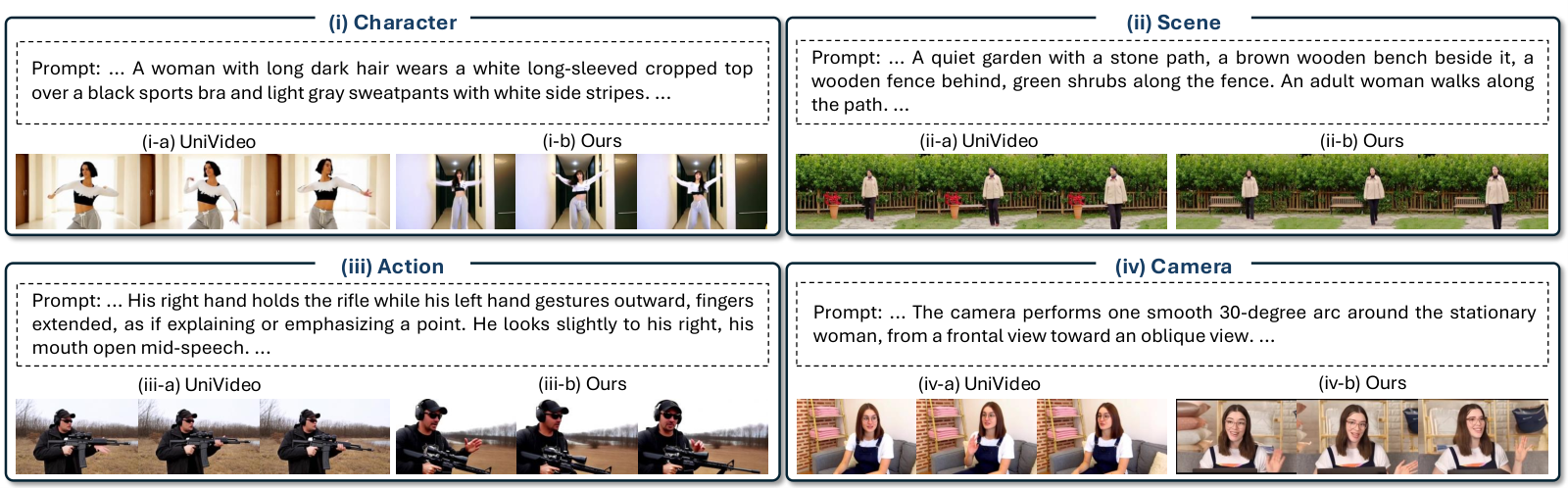
HKUST, Tencent Video, and École Polytechnique’s FAPL paper appeared on arXiv on October 22. The method trains an existing video diffusion transformer to use multimodal language-model representations more deliberately. The authors focus on four pieces of a shot that often get tangled together: character, scene, action, and camera. Change the camera instruction, and ideally the person and setting stay put. Change the character, and the action should not silently change with it.
That sounds obvious until you try to prompt a video model to do it. A model may follow the broad idea while changing hair, clothing, hand positions, or the background. FAPL attacks the problem at training time. It first makes the generator rely on the multimodal model’s projected representations, then swaps the representation span for one named factor between paired examples, and finally trains the multimodal pathway through a frozen generator using text-only and complete-video observations that share the same target. The trick is not a new model architecture. It is giving the existing parts supervision that says what should change and what must remain unchanged.
What the gains actually measure
The main comparison uses UniVideo’s 13B video diffusion transformer as the baseline. On 5,000 sparse-to-video cases, FAPL raises Motion Order from 48% to 61%. That metric concerns the order of actions in a generated shot, not general visual quality. On 5,000 factor-edit cases, its intersection accuracy rises from 42% to 58%. A case counts only when both a yes/no check and a multiple-choice check pass. For a team that needs a person to keep the same clothes while a camera move changes, this second measure is closer to the actual job than a generic image-quality score.
The multi-shot result points in the same direction, but read it with its sample size in mind. On 100 ShotVerse-Bench sequences, FaceSim-Arc rises to 0.523 from 0.451 for UniVideo 13B. The paper also reports better subject and scene consistency. This is a useful signal for short narrative sequences, where identity drift between cuts can make otherwise attractive clips unusable.
The ablations help identify what did the work. Factor swapping raises editing accuracy to 57%, compared with 48% when the same paired training data is used without the swap. Mixed-observation training then moves Motion Order from 57% to 61% and editing accuracy from 57% to 58%. That is more informative than a single headline score: the control intervention appears to help editing, while the final mixed training stage contributes more to prompt-only action ordering and camera trajectory.
But this is a paper result, not a service-level guarantee. The methods are evaluated against the same UniVideo backbone and selected other research systems, not a blind bake-off against every commercial video generator. The datasets and metrics are narrow by design. A 16-point change in one editing metric does not tell you whether your real product shots keep a logo legible, whether a face survives an occlusion, or whether a four-shot sequence cuts together cleanly. The authors also note that complex camera reasoning, 3D blockouts, visual fidelity, and realistic acting remain limitations.
A fair FAPL pilot starts with paired prompts
If your work depends on controlled edits, put FAPL on a watchlist and prepare a small evaluation. Do not commit infrastructure or promise the result to a client based on the abstract. The official project page and repository currently say that training/inference code, model checkpoints, and CineFactor-10K prompts are pending release. Until those land, the central result is not independently runnable from the public materials.
When the assets become available, build a test set from shots you actually need. For each base prompt, make a matched pair that changes exactly one field: the same person and setting with a static camera versus a rightward pan; the same action and camera with one specified wardrobe change; or the same character and scene across two distinct actions. Keep random seeds and permitted references fixed where the implementation allows it. Run the baseline and FAPL on each pair, then score two things separately: did the requested field change, and did the untouched fields stay stable?
A compact scorecard can use four columns: target-factor success, character/scene preservation, action order or camera path, and human review for visible defects. Record the prompt, model/checkpoint hash, sampler settings, number of steps, resolution, generation time, and every failed output. Do not collapse the columns into one average: a model that nails the camera move while changing the product label may still fail your use case. Include easy prompts and awkward ones, such as hands crossing the face, partial occlusion, or a fast camera move, and have reviewers judge outputs without seeing which system made them.
For a first internal gate, require that the new method improve the factor your team cares about without a meaningful regression in the other columns. Set the threshold before you look at results. If you cannot run the authors’ released evaluation unchanged, call your result an internal pilot, not a reproduction of their benchmark. That distinction keeps a useful local experiment from turning into an inflated claim.
Wait for the artifacts, not another headline
FAPL earns attention because its evaluation maps to a real failure mode: video models often treat instructions as a bag of correlated details instead of controllable parts. The paired-edit training design is plausible, and the reported improvement is large enough to justify a test for teams whose work depends on character continuity or precise camera direction.
The sensible decision today is to monitor the project, not deploy it. Wait for checkpoints, inference code, and the named evaluation prompts. Then first reproduce one reported result on the authors’ setup, and only afterward test your own material. If the released model cannot preserve unrelated details on your paired prompts, the headline gains do not transfer. If it can, FAPL may be a practical route to more predictable video editing without rebuilding the generator from scratch.
Sources
- FAPL paper on arXiv: methods, evaluation tables, ablations, and stated limitations
- Official FAPL project page: demonstrations and release-status notes
- FAPL project repository: implementation and evaluation assets status