ProgramGym asks coding agents to rebuild software from its behavior, not patch a repository or follow a neat feature spec. That distinction matters. In the paper's cleanest comparison, the same Qwen3.8-27B model passed an average 55.71% of behavioral tests with Program-Agent, against 34.87% with Claude Code. The agent setup changed. The model did not.
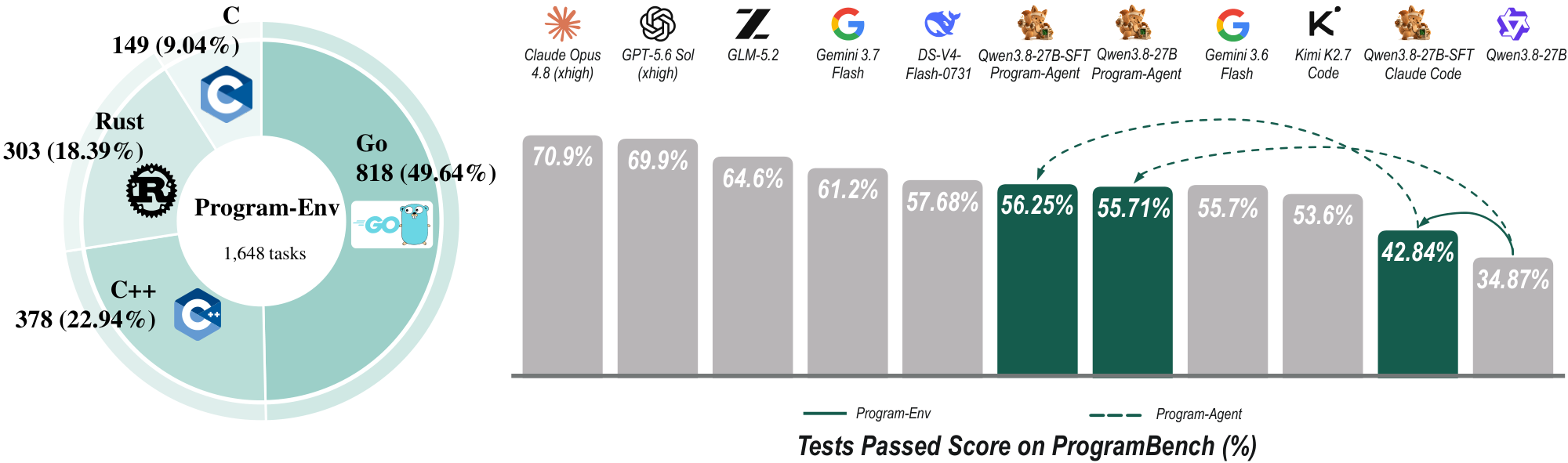
That is a striking harness result, but it is easy to read it as something the study did not prove. ProgramGym does not show that a 27B model is a better general coding assistant than frontier models. It shows that a staged workflow can help one model reconstruct programs in a narrow, unusually demanding setting. For teams building agents that must explore an unfamiliar command-line tool, infer undocumented behavior, or carry a task across many rounds, that is worth testing. For ordinary bug fixing, the result is not a reason to replace your current setup.
The release is a paper and an open dataset, not a ready-made coding assistant you install and point at your work. Program-Env builds executable tasks from open-source repositories. An agent gets documentation and an execute-only reference program, but not the original source or network access. It has to probe the behavior, decide what to build, and write a replacement that passes tests.
What 55.71% actually means
The score is the macro-average of each task's test pass rate. It is not the share of programs completely solved. That distinction changes the headline. Program-Agent's Qwen3.8-27B run scored 55.71% on Tests Passed, but only 5.50% of tasks were Almost Resolved, meaning at least 95% of tests passed. Just 0.50% were Resolved, which requires every test to pass without a cheating flag. A model can therefore pass many individual checks while still failing to reproduce a whole tool reliably.
The comparison worth keeping is the controlled one. With the model held fixed, the Program-Agent scaffold records 55.71% for Qwen3.8-27B, compared with 34.87% under Claude Code, a 20.84 percentage-point gain. For the fine-tuned Qwen3.8-27B-SFT model, the corresponding scores are 42.84% and 56.25%. These are not universal rankings against Claude or GPT: the paper's external model rows use mini-SWE-agent, while its same-model scaffold test compares Claude Code with Program-Agent. Mixing those rows into a single leaderboard would blur different experimental conditions.
The workload itself is specialized. ProgramGym's 1,648 environments cover Go, C++, Rust, and C, with many tasks involving command-line utilities and observable input/output behavior. They come from real repositories, but the reconstruction task hides their source code. That resembles reverse engineering and compatibility work more than the day-to-day task of adding a button to an existing application.
There is another practical limit: the reference test suite checks selected inputs, not every possible behavior. The authors explicitly note that passing a finite suite proves agreement on those tested cases, not full semantic equivalence. A strong score can still hide a broken edge case. The near-zero fully resolved rate is a useful warning against treating a test average as production readiness. We have seen the same gap between training metrics and deployable behavior in a separate analysis of ProAR's early training result.
When to borrow the workflow
Program-Agent separates work into analysis, implementation, and review sessions. Analysis probes the reference and records observed requirements before implementation begins. The implementation stage uses that record rather than relying on a long chat transcript. A separate review stage compares the candidate against observed behavior, after which the agent can revise it. Build checks and saved checkpoints make it possible to recover when a change breaks a previously working case.
The valuable idea is not simply 'use more agents.' It is to keep discovery separate from coding and preserve what discovery found. If an agent starts coding after two quick probes, it may mistake the first behavior it sees for the complete specification. When the context grows, it may also forget why an odd-looking compatibility choice exists. A durable behavior log and a deliberate review step address those failures without requiring a different base model.
A team can test this idea without adopting ProgramGym wholesale:
- Pick a task where the agent must learn behavior by running a tool, not just implement a written request. Use a small internal CLI wrapper or a compatibility test with known expected outputs.
- Freeze the model, task prompt, tools, container limits, and test set. Run the current harness and a staged version against the same cases. If the model changes too, the result cannot tell you whether the workflow helped.
- Have the analysis phase save concrete observations: inputs tried, outputs seen, errors, and requirements inferred. Do not let it quietly turn guesses into facts.
- Give implementation a clean handoff of those observations. In review, run the same tests and record which failures led to a revision. Keep the passing tests fixed so an apparent improvement cannot come from changing the grader.
- Track full-task completion, test pass rate, run time, token use, and regressions separately. A higher average pass rate can coexist with almost no fully reliable outputs, as ProgramGym's own results show.
This is most promising for tasks with hidden behavior, multiple modes, and enough time for exploration to pay off. It is less attractive for a one-file fix with a clear specification, a short latency budget, or work where a human review already catches the same errors cheaply. More stages add calls and coordination. Measure that overhead instead of assuming the score gain comes for free.
A useful starting point is the public ProgramGym-1648 dataset. The dataset card documents a one-task smoke test with Harbor (-l 1) as well as full runs, which is the sensible first move before paying to evaluate all 1,648 tasks. For your own workflow, start with a small fixed sample, and expand only if the staged setup improves complete task success without an unacceptable increase in time or cost. If the agent needs durable state across long work, our guide to editable context for long-running agents covers the related handoff problem.
ProgramGym's most useful result is not a new model leaderboard. It is a reminder to keep the model constant when judging the harness. The 20.84-point gain is a good reason to run that experiment on your own task shape. The 0.50% resolved figure is a good reason not to confuse an improved average with a finished engineer.
Sources
- ProgramGym paper on arXiv: evaluation protocol, score definitions, task design, iteration results, and limitations.
- ProgramGym source repository: release date, workflow overview, and links to the dataset and project site.
- ProgramGym project site: visual results and the 1,648-environment language breakdown.
- ProgramGym-1648 dataset card: task format and Harbor smoke-test command.