TokenRouter reports a 2.01–64.15× decoding-throughput gain across its evaluated routing algorithms, workloads, and model pairs. That is a striking systems result. It is also very easy to read as a promise about your own inference bill, and the paper does not make that promise.
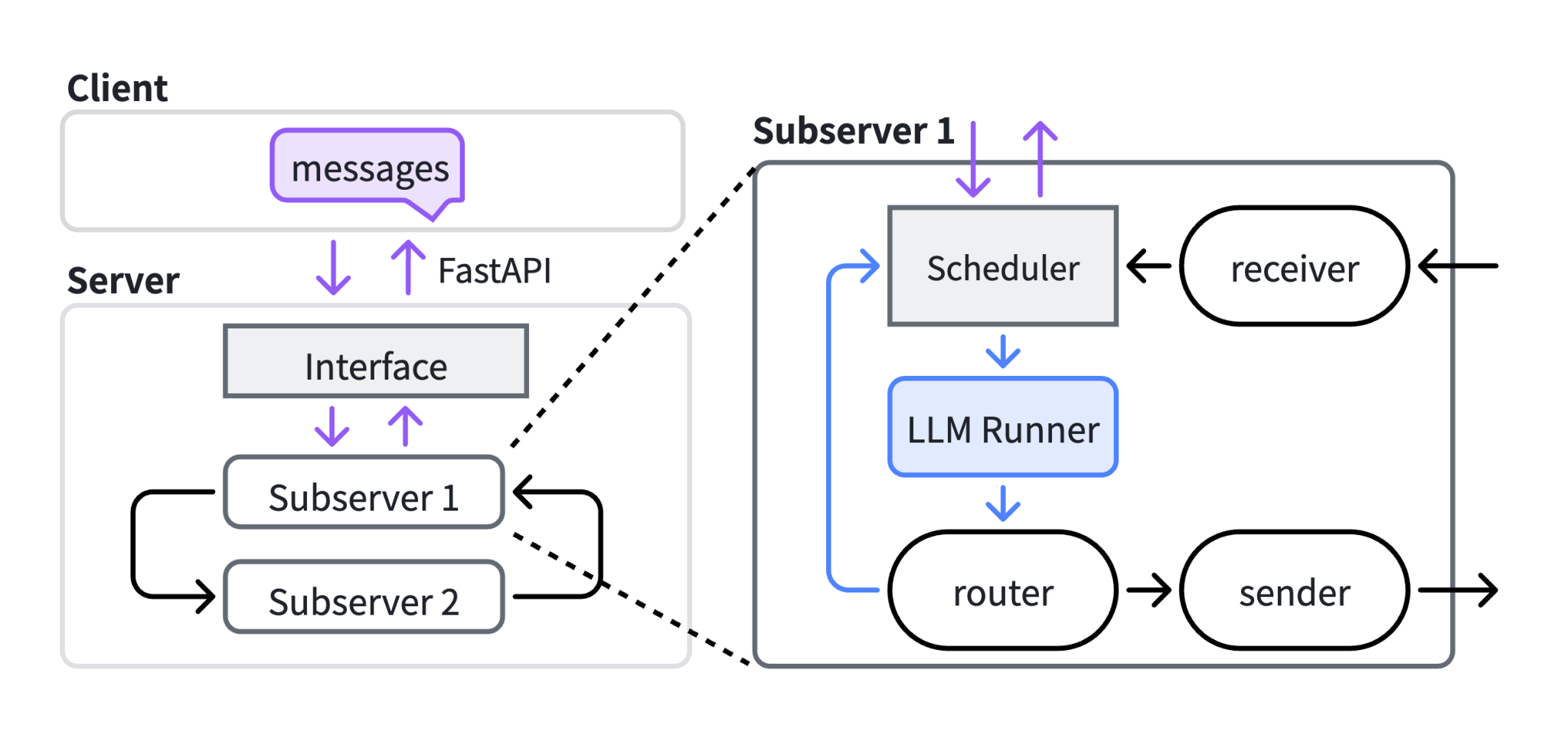
TokenRouter is a serving engine for token-level routing. Instead of picking one model for an entire prompt, a routing policy can hand individual generated tokens to different models during one response. This can make sense when easy parts of a response belong on a small model while difficult tokens need a larger one. But it creates awkward work for the server: the models run at different speeds, requests arrive at each model irregularly, and a naive handoff can throw away useful cache state.
The paper's result is about serving those routing policies efficiently. It does not show that every application gets a 64-fold quality-adjusted cost reduction, nor does it compare the resulting answers with every query-level router. The useful question is narrower: do you already have a token-level policy whose runtime is the bottleneck, and is your workload close enough to the authors' tests to justify trying their engine?
When token-level routing is worth serving
Start with the routing decision, not the server. Ordinary query-level routing assigns a whole request to a model. That is much simpler and is already common in production. Token-level routing makes a different bet: the difficulty of generating one answer changes as it unfolds, so a small model can handle routine tokens and a more capable peer can step in for selected ones. The paper describes R2R as matching a 32B model's quality while sending 5% of tokens to that model and using a 1.5B model for the rest. That is a result reported for that routing method and setup, not a universal ratio to copy.
If your product only chooses between a cheap and an expensive model once per prompt, TokenRouter may solve a problem you do not have. First measure whether that coarse router leaves a meaningful cost or quality gap. If it does, and you have a token-level policy worth serving, TokenRouter gives that policy an execution engine rather than asking you to retrofit every model switch into a single-model server.
The design is sensible. Each model runs in its own asynchronous subserver. The router describes one request using route, send, and receive; the runtime handles model-specific batches and inter-model handoffs. A request can become pending while a peer generates its token, then resume with its serving state intact. The returning request does not have to repeat prefix matching and KV-cache allocation. A delayed-batching scheduler can also wait briefly for more peer requests instead of launching a thin batch immediately.
That wait is a trade-off, not free speed. A threshold that is too low can leave batch admission delays in place. A threshold that is too high can strand requests in a queue and leave the small model idle. TokenRouter's throughput model uses concurrency, routing probabilities, and each model's step latency to select a threshold. Your traffic may have different routing probabilities and latency distributions, so do not assume the best setting transfers unchanged.
The authors evaluated five policies across three workloads. The headline range compares the engine against the stronger baseline for 15 algorithm-workload combinations. In their original settings, the paper reports throughput gains of 2.73–21.97× and latency reductions of 2.78–21.61× over official implementations. Those are still substantial numbers, but they answer a serving-engine question under the authors' evaluation conditions, not a generic promise that any workload will be faster.
What to measure before switching
Use the official repository's example config as a reproduction starting point, not as a production deployment prescription. Its quick-start path launches an R2R server with the Qwen3 0.6B and 32B models:
python -m tokenrouter.launch_server \\
  --config_path config/r2r/Qwen3-0.6B_Qwen3-32B.yaml
The experimental setup is a major part of the result. The paper used an 8× A100-80G server. For two-model methods, the small model used one GPU and the large model used two GPUs with tensor parallelism; the models shared two GPUs via CUDA MPS. The project page also reports a multi-node setup with 3.7 GB/s RoCE networking and no GPU overlap. If you have a smaller box, different accelerators, or slower links, treat the published numbers as a reason to test, not a forecast.
Keep your current system as a baseline and hold the workload constant. Use the same model versions, routing policy, prompts, output limits, concurrency and hardware. Record output tokens per second and end-to-end request latency together. Throughput can climb when you admit more concurrent requests even while each user's generation slows down. The paper itself reports that at concurrency 16, TokenRouter retained 51.7% of its single-user speed while raising aggregate throughput 8.61×. Those metrics describe different user experiences; do not collapse them into one “faster” number.
Also inspect the task mix. The reported tests include short-input AIME reasoning, long-output reasoning with an 8,192-token cap, and multi-turn SWE-Smith trajectories with roughly 8,192 input tokens and a 1,024-token output cap. If your prompts are short, your output is brief, or your traffic rarely switches models mid-response, the bottleneck may be elsewhere. Run a sample that resembles production, then sweep concurrency and delayed-batch thresholds rather than reporting one best-case point.
Before calling a pilot successful, compare answer quality and total cost per completed task as well. TokenRouter speeds up serving an existing routing policy; throughput alone does not establish that the policy routes wisely, that answers remain equally good, or that the system costs less once both models, GPU memory, and networking are counted. Include failed requests and tail latency in your own evaluation. A gain in generated tokens per second can coexist with a regression in the metric users notice.
I would pilot this only when token-level routing is already justified and the current implementation spends measurable time waiting on model switches, fragmented batches, or repeated cache work. If you have not built that policy yet, compare the simpler query-level router first. It may be the right answer, even if the paper's runtime is technically impressive.
Sources
- TokenRouter paper on arXiv: evaluation, scheduling design, baselines, and experimental limits
- Official TokenRouter implementation: install instructions, server configs, examples, and reproduction commands
- TokenRouter project page: interactive system explanation, measurements, and deployment notes