A deep research agent usually has one move when it gets stuck: search again. AREX adds a more useful move. It checks which parts of its answer are actually supported, keeps the evidence that survived, and turns the missing pieces into a new research question.
That sounds like a small change to the usual browse, summarize, answer loop. It is not. On the paper's main BrowseComp ablation, the full system scored 82.5. Removing both its learned context update and its outer revision loop dropped the score to 59.6. Context management alone lifted the matched single-round setup to 71.4, while the second loop pushed it to 82.5. The improvement is larger than most prompt tweaks because AREX changes what the agent does with failure.
The useful idea is not “search longer”
AREX is built around an asymmetry that shows up in almost every serious research task. Finding a candidate that satisfies five or six constraints can be expensive. Checking one candidate against those constraints is often easier. A good research system should therefore use verification as a control signal, not as a final quality check after the answer is already written.
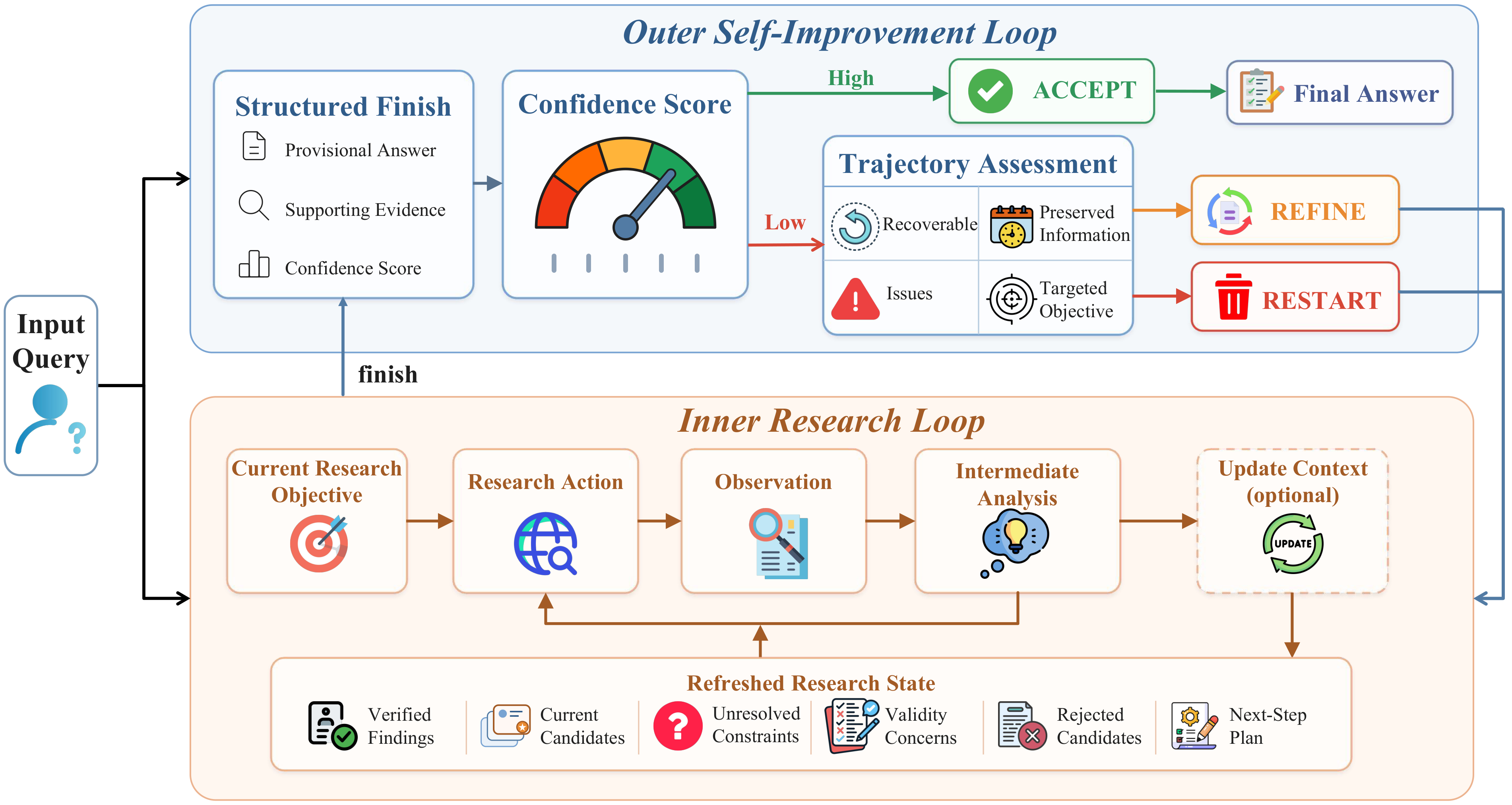
The model has two nested loops. The inner loop searches, visits pages, collects evidence, and builds a provisional answer. It can call an update_context tool when the current history becomes noisy or when a meaningful subproblem has been resolved. That tool does not merely shorten the transcript. It is trained to keep verified findings and source identifiers, rejected candidates, unresolved constraints, validity concerns, and the next plan.
The outer loop receives the provisional answer, its evidence, and a confidence score. If the score is high enough, AREX stops. If the trajectory contains useful progress but still has weak claims, it preserves the useful state and launches a targeted follow-up round. If the trajectory is too noisy to rescue, it restarts from the original question. That last branch matters. A system that blindly carries every earlier assumption forward can turn one bad search result into a very long hallucination.
The paper reports two released sizes. AREX-Turbo is a dense 4B model. AREX-Base uses a 122B mixture of experts with 10B active parameters. Both use Qwen3.5 backbones, then receive agentic mid-training and long-horizon reinforcement learning designed around research trajectories instead of isolated answers.
The training recipe has a sharp opinion about where learning signal is valuable. Most steps in a browse trace are routine: open a result, read a page, reformulate a query. A few steps decide whether the investigation recovers: discovering decisive evidence, rejecting a false candidate, redirecting the search, or updating the research state. AREX identifies those key steps and gives them extra supervision. Its reinforcement learning objective also assigns credit at the step level rather than spreading one final reward across every generated token.
That is a practical answer to a boring but important problem. If a 200-step investigation fails because the agent chose the wrong entity on step 37, a single success or failure reward does not tell the model much about step 37. AREX tries to make that decision visible during training.
The numbers make the case, with caveats
The released Base model scored 82.5 on BrowseComp, 85.4 on GAIA, 71.0 on xbench-2510, 89.9 on DeepSearchQA, 82.0 on the English WideSearch set, and 52.4 on Humanity's Last Exam with tools. The compact Turbo model scored 70.7, 81.6, 57.0, 78.5, 68.5, and 40.6 on the same columns.
| Model | BrowseComp | GAIA | DeepSearchQA | WideSearch-en | HLE with tools |
|---|---|---|---|---|---|
| AREX-Turbo, 4B dense | 70.7 | 81.6 | 78.5 | 68.5 | 40.6 |
| AREX-Base, 122B total, 10B active | 82.5 | 85.4 | 89.9 | 82.0 | 52.4 |
| DeepSeek-V4-Pro | 83.4 | not reported | 88.7 | 78.0 | 48.2 |
| Gemini-3.1-Pro | 85.9 | 80.6 | 93.3 | 66.4 | 51.4 |
| Kimi-K2.6 | 83.2 | 80.6 | 92.5 | 80.8 | 54.0 |
The attractive result is not that AREX wins every row. It does not. Gemini leads on BrowseComp and DeepSearchQA in this table. Kimi leads on HLE. The interesting part is the trade-off: AREX-Base gets those results with 10B active parameters, and it beats the much larger Qwen3.5-397B baseline on the reported tasks. Its WideSearch score is also higher than the frontier entries listed by the authors.
The strongest evidence comes from the controlled component test. With the same model and budget, the no-ACU, no-outer-loop setup scored 59.6 on BrowseComp. Adding only the outer loop raised it to 69.8. Adding only autonomous context updating raised it to 71.4. Turning on both reached 82.5. The gains are not redundant. Each mechanism gives the other a better state to work with.
The context tool is used earlier than a simple token emergency would suggest. AREX invoked it in 80.3 percent of BrowseComp cases, at a mean active context size of 25,721 tokens and a median of 25,386. The configured window was 128K tokens, yet only 0.01 percent of updates happened at or above that limit. Most calls happened because the search strategy needed revision, not because the context physically ran out of space.
The update state also tells us what the model thinks matters. It retained unresolved constraints in 95.5 percent of updates, next-step plans in 96.4 percent, verified findings in 72.1 percent, and rejected candidates in 81.5 percent. That last number is easy to overlook. Negative evidence is memory. A research agent that remembers what failed wastes less time rediscovering it.
The ablations expose where the performance comes from. Replacing progressive browsing-then-reasoning training with mixed training lowered BrowseComp from 82.5 to 77.5. Replacing key-step replay with random intermediate steps caused the largest drop, down to 74.1. Replacing step-aware reinforcement learning with standard GRPO produced 79.4. The 8.4 point loss from random-step replay is a strong signal that the useful unit is not “another training example.” It is the decision that changed the investigation.
What this changes for local agents
AREX is more interesting as a design pattern than as a model download. The architecture gives an agent a disciplined answer to three questions: what have I established, what remains uncertain, and should I continue this line of work or throw it away?
That pattern can be implemented without a 122B model. A local coding or research agent could maintain a small state file with confirmed claims, citations, rejected leads, open checks, and a next query. It could trigger a refresh after a contradiction, after eliminating a candidate, or when the plan changes. The important trigger is semantic progress, not an arbitrary token count.
There is a catch. AREX's evidence and confidence machinery is still produced by the model. A confident wrong audit is possible. The paper's confidence analysis is encouraging but not a proof of reliability: 95.9 percent of correct outputs with ACU fell in the 90 to 100 confidence bin, while 55.2 percent of errors fell below 60. That leaves a meaningful group of wrong answers that can still sound sure, plus a group of correct answers that look uncertain.
The benchmark protocol deserves a warning label. It tests search and tool use under a fixed interface, with up to 300 inner research turns and five outer operations. That is useful for comparing systems, but it is not the same as deploying an agent against messy private documents, paywalled sources, changing websites, or a user who will not wait through hundreds of tool calls. Cost, latency, citation quality, and failure recovery outside the benchmark remain open questions.
Still, the central lesson holds. Long context is not the same thing as useful memory. More searches are not the same thing as better research. A system that can say “this part is verified, this part is not, and this path is dead” has a better chance of finishing with an answer worth reading.
AREX does not make agents magically skeptical. It gives skepticism a place in the control loop. That is a much more concrete promise, and one other research systems should steal.
Sources
- AREX paper on arXiv: architecture, training recipe, benchmark results, and ablations
- AREX project page: recursive loop diagrams and benchmark visualizations
- AREX models on Hugging Face: model releases and cards for AREX-Turbo and AREX-Base