A team can have a capable model and still hand it a job it cannot finish. The client’s spreadsheet never arrived. The agent cannot access the required design file. The task needs a deliverable the configured tools cannot create. Then the system confidently predicts success because nobody told it what the system actually can do.
That failure mode is the useful finding in PayWorthy, a new benchmark built from real freelance listings. The paper tested 18 language models as forecasters. When the prompt described the agent’s actual limits, their success rankings reached AUC 0.66–0.86 versus 0.45–0.56 for the generic description, which is essentially random ranking. This is not a new “AI can do freelance work” score. It is evidence that task triage depends on an honest capability description.
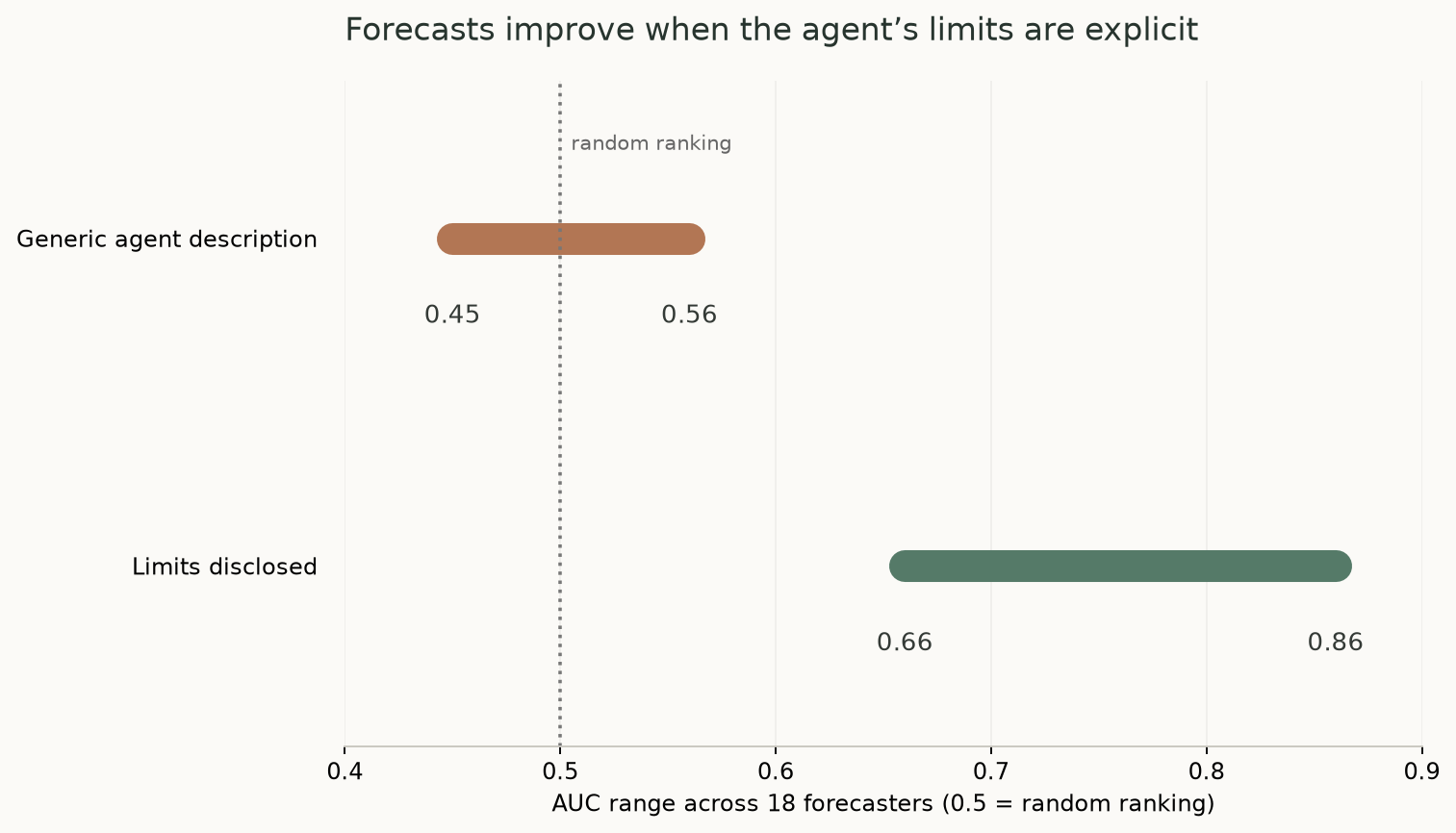
PayWorthy sampled 1,494 postings from 18.8 million ads, across 12 categories. Its benchmark agent received the posting and returned one response without tools. A simulated client judge scored whether the result met the stated requirements. Forecasters saw the posting before the attempt and estimated the chance of success. AUC measures how well those estimates rank accepted jobs above rejected jobs; 0.5 is random ordering.
The point for an operator is less glamorous than a new model leaderboard, and more useful. A forecasting model cannot compensate for a fantasy description of the executor. If your agent has no file-upload path, access to private company data, or ability to create a required artifact, you need those facts in the task-fit check before it bids or starts work.
A task-fit screen before you bid
Use a four-part screen for every paid task. It is a routing checklist, not a statistical guarantee. PayWorthy did not validate this exact checklist in production; the paper supports the need to disclose constraints, while the checklist turns that lesson into an operating procedure.
Name the deliverable. Rewrite the client’s request as one concrete object someone can inspect: a workbook, a set of edited images, a tested code change, or a written analysis. If the request describes ongoing judgment or an unclear outcome, do not pretend it is a crisp agent task. Ask the client to define acceptance criteria or send it to a human first.
List required inputs. Identify each file, credential, dataset, account, and client decision the work depends on. Mark whether the agent can actually receive and read it. This is not paperwork. The PayWorthy authors found that generic forecasters missed jobs requiring client files when the benchmark agent never received those files. Stating “the agent can use a browser” does not solve missing input access.
Match tools to output. Check that the configured environment can produce the requested format and verify it. A code-only sandbox cannot promise a finished spreadsheet with formulas, and a text model cannot claim it has edited a source file it never opened. Keep a human in the loop when the deliverable cannot be checked automatically.
Write down the limits in the forecast prompt. State what the agent can do, what it cannot do, what it will receive, and what counts as acceptance. Then ask a model to flag mismatches and estimate task fit. The paper’s result suggests that this information can make forecasts rank tasks meaningfully better. It does not establish that an individual forecast is calibrated well enough to decide a contract alone.
A practical routing rule follows: send a task to the agent only when the deliverable is explicit, its required inputs are accessible, the tools can create and check it, and the forecast is based on those exact conditions. Send ambiguous work to a person. Use supervised agent work when the task is mostly suitable but one consequential step needs approval. Decline or renegotiate when the client’s requirements cannot be met with available access.
When the forecast is not enough
The range difference looks large, but read the experiment carefully. The forecast task was not a live freelancer marketplace. One benchmark agent attempted each posting in a single response without tools, and an LLM acting as the client judged the result. The benchmark used 18.8 million source listings to construct a stratified sample, then retained 1,494 jobs with defined deliverables. That is a valuable test of task-fit prediction, not a representative measure of what all deployed agents can earn.
The study also shows why a better average ranking is not a contract-level promise. The authors report that 54% of benchmark deliverables were accepted overall under the headline judge. Even the top fifth of jobs selected by the informed forecasts were accepted 65–92% of the time, depending on the forecaster. Useful lift, still plenty of failures. The generic description performed near chance, and for 15 of 18 forecasters its top-ranked fifth did worse than a random fifth. The mistake was not simply choosing the wrong model size. Describing the agent inaccurately hid the failure conditions.
Treat the AUC as a ranking aid. It does not tell you the correct bid price, the expected time to finish, the chance of a dispute, or whether a particular client will accept an output. Nor does the paper show that a model can predict performance for your agent stack, your tools, or your quality bar. AUC says how often a randomly selected accepted item receives a higher score than a randomly selected rejected item; it does not give you a safe probability threshold by itself.
If you want to use this idea, start with a small internal queue where humans already review outcomes. Record the task, the exact capability description shown to the forecaster, its score, the route chosen, and the final acceptance result. Check calibration on your own work before letting any score make a commercial decision. Keep the human override, especially for high-cost tasks or work with private inputs. Do not copy a threshold from this paper and call it your policy.
The clean operational lesson is simple: describe the executor you have, not the agent you wish you had. A triage model can help sort work only after you make the missing files, unavailable tools, and acceptance conditions visible. If those facts stay out of the prompt, a confident forecast is just a polished guess.
Sources
- PayWorthy paper on arXiv: benchmark design, model forecasts, measured AUC ranges, and limitations
- Upwork Payworthy code repository: authors’ released implementation and benchmark materials