The burst lasted five minutes. The vLLM server stayed degraded for the next 70 minutes. In a new paired experiment, the prefix-cache hit ratio settled at ~10%, throughput fell to about half, and the matched server without the burst remained healthy. This is a specific failure mode for closed-loop agents, not a generic warning that caches can miss.
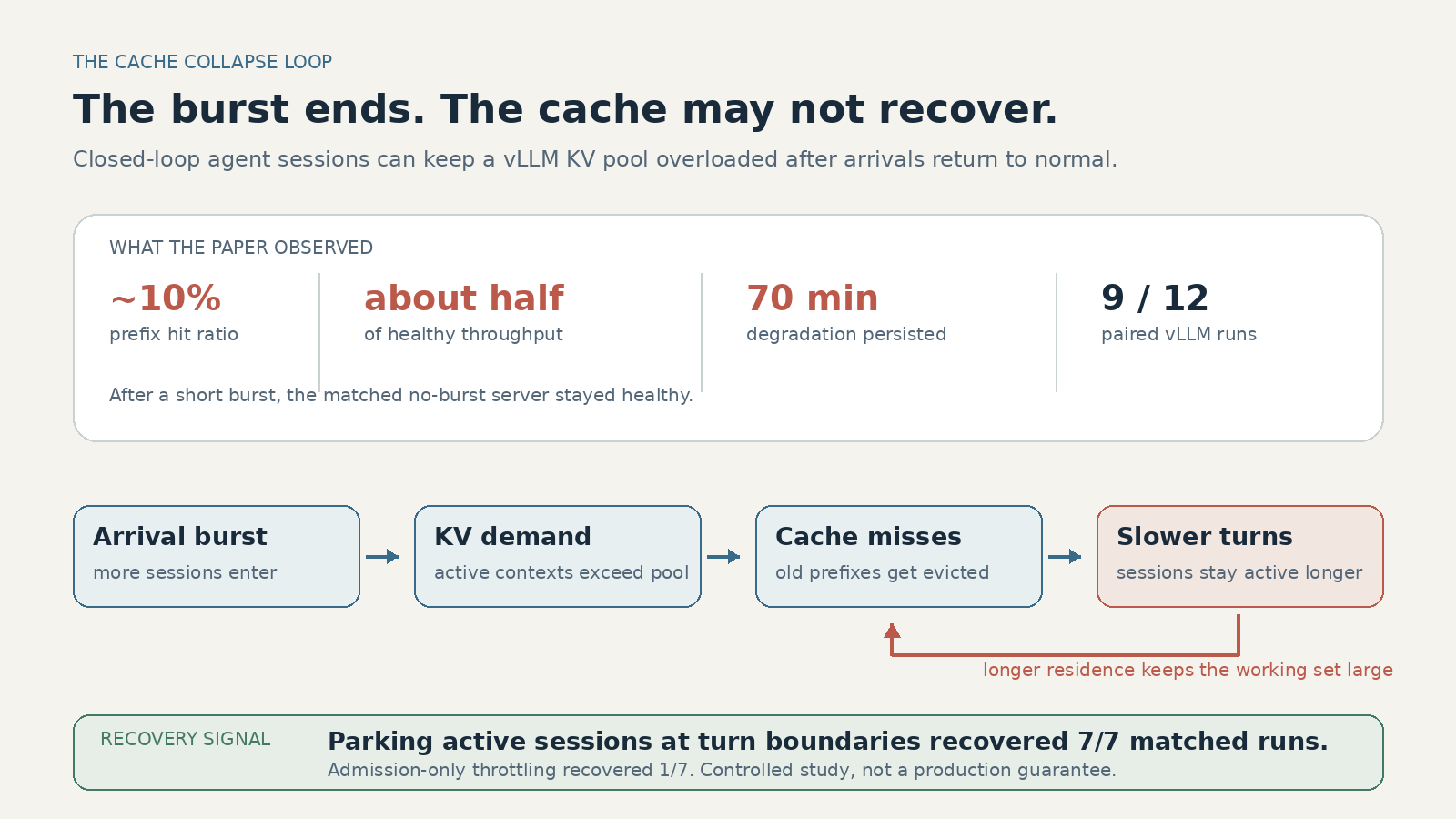
Wen Huang and Jack Liu’s November 10 preprint, “Bursts That Outlast Themselves,” tests a disturbing feedback loop: one short surge can leave a prefix-cached agent server unable to restore its own cache after load returns to normal. The result is worth a look if you run coding or browser agents behind a self-hosted vLLM endpoint. But keep the boundaries in view. The main experiment used one AMD MI300X, vLLM 0.20, Qwen3-8B, and a fixed 400,000-token KV pool. It is a controlled study, not a production incident report.
An agent’s next turn usually includes its task, prior model messages, and tool results. Prefix caching can reuse most of that context when the session resumes. If the previous turn’s KV blocks have been evicted, the engine has to prefill the longer context again. That costs more work just as the server is already slow.
The researchers paired identical base arrival streams, then added five minutes of extra arrivals to one server. 9 of 12 pairs ended in persistent degradation, and none of the no-burst twins did. The cache-warm server was otherwise handling the base load. Once response times rose, more sessions stayed in the system at once. Their combined contexts outgrew the KV pool. LRU eviction knocked out prefixes between turns, so the next turn needed a full prefill. More recomputation meant slower turns, which kept more sessions resident. The brief surge was over; the loop was not.
Spot the collapse in live metrics
A low cache hit ratio alone does not prove this failure. A server just restarted, or prompts whose prefixes change on every request, can also produce misses. Look for the combination after traffic has returned to its usual level: prefix-hit ratio stays depressed, running or waiting sessions remain elevated, KV usage stays high, and time to first token or queue time remains worse than the pre-burst baseline. The paper’s degraded runs kept 16 to 32 requests running, used 83% to 100% of the KV pool, and served at roughly the throughput of the same engine with caching disabled.
The official vLLM metrics page documents counters for vllm:prefix_cache_hits and vllm:prefix_cache_queries, plus vllm:kv_cache_usage_perc, running requests, queue time, and TTFT. The KV-usage gauge reports a fraction on a 0–1 scale. A token-weighted hit ratio can be estimated over a rolling window as:
rate(vllm:prefix_cache_hits[5m]) / rate(vllm:prefix_cache_queries[5m])
Metric exposition can vary across vLLM versions, so confirm the exact counter names on your own /metrics endpoint before wiring a dashboard. Then graph the ratio beside kv_cache_usage_perc, num_requests_running, num_requests_waiting, queue time, and TTFT. Compare the trend with your own healthy baseline; the paper’s 10% result is not a universal alarm threshold.
That distinction matters because conventional prefix-cache advice answers a different question. If cache misses happen on every request, inspect whether timestamps, shuffled tool schemas, or other changing text appears early in the prompt. Our guide to keeping prompt prefixes stable covers that kind of miss. Here, the tell is that the same traffic mix slows down after a short burst and stays slow after the burst disappears. For a related capacity check, start with estimating the KV budget before serving a model.
Choose a recovery action without overclaiming
The paper’s most useful operational result is that rejecting new arrivals may not be enough once the server has collapsed. Already admitted sessions keep cycling through the overloaded pool. The authors instead tested a gateway that parks some sessions at turn boundaries, so no in-flight model call gets interrupted. A parked session stops issuing turns for a while; its prefix may be evicted, but the remaining sessions can begin hitting cache again. Sessions wait in a FIFO queue and resume as capacity allows.
In seven matched runs that had collapsed across every tested control, parking sessions against the KV-pool budget restored all seven in under five minutes. A fixed session cap with parking restored all seven within six minutes. A cap that only throttled new arrivals recovered one of seven matched runs. That is a useful comparison, not a guarantee for your fleet. The full experiment also reports two recoveries among eight admission-only runs when counting the broader, not fully matched set; denominator and comparison set matter.
The budgeter estimates each active session’s context plus its output allowance, then admits or parks sessions against a share of the pool. The paper used a 75% admission threshold and a 95% parking threshold. Do not copy those numbers blindly. Their controller ran at the gateway, parked work only at turn boundaries, and put resumed sessions ahead of new arrivals. A deployment needs those queueing semantics, fair service, cancellation handling, and limits that match its own context lengths. Simply dropping requests or setting a lower global concurrency limit is not the same intervention.
There is another catch: restoring cache efficiency does not conjure extra capacity. In the study’s larger-model trace replay, the budgeter restored hit ratios, but the arrival rate still exceeded what the cache-warm engine could complete, so the backlog continued to grow. Keep load shedding, additional replicas, or routing options available if the queue itself must drain. The paper found that CPU offload delayed the failure but did not prevent it. SGLang tolerated larger triggers than vLLM in the tested setup, which is not evidence that it cannot fail too.
The experiment has real limits. Synthetic sessions used random token contents, and the public coding-agent trace replay preserved lengths and timing rather than executing agents. The authors tested one GPU type and one replica, without production routing, autoscaling, or client retries. They also say that, on the 32B setup, queue-stability evidence was limited. Treat the work as a strong incident hypothesis to test against your own traces, not a change request to copy directly into production.
If your hit ratio tanks during a burst and stays low afterward, do not just wait for the cache to “warm up.” Check whether the active session working set still exceeds the pool. If it does, test a controlled turn-boundary parking policy in a staging workload, and verify both cache recovery and queue drain before trusting it with live traffic.
Sources
- Bursts That Outlast Themselves: Persistent Degradation in Prefix-Cached Agent Serving: paired-run results, recovery controls, and experimental limitations.
- vLLM metrics documentation: Prometheus cache, KV usage, request, queue, and latency metrics.