I have started treating long prompts as a code smell. When an AI coding tool asks me to describe every change in a paragraph, I am doing two jobs at once: designing the program and translating that design into instructions the model can parse. Huzzah, an experimental editor by Daniel Vaughn, tries to remove that translation step. You write persistent pseudocode, save the file, and the editor reconciles the affected source code with an AI model.
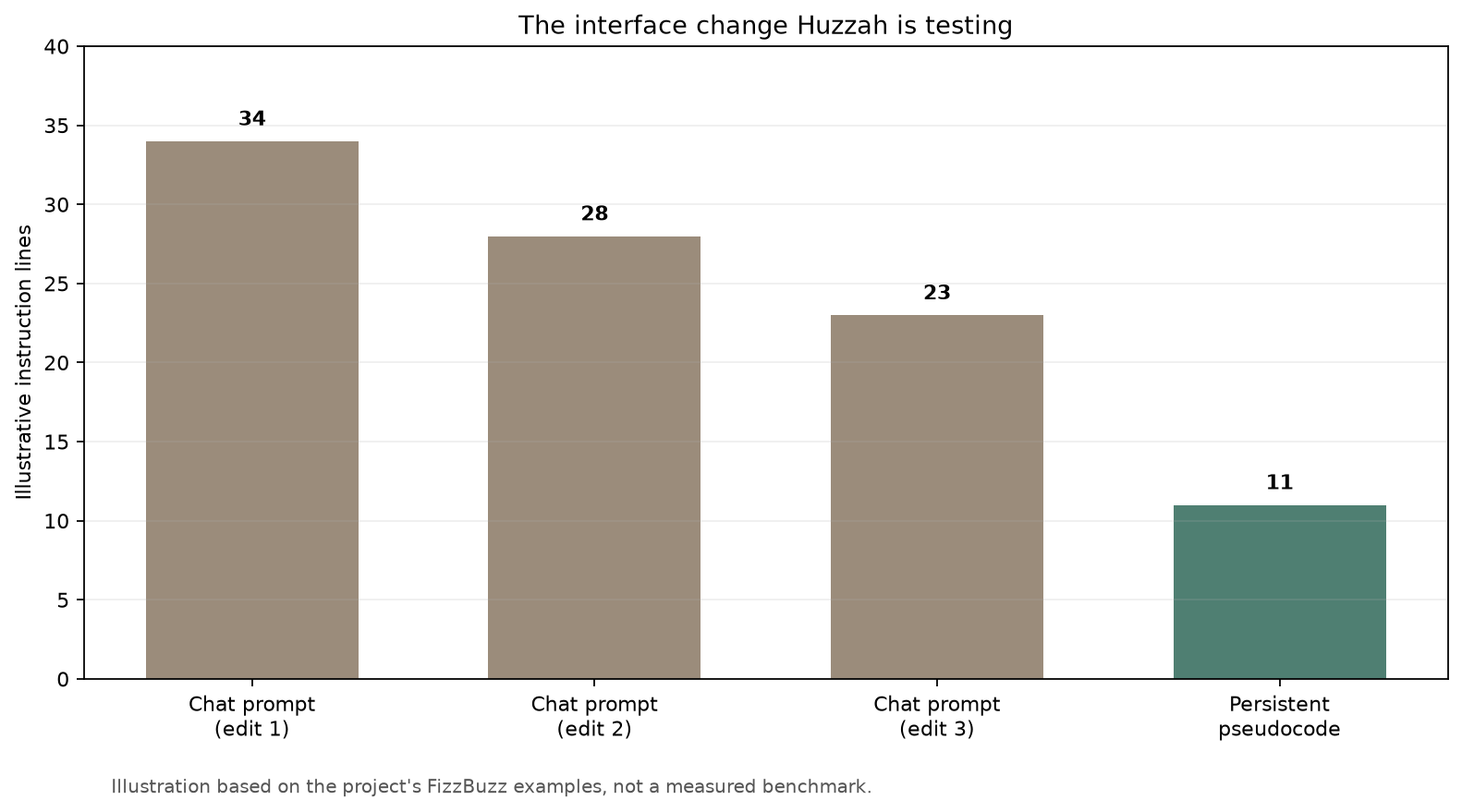
That sounds like a small interface tweak. It is not. A chat transcript is a temporary trail of requests. Huzzah treats the pseudocode as a durable record of intent that stays beside the generated implementation. If the implementation drifts, you edit the intent instead of searching through an old conversation for the sentence that started the whole thing.
The project is still a proof of concept. That is exactly why it is worth trying on a toy project, not why you should point it at a production repository.
The setup that makes sense
The install is pleasantly ordinary, but the version requirement matters. The README asks for Node.js 22.19 or newer. From there, the path is:
git clone https://github.com/danielvaughn/hz.git
cd hz
npm install
npm run dev
The app should appear at http://localhost:5173. Huzzah delegates provider and credential handling to Pi, so it is not tied to one model vendor. You can authenticate with a provider API key, or use Pi's /login flow for a supported subscription. The README also documents local options such as Ollama, LM Studio, and vLLM through Pi's model configuration.
For a first run, I would use a cheap model or a local model and a disposable directory. Do not start with an existing application containing secrets, private customer data, or a complicated build. Huzzah sends the specification and current generated source to the provider you choose. Accepted JavaScript runs locally in a Web Worker, but the project explicitly says that this is containment, not a hostile-code sandbox.
The first useful test is a small utility with a clear boundary. A shopping cart, rate limiter, Markdown formatter, or budget calculator is better than a web app with twelve routes. Make one .hz file. Describe the data and behavior in terse pseudocode. Save it. Inspect the generated source. Then make one change and inspect the diff before you accept anything.
The author uses FizzBuzz to show the loop. A normal coding-agent interaction starts with a paragraph such as “loop 100 times, check divisibility by 3 and 5, then print the matching label.” A later change requires another paragraph. In Huzzah, the intent can look like this:
fizz_buzz(n)
    loop n
        modulo 3 ? "fizz"
        5 ? "buzz"
        both ? "fizz buzz"
The workflow has two steps after you write the intent: save the specification, then inspect the regenerated source. The important part is not that this pseudocode is shorter. The important part is that the file remains after the model call. When the function changes from a fixed loop to n, the saved diff becomes the prompt. The human-readable specification and the generated implementation can be reviewed together.
What breaks first
The approach has a clear boundary: it is strongest when you know what you want the program to do and weakest when you are still discovering the domain. Vaughn's own caveats call out cross-file dependencies, larger codebases, missing language-server features, and the difficulty of expressing some ideas reliably. Those are not footnotes. They define the test plan.
Start with one module. Keep the generated target small enough that you can read it in one sitting. After each save, run the program and its tests before adding another concept to the pseudocode. If the model invents a data shape, do not patch the generated JavaScript by hand and move on. Change the pseudocode so the durable intent catches up with the implementation. Otherwise you have recreated the same drift Huzzah is trying to prevent.
The other failure mode is false confidence. A saved specification feels like documentation, but it is only useful if it expresses the behavior a reviewer would care about. “Make checkout work” is not a specification. “Reject an empty cart, apply one discount code, calculate tax after the discount, and return a price in cents” gives the model and the human something to check.
Security deserves a separate line. The README says generated JavaScript runs in a Web Worker, then immediately warns that this is not a hostile-code sandbox. Treat the warning literally. Do not paste credentials into the editor. Do not run generated code against a production filesystem. Keep network access and sensitive fixtures out of the first experiment. The point of the test is to evaluate the interface, not to create a new execution boundary you have not audited.
The project had 102 GitHub stars when I checked it and its Show HN discussion had 337 points and 183 comments. Those numbers do not prove that persistent pseudocode improves productivity. They do show that the problem is recognizable: the author described fatigue from writing full sentences for every change, and the community discussion focused on whether a durable intent layer can keep coding agents from confusing themselves as projects grow.
Try it without betting your codebase
Use a three-pass trial.
First, recreate a tiny function from scratch. Compare the amount of intent you wrote with the amount of generated code. You are looking for control, not fewer keystrokes.
Second, change one requirement. Edit the pseudocode, save, inspect the generated diff, and run a test. If you cannot explain why the changed lines exist, the interface has not solved your problem yet.
Third, deliberately add a requirement that crosses a boundary, such as persistence or a second module. This is where the current proof of concept may stop being comfortable. Record the point where you need to fall back to ordinary code and tests.
My verdict is narrow. Huzzah is a good experiment for people who miss writing code but do not want to return to typing every implementation detail. It is not a replacement for a coding agent, an IDE, or a sandbox. Its useful idea is the persistent intent file. Even if the editor goes nowhere, keeping a small declarative specification next to generated code is a habit worth stealing.
Try it on a toy project for an hour. If the pseudocode makes the change easier to review, keep the habit. If it only gives you another surface to maintain, go back to the chat tool and save yourself the ceremony.
Sources
- Huzzah project article: the author’s problem statement, pseudocode examples, workflow, and limitations
- Huzzah GitHub README: Node.js 22.19 requirement, setup commands, provider configuration, and safety notes
- Show HN discussion: community response with 337 points and 183 comments when checked