Every agentic coding loop has the same dirty secret: the model spends more tokens thinking about the problem than actually writing code. Moonshot AI's answer is K2.7 Code, released June 12, which claims a 30% reduction in "overthinking" compared to its predecessor K2.6. The pitch is straightforward. Fewer reasoning tokens means lower latency and lower API bills, with no loss in output quality. Whether that claim holds up depends on who you ask.
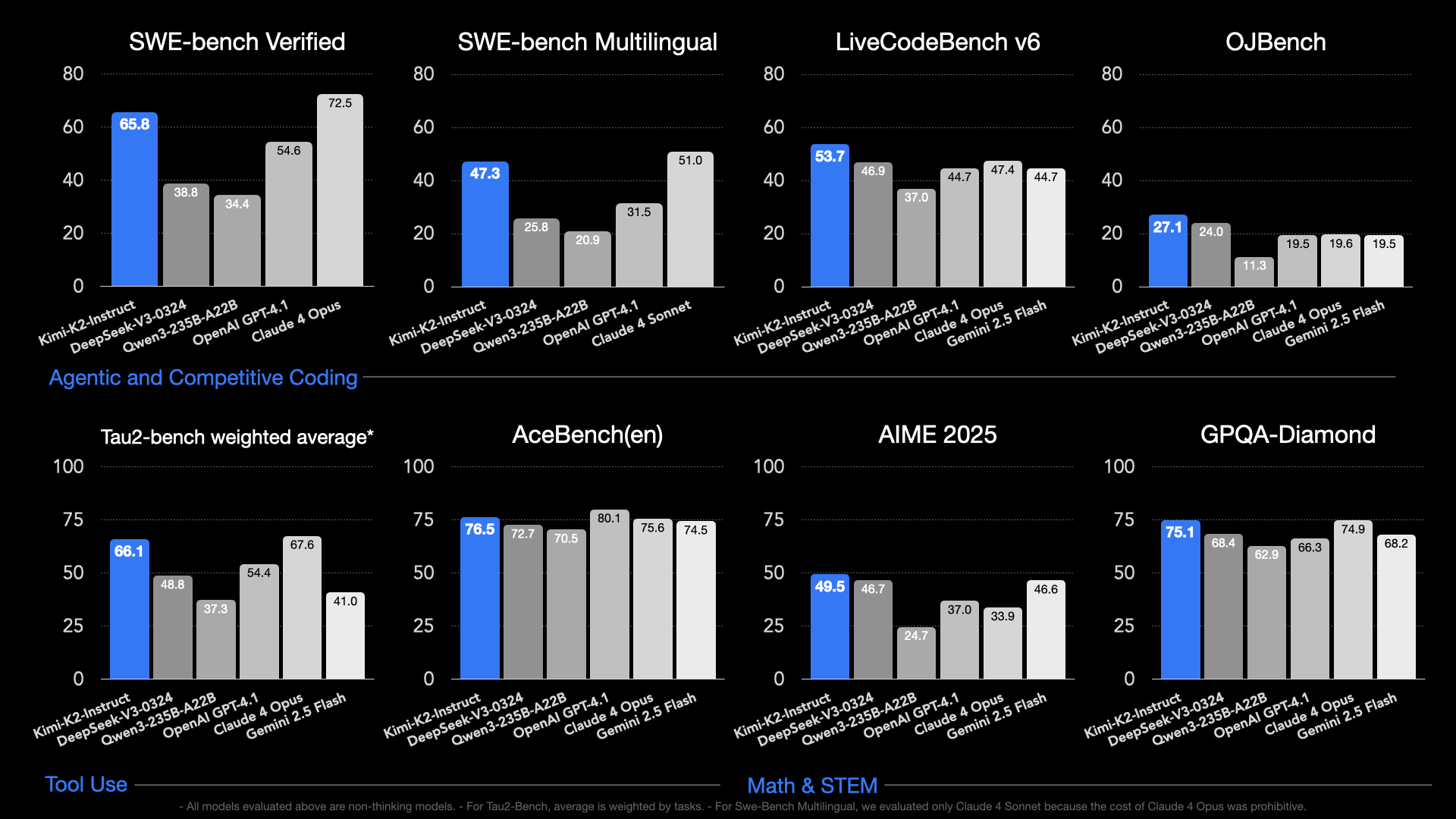 The architecture hasn't changed. K2.7 Code is still a trillion-parameter Mixture-of-Experts model with 32 billion active parameters per token and 384 experts. What Moonshot changed is the reasoning loop itself. The model now writes implementation code directly rather than wrapping existing libraries, which they claim produces more general solutions across Rust, Go, and Python. On their internal benchmarks, this translated to a 21.8% improvement on Kimi Code Bench v2 and a 31.5% jump on their multi-language eval. The 256K context window stays the same, with automatic compression for longer sessions. Moonshot documented unattended runs exceeding 12 hours and 4,000 tool calls without losing coherence, which is the kind of stat that matters for production agent loops.
The tool-calling numbers are worth highlighting. K2.7 scores 81.1% on MCPMark Verified, a benchmark for tool invocation accuracy. That's ahead of Claude Opus 4.8 at 76.4%. For agent workflows where the model needs to call APIs, read files, and chain operations reliably, that gap matters more than a SWE-Bench point. A model that invokes the right tool correctly on the first try saves more tokens than one that reasons its way to a wrong tool call and has to retry.
Here's where it gets interesting. Moonshot did not submit K2.7 Code to DeepSWE, an independent coding benchmark that produces a 70-point spread across models. SWE-Bench, the industry standard, only spreads 30 points. A developer who built a model routing system using DeepSWE as his reference signal called Moonshot out directly: "Respectfully, every model 'improves' double digits on its own test suite." The VentureBeat coverage noted that researcher Elliot Arledge tested K2.7 on KernelBench-Hard and found the model was "more honest" (writing its own kernels instead of using wrappers) but actually regressed on MoE kernel tasks, dropping from 0.222 to 0.157. That regression on its own specialty is a harder pill to swallow than missing an external benchmark.
The pricing tells a different story. At $0.95 per million input tokens and $4.00 per million output tokens, K2.7 Code undercuts Claude Fable 5 ($10/$50) by an order of magnitude. For a typical agentic session involving 50K input tokens, 10K reasoning tokens, and 5K output tokens, the cost is roughly $0.07 per API call. If the 30% token reduction is real, that rewrites the economics for teams running thousands of agent loops daily. The high-speed variant pushes output to 180-260 tokens per second, which matters when you're chaining tool calls in an agent loop and latency compounds. At those speeds, the model can complete a multi-file refactor in the time it takes Claude to finish its reasoning phase.
GitHub Copilot picked up K2.7 Code for general availability, which is the most concrete validation the model has gotten. Cloudflare also added it to Workers AI. Both integrations matter because they put the model in front of millions of developers who weren't going to self-host a trillion-parameter MoE on vLLM. The OpenAI-compatible API means teams currently running K2.6 can swap the base URL and A/B test without architectural changes. One Reddit user on r/GithubCopilot noted the model has "an elevated hallucination rate" compared to more conservative models, which GitHub flagged in their announcement. That's a meaningful caveat for anyone considering it as a default.
The honest take: K2.7 Code is a budget play, not a frontier model. It scores well on Moonshot's internal evals, but independent validation on DeepSWE is missing. The hallucination rate dropped from K2.6's 65% to 39%, which is a real improvement but still means roughly one in three generations hallucinates something. For boilerplate-heavy refactoring, multi-language migrations, and high-volume agentic loops where cost per task is the binding constraint, this is probably the best price-performance ratio available. For architectural decisions or anything where a hallucination costs you a production incident, you still want Claude or GPT.
The 30% token reduction is the most interesting signal here, even if the benchmarks are self-reported. If true, that alters the calculus for teams choosing between running Claude Code at $15/M tokens or K2.7 Code at $0.95/M. The model doesn't need to beat Claude on SWE-Bench to matter. It just needs to be good enough at 1/15th the price, and for the right workload, it is. The real test isn't a leaderboard number. It's whether teams actually switch their production routing tables to include it.
Sources
- Moonshot AI Kimi K2.7 Code on Hugging Face: open weights, Modified MIT license, deployment guides
- Kimi K2.7 Code Platform Documentation: API specs, pricing, and integration guides
- VentureBeat: Practitioners say benchmarks don't check out: independent critique of self-reported numbers
- Cloudflare Workers AI: K2.7 Code available: deployment on Cloudflare infrastructure
- Jake Handy's Model Drop analysis: detailed pricing and benchmark breakdown
- Kimi K2.7 on VM0: benchmark and pricing: SWE-bench Pro scores and hallucination rate data