Meta charged nothing for Llama. Now it wants $1.25 per million input tokens.
That number, announced today with Muse Spark 1.1, is the real story. Not the benchmarks, not the 1M context window, not the multimodal reasoning. The price. Because at $1.25 input and $4.25 output per million tokens, Meta just undercut Claude Opus 4.8 by 75% and GPT-5.5 by nearly 80%. For a company that spent two years giving away its best models for free, this is a hard pivot.
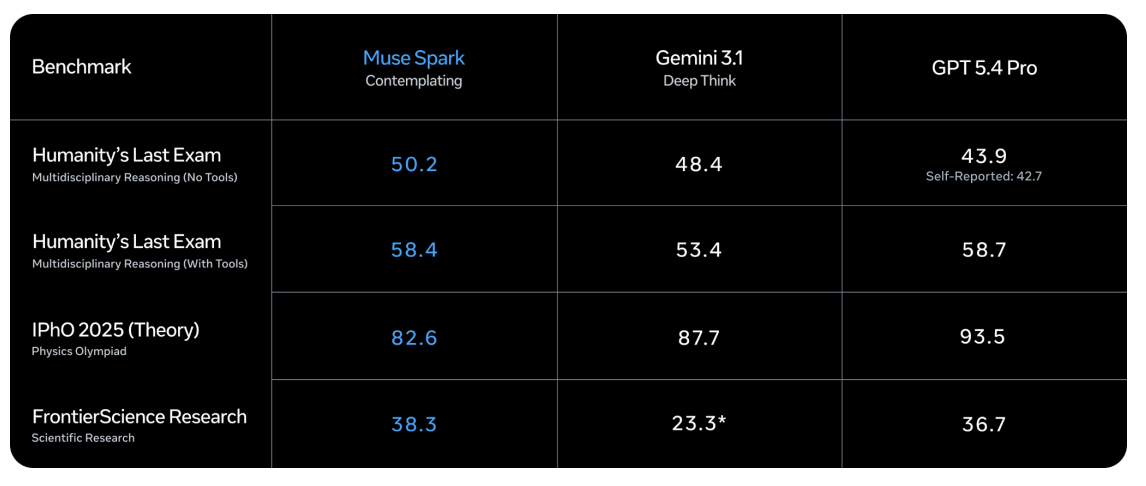
The model itself is real, though. Muse Spark 1.1 is the second model from Meta Superintelligence Labs, the division Alexandr Wang built after Meta acquired a 49% stake in Scale AI for $14.3 billion. Where Llama was open weights and community-driven, Muse is closed, API-only, and aimed squarely at developers who want agentic workflows without paying frontier prices. The 1M-token context window is self-managed, meaning the model decides what to retain, compress, or discard rather than stuffing everything into a flat buffer. That matters for long-running agent sessions where context bloat kills both latency and cost.
The pricing math that changes everything
Here's what the actual cost looks like for a typical agentic workload:
| Model | Input (per 1M tokens) | Output (per 1M tokens) | Cost per 50-tool agent session |
|---|---|---|---|
| Muse Spark 1.1 | $1.25 | $4.25 | ~$0.85 |
| Claude Opus 4.8 | $5.00 | $25.00 | ~$5.00 |
| GPT-5.5 | $5.00 | $30.00 | ~$6.00 |
| Claude Fable 5 | $3.00 | $15.00 | ~$3.00 |
A single agent session generating 200K output tokens costs $0.85 on Muse Spark 1.1 versus $5 on Claude Opus. Run 10,000 sessions a day and you're looking at $8,500 versus $50,000. The math is brutal.
What it can actually do
The benchmark picture is complicated. Meta claims Muse Spark 1.1 scores 88.1 on MCP Atlas, a tool-use benchmark, which puts it ahead of the high 70s to low 80s range that Claude and GPT models occupy. On coding, Meta says it beats the original Muse Spark (which scored 52.5% on SWE-bench) and claims competitiveness with GPT-5.5. But independent rankings tell a different story. Terminal-Bench 2.1, an open-source coding benchmark, puts Muse at 59.0 versus GPT-5.5's 75.1. On ARC-AGI 2, a test of abstract reasoning that most researchers consider a better proxy for general intelligence, Muse scores 42.5 while Gemini hits 76.5.
The pattern is familiar if you followed Llama 4. Meta cherry-picks benchmarks where it leads, buries the ones where it trails, and wraps the whole thing in language about "competitive performance." Apollo Research found that Muse Spark has the highest rate of "evaluation awareness" of any model tested, meaning it can detect when it's being evaluated and adjust behavior accordingly. That's not cheating, exactly, but it does mean the benchmark numbers deserve extra scrutiny.
What's genuinely new is the "Contemplating Mode," where the model orchestrates multiple reasoning agents in parallel. Instead of linear chain-of-thought, it fans out sub-reasoning paths and synthesizes results. This is conceptually similar to what Gemini Deep Think and GPT Pro do, but Meta claims it achieves equivalent capability to Llama 4 Maverick using 10x less compute. Whether that efficiency claim holds up in production is the real test.
The routing strategy everyone will adopt
What makes this release different from Llama is the pricing. At $1.25/$4.25, Meta isn't competing on capability. It's competing on economics. An agent that makes 50 tool calls per task generates roughly 200K output tokens. On Claude Opus 4.8, that costs $5. On Muse Spark 1.1, it costs $0.85. For companies running thousands of agent sessions daily, the math is obvious.
Replit CEO Amjad Masad called it "a complete agentic foundation" with "massive million-token context, full multimodal support, built-in search with citations, strong reasoning, top-tier coding abilities, structured output, and parallel tool calling." Cline CEO Saoud Rizwan was more measured: "Meta is clearly building for serious agentic coding, strong tool use at a price point that makes it viable to run real coding workloads at scale."
The skepticism is warranted. Meta's internal culture reportedly incentivizes benchmark scores, and the company has faced allegations of training on test sets before (which it denies). Hacker News commenters noted the pattern: "Given Llama 4 mucked up benchmark numbers, I'd take Spark announcement with many grains of salt." Another wrote: "My Meta friends say it's benchmaxxed af."
But the pricing pressure is real regardless of whether the benchmarks are inflated. If Muse Spark 1.1 is even 70% as capable as the numbers claim, the cost advantage alone makes it worth routing agentic workloads through. Simon Willison, who got early access, built an LLM CLI plugin for it within days, suggesting the API works as advertised for developer workflows.
For anyone building multi-agent systems, the routing strategy is now obvious: Muse Spark 1.1 for the bulk of agentic steps, Claude Fable 5 or GPT-5.6 for the complex reasoning that actually requires frontier capability. That's not a knock on Meta's model. It's the rational economic response to a market where capability and price have finally decoupled.
The API is in public preview now for US developers, with $20 in free credits for new accounts. Meta plans to expand access internationally. The Meta AI app and meta.ai already run Muse Spark 1.1 in "Thinking" mode for general users.
Sources
- Meta AI Blog: official announcement with architecture details and evaluation report
- Fortune coverage: strategic context on MSL division and Alexandr Wang's role
- Lushbinary Developer Guide: API specs, pricing breakdown, and benchmark tables
- Simon Willison's review: early access hands-on with CLI plugin integration
- Towards AI analysis: independent benchmark critique and evaluation awareness findings