ByteDance did not make Seedance 2.5 interesting by adding another vague promise about cinematic quality. The useful change is more mechanical: one generation can now run for 30 seconds, and the model can take a pile of references before it starts. That attacks the two parts of AI video work that waste the most time, broken continuity and endless re-rendering.
The model was announced on July 31 and is rolling out through Jimeng AI, Doubao Pro, and other ByteDance surfaces, with API access planned through BytePlus ModelArk. Hacker News picked up the official post on August 1. The thread had only seven points when checked, which is a useful reality check: this is fresh, not a settled industry consensus.
The boring numbers matter most
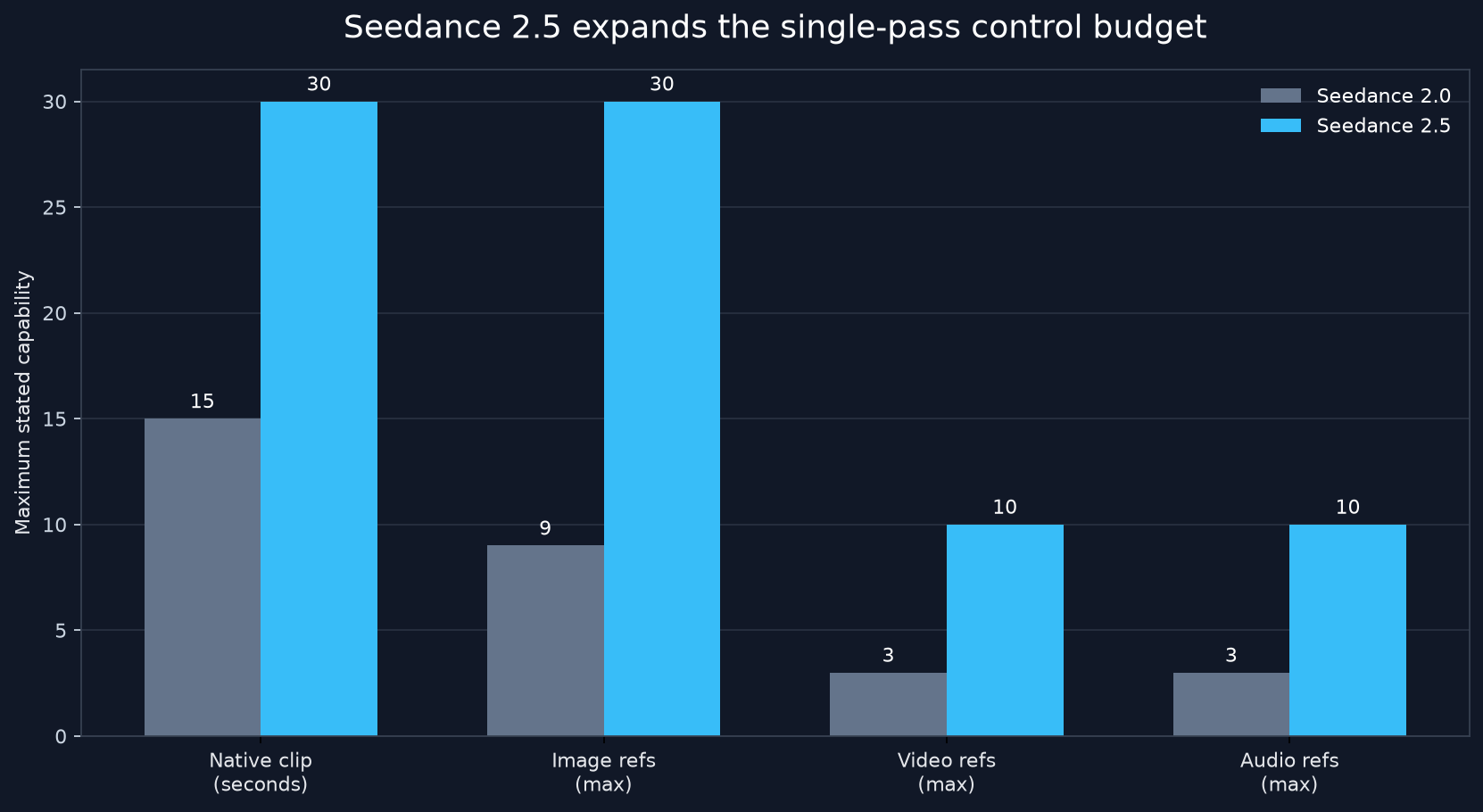
Seedance 2.5 doubles the stated single-pass length: 15 seconds became 30 seconds. That sounds like a bigger number on a product page. In practice, it changes the editing problem. A 30-second scene can contain a setup, a turn, and a payoff without forcing the creator to stitch together four separate clips. Every stitch is a chance for a face, room, costume, or light source to drift.
ByteDance also says the model accepts up to 30 images, 10 video clips, and 10 audio clips in one request. The references can describe different jobs: a character sheet, a location, a prop, a motion path, a camera move, a voice, or the sound of the finished scene. A clay render can provide blocking and camera geometry while another image supplies materials and lighting. That is a much more practical control scheme than repeating the same text prompt and hoping the model remembers what the last version looked like.
The comparison is stark:
| Capability | Seedance 2.0 | Seedance 2.5 stated limit |
|---|---|---|
| Single-pass video | 15 seconds | 30 seconds |
| Image references | 9 | 30 |
| Video references | 3 | 10 |
| Audio references | 3 | 10 |
These are launch specifications, not independent benchmark results. ByteDance has not published a neutral evaluation that proves the model keeps a character stable for every second of a complicated scene. The company has shown examples and described improvements in shot transitions, motion, audio synchronization, texture, skin, eyes, lighting, and color. That is enough to explain the target. It is not enough to call the problem solved.
The model is becoming an editor
The more revealing feature is timestamp-level editing. Seedance 2.5 is meant to accept instructions that target a particular slice of a clip, changing a character, action, camera move, or plot detail while preserving what happens before and after it. It also supports green-screen replacement, camera-perspective edits, and reference-based edits.
This matters because generation and editing are now colliding. A creator may get a good 20 seconds but hate the camera move between seconds 11 and 14. The old workflow regenerates the whole clip, then compares versions. A usable timestamp editor lets the creator keep the good material and repair the bad part. If the continuity claims hold, the model is closer to a rough post-production assistant than a prompt-to-video slot machine.
The reference system points in the same direction. ByteDance's own examples use a single request to combine several performers, a venue, instruments, an orchestra, and audience seating. Another example uses a textureless 3D scene to specify the camera path and actor positions, then asks the model to render a polished animated shot. That is the workflow film people already understand: block the scene first, then decide how it should look.
There is a catch. More references do not automatically create more control. They create more ways for the model to misunderstand which reference matters at which moment. A production tool needs predictable precedence rules, useful error messages, and a way to inspect what the model actually used. The official announcement explains what can be supplied, but not how conflicts are resolved when the tenth image disagrees with the first one.
What creators should test before trusting it
The right first test is not a beautiful one-take demo. It is a deliberately annoying scene. Use two characters with different clothing, a location with readable signage, an object that changes state, and a camera move that passes behind something. Ask for dialogue and a specific sound effect. Then extend the result by another 30 seconds. Check faces, hands, text, lighting direction, object identity, and audio sync at the extension boundary.
That test will expose the difference between a longer clip and a better production primitive. A longer clip with one broken hand at second 23 is still a broken clip. A reliable extension with stable characters could remove hours of stitching and cleanup from short-form production.
Early community coverage is enthusiastic but cautious. A Reddit search surfaced users framing the release around the same three numbers ByteDance leads with, 30-second single takes, 50 multimodal references, and native 4K. Another discussion had treated the upcoming release as a possible competitor-killer before public access was available. Those reactions are useful as demand signals, not evidence. The first independent tests need to probe hard cases instead of replaying launch prompts.
The pricing question is also unresolved at the official level. A third-party playground currently lists 480p output at $0.30 per second and 720p at $0.80 per second, but those are provider rates rather than a BytePlus price sheet. At those numbers, a 30-second 720p draft would cost $24 before retries or reference-video charges. That is cheap enough for professional iteration only if the first-pass hit rate is high. If creators need ten attempts to get one clean take, the duration advantage disappears into the bill.
Seedance 2.5 is therefore less interesting as a prettier video generator than as a bet on continuity. ByteDance is pushing the model toward a single creative workspace where references, blocking, audio, generation, extension, and targeted repair happen around the same scene. The bet is sensible. The hard part is still the same one every video model faces: can it keep the details that humans notice after the novelty wears off?
Sources
- ByteDance Seedance 2.5 announcement: official launch details, reference limits, editing features, and access
- Seedance 2.5 project homepage: official product information
- Hacker News discussion: early community reaction to the launch
- PiAPI Seedance 2.5 playground: third-party API contract and indicative provider pricing
- Reddit Seedance 2.5 discussion: early user reaction and feature discussion