A general LLM is a strange thing to put in the middle of a production if statement. You ask it to classify a ticket, route a request, or decide whether an invoice needs review. It writes a little paragraph. Then your code tries to recover the decision from that paragraph without getting surprised by punctuation, missing fields, or a confident answer that should have been a handoff.
TypeSafe AI is attacking that mismatch from the other side. Its first System One model, Jev, does not generate prose. You give it a state and a set of typed questions. It returns choices, scores, yes-or-no values, probabilities, and confidence that your program can consume directly. The pitch is less "a smarter chatbot" and more "a fast judgment function for software."
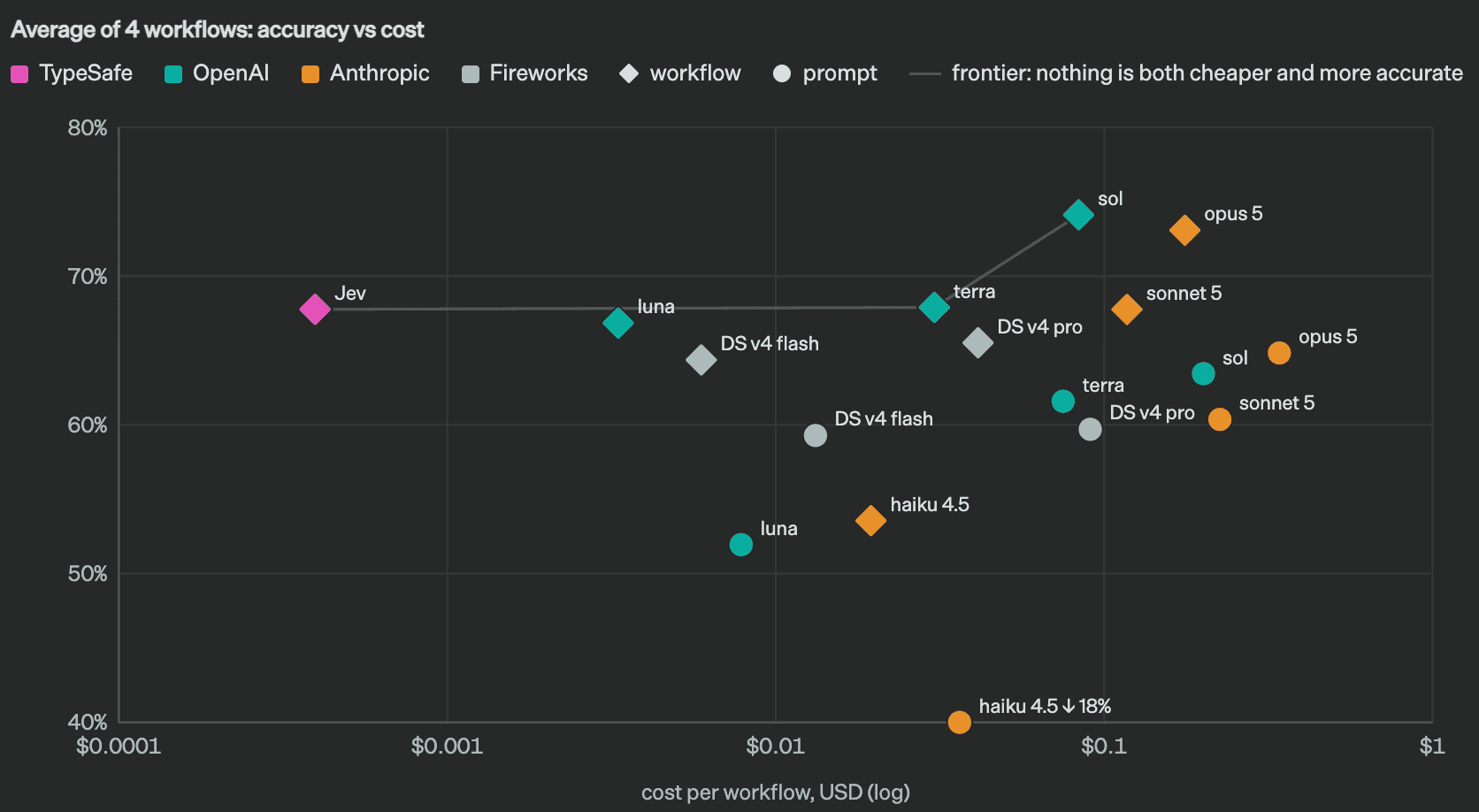
That distinction matters, but the launch numbers need a skeptical reading. TypeSafe lists Jev at $0.042 per million input tokens, with output priced at zero, and gives a 70ms-500ms end-to-end service latency. Its launch post also claims roughly 40x to 200x lower latency and up to 444.6x lower cost on its workflow evaluations. Those are attractive numbers. They are also not a reason to replace every model call you own.
The useful question is narrower: when should a developer put a typed decision model in front of a larger language model, and when should they keep using ordinary code or strict JSON output?
The decision matrix
Start with the job, not the model. Jev is a fit when the output space is known before the request arrives. Route a support ticket to billing, technical support, or sales. Score fraud evidence. Decide whether an agent trace needs human review. Pick one of several approved actions. Those are decisions with a bounded vocabulary, even when the input is messy natural language.
A general LLM remains the better tool when the answer itself is the product. Drafting an email, writing code, explaining a contract, extracting an unfamiliar schema, or planning a long multi-step operation needs generated text and open-ended reasoning. Deterministic code wins when the rule is already explicit. Do not pay for a model to compare two timestamps or add invoice lines.
| Situation | Best first layer | Why |
|---|---|---|
| Fixed labels and messy text | Jev or another classifier | The program receives a typed choice and uncertainty |
| Known arithmetic or policy rule | Ordinary code | The rule is cheaper and easier to audit |
| Open-ended explanation or drafting | General LLM | Text generation is the actual output |
| High-risk action with ambiguous evidence | Jev plus human review | Confidence can gate the handoff |
| Unknown task shape | General LLM during discovery | You need to learn the decision space first |
The model's interface encourages a different design. TypeSafe documents 3 primitives: Choice, Score, and Noul. A Choice selects from labels. A Score places the state on a rubric. Noul answers whether a statement is true on a 0 to 1 scale. Questions run independently against the same state, so adding narrow questions does not create a longer chain of generated text.
That lets the application own the control flow. Instead of asking one large prompt to "understand this customer and decide what to do," ask separate questions about intent, urgency, frustration, account risk, and complexity. Then let ordinary code combine the results. If the business changes the weighting between urgency and account risk, you change a coefficient or branch in the program. You do not rewrite a paragraph prompt and hope the model still follows it.
The confidence field is the part I would pay attention to. TypeSafe returns the full probability distribution for Choice and Score answers, plus a confidence value derived from it. The documentation suggests three paths: act automatically on high confidence, ask for confirmation or gather more information in the middle, and route to a person when confidence is low. The thresholds must scale with the damage of a wrong decision. Showing the wrong help article is recoverable. Approving a transfer or disabling an account is not.
A small routing layer could look like this:
response = client.system_one(
    state=ticket,
    questions={
        "intent": Choice(
            instructions="What does the customer want?",
            criteria={
                "order_status": "Track an order",
                "product_question": "Ask how a product works",
                "complaint": "Report a serious problem",
            },
        ),
        "risk": Score(
            instructions="How risky is an automatic response?",
            criteria=["Low", "Medium", "High"],
        ),
    },
)

intent = response.answers["intent"]
risk = response.answers["risk"]

if intent.confidence < 0.5 or risk.score >= 2:
    return route_to_human(ticket)
if intent.choice == "order_status":
    return handle_order_status(ticket)
return handle_with_specialist_llm(ticket)
The point is not the exact threshold. TypeSafe's own docs say thresholds should be tested against your data and raised for high-risk actions. The point is that uncertainty becomes a value your code can inspect instead of a sentence buried in a model response.
The failure modes
The biggest catch is that Jev needs a well-defined workflow. You have to know what questions to ask, what labels mean, which signals deserve a separate question, and how the answers combine. TypeSafe's docs explicitly recommend decomposing broad judgments into atomic questions. That is good engineering, but it transfers work from prompt writing into schema and workflow design.
This can be a win if you own a real process. It can be a trap if you are still discovering what the process is. A startup with ten support categories and no stable policy may get more value from a general model and a review queue first. Once the categories stop changing, a typed decision layer becomes easier to justify.
The second catch is evidence quality. TypeSafe's public workflow evaluations compare Jev with other models across four example workflows, including security incidents, invoice processing, and customer service. The site says every model receives the same workflow and that the reference labels come from an average of GPT-6 Astra and Claude Fable 5.1 at high thinking. That is a useful systems comparison, because it measures an actual decision graph instead of a single prompt. It is still a vendor-designed test against model-generated reference answers, not an independent ground-truth benchmark.
The launch post admits as much. The workflow examples were produced by TypeSafe's model capabilities team, so some selection bias may remain. The company also says the headline 193.6x speed and 444.6x cost gains are likely toward the high end of real-world results. Treat those figures as an upper-bound signal, not a budget forecast.
There is a third limitation hiding inside the phrase "cannot hallucinate." Jev can avoid type errors because the available output structure is defined in advance. That does not make the underlying judgment true. A typed answer can still be wrong. A probability distribution can still be poorly calibrated on your domain. The guarantee is about the shape of the response, not the correctness of the business decision.
Run a small shadow evaluation before moving a live branch. Save the input state, the Jev answer, its probabilities, the action your current system took, and a human verdict. Compare it with your current LLM or rules over a few hundred representative cases. Measure the things the vendor cannot know for you: false approvals, unnecessary escalations, latency at your region, and cost per completed workflow. If the model is only cheaper because your old system was asking a frontier model to do arithmetic, the right fix may be ordinary code.
Where I would deploy it
I would not start with a chatbot. I would put Jev in front of one expensive, repetitive decision path where the output labels are stable and the next action is already understood. Customer-support triage is a clean first test. So is routing agent traces for review, screening invoices before a human payment queue, or deciding which specialist model should see a request.
The architecture would be a three-stage funnel. Code handles facts and policy rules. Jev handles bounded semantic judgments and emits confidence. A larger model or a human handles the cases that need language, broad reasoning, or escalation. That split makes the expensive model a specialist instead of the default reflex.
TypeSafe's own examples point in this direction. The security workflow asks a series of narrow questions before choosing whether to close, queue, or contain an incident. The invoice workflow computes sums, dates, and statuses in code, then asks the model about document meaning and policy conditions. The customer-service workflow classifies intent, frustration, urgency, and risk before code applies the order of operations. Those are sensible boundaries because software remains in charge of the final branch.
The practical test is simple. If you can write the possible answers on a whiteboard and explain what the program should do for each confidence band, Jev is worth a trial. If you cannot describe the output without saying "it depends, and let the model figure out the rest," stay with a general LLM while you learn the shape of the task.
Jev is interesting because it attacks an unglamorous part of AI systems: the conversion between fuzzy language and hard software state. The model is giving up the thing that made chatbots popular, free-form text, to make a narrower promise that production code can actually use. That is a trade, not magic. For the right workflow, it may be the trade that finally makes continuous AI classification cheap enough to run everywhere.
Sources
- TypeSafe launch post for System One and Jev: pricing, latency, architecture, workflow evaluation methodology, and caveats
- TypeSafe System One documentation: typed outputs, API shape, and the boundary between System One models and LLMs
- TypeSafe documentation introduction: Choice, Score, and Noul primitives with parallel question evaluation
- TypeSafe confidence guide: probabilities, confidence thresholds, and risk-gated routing
- TypeSafe workflow evaluations: structured workflow comparisons across security, invoice, and customer-service tasks
- TypeSafe Python adapter: a compatibility layer for comparing System One workflows with LLM APIs