You pick a $20 coding agent. By Friday you are on the $200 tier. You still need three more tools.
That is the current state of AI coding in 2026. Ninety-two percent of developers use these tools now. Fifty-one percent of commits on GitHub have AI fingerprints. The market hit $12.8 billion and nobody is happy about what they are paying.
The problem is not the tools. They are genuinely good. The problem is the pricing trap. every vendor advertises an entry tier that collapses the moment you do real work.
The price tags versus what you actually pay
Every coding tool has a pricing page that tells a neat story. The real story starts where the tier ends.
The $10 tier. GitHub Copilot at $10/mo gives unlimited basic autocomplete. It works everywhere and 90% of Fortune 100 companies use it. But it does not do multi-file refactors. It does not plan architecture. It is a safety net, not an agent.
The $20 tier. Cursor Pro ($20), Claude Code Pro ($20), Windsurf ($15). This is where most developers start and where most developers get stuck. Cursor gives you 500 "fast requests" before you fall into slow mode. Claude Code gives you Sonnet but not Opus. Windsurf is the most generous here with unlimited Cascade flows.
The $200 convergence. Claude Code Max, Cursor Ultra, ChatGPT Pro all converge around $200/mo for "effectively unlimited" frontier model access. This tier is where heavy users end up. The pricing pages do not advertise this as inevitable, but the data says it is.
A Morph Labs test of 15 coding agents found that only three changed how developers actually work: Claude Code for reasoning depth, Codex CLI for speed, and Cursor for IDE flow. Everyone else is either a niche tool or a worse version of these three.
What each tool is actually good at
The benchmark numbers are interesting but the real question is: what does this thing do when you open it on a Tuesday morning?
Claude Code wins on hard problems. 80.9% SWE-bench Verified with Opus 4.5. It handles multi-file refactors that break Cursor. The 200K token context window lets it reason across entire repos. The cost is the problem. $20/mo gets you Sonnet, but the good stuff needs $150-200/mo.
Codex CLI is the speed champion. 240+ tokens per second. Open-source Rust-based. It handles high-volume edits and boilerplate better than anything else. But its reasoning is shallower than Claude's, and the usage limits can be restrictive.
Cursor owns the IDE experience. 360K paying customers, $29.3B valuation. Its codebase indexing is best-in-class. The Composer agent handles multi-file edits with a 72% acceptance rate. Users report saving 47 minutes daily. The credit system is the catch. when you burn through fast requests, you are waiting on inferior models.
Windsurf is the value pick at $15/mo with unlimited Cascade agent flows. It excels at prototyping and greenfield work. But it struggles with large-scale refactoring and can spike CPU usage to 70-90% during long agent runs.
Cline is the BYOM (bring your own model) option with zero markup and 5 million-plus installs. You pay providers directly. No credit games. But you are managing your own keys and billing alerts.
The "multi-tool" tax
Here is what nobody puts on the pricing page: most productive developers use three tools at once.
An IDE agent for daily work. A terminal agent for hard problems. A safety net for frictionless autocomplete. That is $20 + $20 + $10 minimum. More like $60 if you want Opus-class reasoning on the terminal side.
And the context switching between them carries a cognitive tax. Each tool has its own config format, its own rules file, its own mental model. Cursor rules do not port to Claude's CLAUDE.md. Copilot's enterprise compliance does not help you when you are doing a midnight refactor in Cursor.
The code quality problem
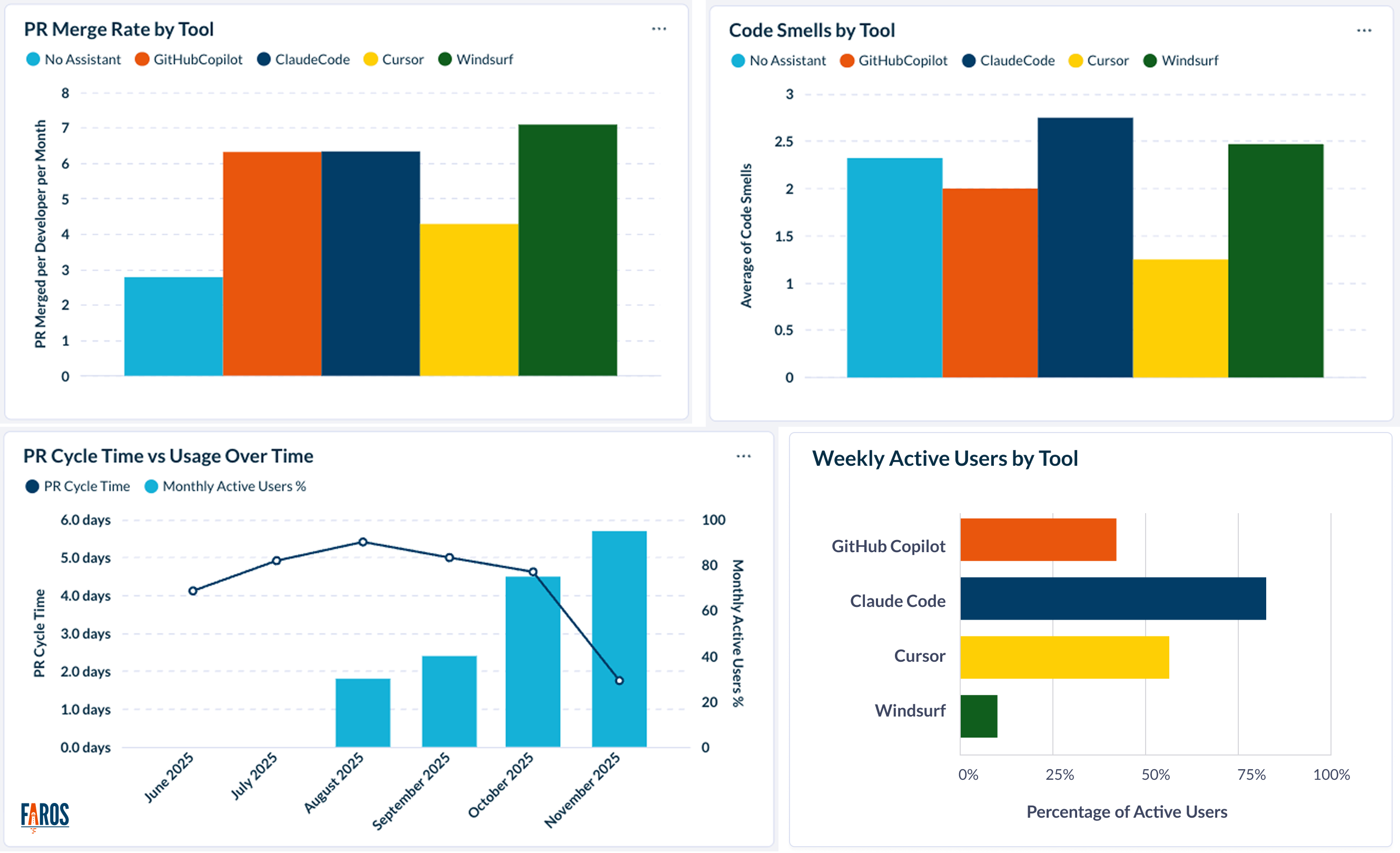
A 2026 study found 14.3% of AI-generated code contained security vulnerabilities, compared to 9.1% for human-written code. Over 90% of "code smells" appeared in AI-generated snippets.
The HN community put it more bluntly in a thread with 461 points and 455 comments asking "do you have any evidence that agentic coding works?" The consensus: agents are like extremely fast junior developers who will do exactly what you asked, including the wrong thing, unless you actively steer them.
The Faros.ai review of developer sentiment found people increasingly worried about "AI-generated debt." The codebase becomes messy, filled with unnecessary code and duplicated files. One developer said they stopped using Copilot entirely and noticed no productivity decrease.
The open-source counter-movement
Tools like Cline, Aider, and Roo Code are gaining ground precisely because they let you bring your own model. No markup, no credit games, no surprise throttling. Aider makes every edit a commit. structured, auditable, reversible. Roo Code prioritizes reliability for large changes.
The BYOM trend is a direct response to the pricing chaos. When Cursor switched to a credit system, developers started looking elsewhere. When Augment raised prices, people left. The open tools do not have flashy demos, but they do not trap you in a subscription either.
So what
The most honest thing I can say about AI coding tools in 2026 is this: they work, but they are priced like they are replacing you instead of helping you.
The $20 tiers are bait. The $200 tiers are where the real work happens. And if you are using three tools to cover all your needs, you are paying $60-200 a month for the privilege of being faster at writing code that you still need to review line by line.
The open-source counter-movement. Cline, Aider, Kilo Code. matters because it gives developers an escape hatch from the credit economy. You pay for the model directly, nothing more. No throttling, no "fast request" accounting.
If you are picking a tool today: start with what you already have. Copilot at $10 does more than most people realize. Only upgrade when you hit a ceiling you can measure in hours, not feelings. And if you are already at $200/mo and still paying for three tools, the problem might not be the tier. it might be the workflow.