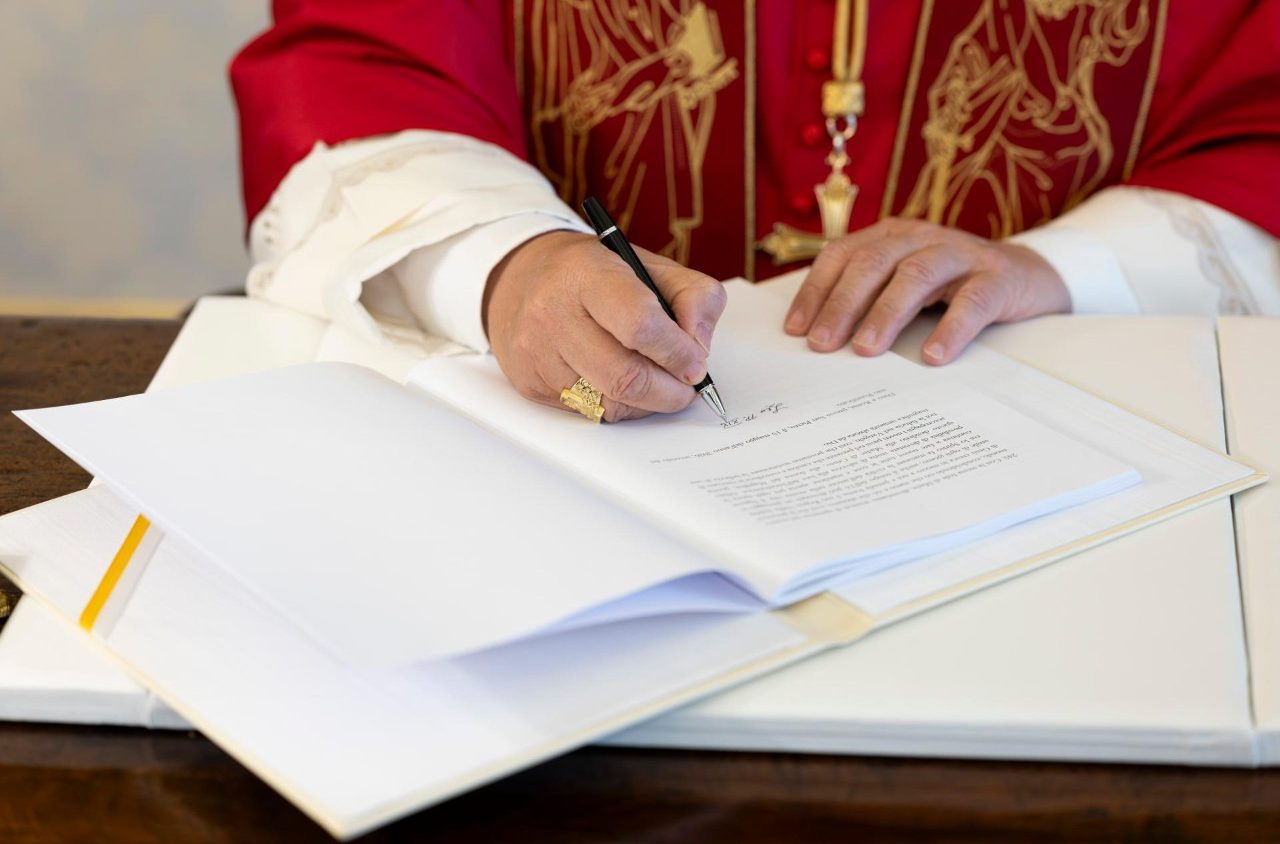
On May 25, 2026, Pope Leo XIV did something no pope has done before. He personally walked into the Vatican Synod Hall alongside a 33-year-old atheist AI researcher to present a 42,300-word document that may end up shaping how the world governs artificial intelligence for the next decade. Unlikely is an understatement.
The encyclical is called Magnifica Humanitas (subtitled "Magnificent Humanity"), and it draws a direct line between the Industrial Revolution of 1891 and the AI revolution of today. Pope Leo XIII's Rerum Novarum became the foundational text of modern Catholic social teaching on labor. Leo XIV is aiming for the same weight with AI. And he brought Anthropic co-founder Christopher Olah to help make the case.
What the encyclical actually says
The document is sweeping. Here are the four pillars that matter most:
Labor and the economy: The Pope argues that employment is a "primary good" for society and that the market's invisible hand isn't enough in the age of AI. Governments must intervene to ensure benefits are shared. The specific language is pointed: "The pursuit of greater profits cannot justify choices that systematically sacrifice jobs, because the human person is an end, not a means."
Warfare and autonomous weapons: The most concrete policy demand. The Pope calls for an international framework to ban lethal autonomous weapons entirely: "Deployment of lethal force cannot be automated." He demands an "identifiable chain of responsibility" for anyone who designs, trains, or authorizes AI in conflict.
Democracy and disinformation: AI is a "powerful amplifier" for misleading content. The Pope warns that "indifference to the truth leads, slowly but surely, to a descent to totalitarianism." He calls on tech leaders to prioritize human dignity over engagement metrics.
Data as the new colonialism: This is perhaps the sharpest angle. The Pope describes the appropriation of genetic data, health records, and demographic information by wealthy tech firms as "the new face of colonialism," treating human information as "the new rare earths of power."
The Anthropic play
Chris Olah didn't just show up. His speech at the Vatican was the most direct acknowledgment by a frontier-lab founder that his own industry cannot be trusted to self-regulate.
"Every frontier AI lab , including Anthropic, operates inside a set of incentives and constraints that can sometimes conflict with doing the right thing," Olah said. He listed the pressures: commercial deadlines, geopolitical competition, the ego of building impressive systems. "That is why, if we want this technology to go well, it is enormously important that there be people outside those incentives."
He also made a remarkable admission about labor displacement: that AI dislodging employment at "very large scale" is a "real possibility," and that "supporting those displaced will be a moral imperative of historic proportions."
This is the same company currently raising $30 billion at a $900 billion valuation. The same company that pays SpaceX $1.25 billion per month for compute access. The cognitive dissonance is the point: Olah is saying that even with all that power and money, the incentives inside Anthropic's walls are not aligned with what society needs.
Why the Vatican, why now
The Vatican's choice of Anthropic as its AI interlocutor is strategic. Interpretability, the discipline of understanding what models are actually doing internally is Olah's specialty. The Pope is essentially endorsing the view that the most important question about AI is not how fast we can ship it, but whether we can understand what we're shipping.
Olah provided a vivid frame for this: "AI systems are not engineered the way a bridge or an airplane is engineered. They are grown, on a structure roughly modeled after the brain, on an enormous inheritance of human thought and speech."
If you can't engineer them from first principles, you can't fully control them. And if you can't control them, you need external governance, not just internal "safety teams" that report to the same CEO pushing for growth.
The Forbes analysis of the event put it bluntly: "The Vatican picked Anthropic as the AI industry's moral interlocutor. That's the story." Legislators in Catholic-majority countries (Italy, Poland, Brazil, the Philippines) are expected to use the encyclical as a moral mandate for aggressive AI regulation. The "legitimacy race" in AI just got a new frontrunner.
What surprised me
Two things.
First, the specific policy demands are refreshingly concrete for a document from a religious institution. An international ban on autonomous weapons. Mandatory retraining funds for displaced workers. Age-verification and child-safety requirements. This is not a vague "we should be careful" statement. It's a 42,300-word regulatory blueprint.
Second, the timing is brutal for big tech. This lands in the same week that SpaceX filed its S-1 (revealing $2.47 billion in operating losses from SpaceXAI), that OpenAI filed its confidential S-1 (with a $30 billion annual burn rate), and that Anthropic is closing its $30B round. The entire industry is racing to public markets, and the Vatican just published a document that questions whether any of these companies should be trusted to build AI without external oversight.
The Pope's closing frame stuck with me: "Disarming AI means freeing it from the mentality of armed competition, which today is not limited simply to the military context, but is also an economic and cognitive phenomenon."
We are watching a moral framework for the next decade being written in real time. Whether you're Catholic or not, this document will shape AI regulation in ways your tools will feel.
Sources
- Full text of Magnifica Humanitas: https://www.vatican.va/content/leo-xiv/en/encyclicals/documents/20260515-magnifica-humanitas.html
- Anthropic's Chris Olah's remarks at the Vatican: https://www.anthropic.com/news/chris-olah-pope-leo-encyclical
- The Next Web: Olah says AI cannot be steered by AI labs alone: https://thenextweb.com/news/anthropic-olah-vatican-ai-oversight-big-tech
- Forbes: The Vatican picked Anthropic as the AI industry's moral interlocutor: https://www.forbes.com/sites/gabrielalinzainescu/2026/05/25/the-vatican-picked-anthropic-as-the-ai-industrys-moral-interlocutor-thats-the-story
- NCR: 8 things to know about Pope Leo XIV's sweeping AI manifesto: https://www.ncronline.org/news/8-things-know-about-pope-leo-xivs-sweeping-ai-manifesto
- KOSU/NPR: Pope Leo takes aim at big tech in sweeping encyclical on AI: https://www.kosu.org/religion/2026-05-25/pope-leo-takes-aim-at-big-tech-in-sweeping-encyclical-on-ai
- Build Fast with AI: AI News May 24, 2026: https://www.buildfastwithai.com/blogs/ai-news-today-may-24-2026
- Vatican News: Magnifica Humanitas released: https://www.vaticannews.va/en/pope/news/2026-05/pope-leo-xiv-encyclical-magnifica-humanitas-ai.html
- The Guardian: Pope Leo to issue text on human dignity and AI: https://www.theguardian.com/world/2026/may/18/pope-leo-encyclical-human-dignity-ai-anthropic