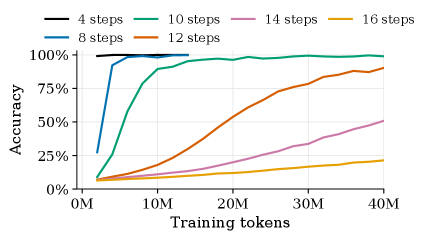
Have you ever spent hours feeding an LLM context, only for it to forget half of what you told it by the time it reaches the end? The usual fix is bigger context windows: 128K, 1M, even 10M tokens. But that just masks the underlying problem. Attention doesn't scale, and even hybrid models that fix the memory problem still can't reason deeply about what they remember.
A new paper with the irresistible title "Language Models Need Sleep" suggests a completely different approach. Instead of trying to cram more tokens into a single forward pass, let the model consolidate what it has seen and then forget the raw context. The results on long-horizon reasoning tasks are surprisingly good, and the biological metaphor, however controversial, points at something real about how computation and memory interact in transformer architectures.
The Problem
Standard transformers handle long contexts poorly for two separate reasons. First, full self-attention scales quadratically with sequence length, making billion-token contexts computationally infeasible. Second, even efficient alternatives like sliding-window attention (SWA) or state-space models (SSMs such as Mamba), which solve the compute scaling problem, suffer from a subtler failure: they can store the information but can't do anything useful with it.
The authors formalize this as a reasoning depth problem. In a hybrid SSM-attention model, the SSM layers are good at compressing long-range context into a compact hidden state. But compressing and reasoning are not the same thing. When the model needs to perform multi-step inference over evicted context, say tracking a chain of logical dependencies across 16 hops, the single forward pass through the SSM simply does not have enough sequential computation to resolve it.
Think of it this way: an SSM can memorize a phonebook, but it cannot trace a social network through the phonebook without multiple passes over the data.
The "Sleep" Mechanism
The proposed solution is elegantly simple. When the context window fills up, instead of dropping the old tokens, the model enters a "sleep" phase:
- Consolidation: The model performs N recurrent offline passes over the accumulated context.
- Fast weight update: Each pass updates the SSM block's fast weights through a learned local rule.
- Cache eviction: After consolidation, the KV cache is cleared. The model forgets the raw tokens.
- Continue: The model wakes and processes the next context window.
Architecturally, this means adding a recurrent loop to the model's forward pass:
Embed -> [Battn -> Bssm -> ... -> BD-1attn] x N -> OutProj
During sleep, the model cycles through its own layers multiple times (controlled by N), converting transient context into persistent weight adjustments. During inference, prediction happens in a single forward pass, maintaining low latency.
This is conceptually similar to hippocampal replay in biological brains, where memories are consolidated during sleep by replaying the day's experiences. The paper does not overplay the analogy, but it is hard to miss.
Benchmarks
The authors tested on three categories of tasks.
Synthetic: Rule 110 (Cellular Automata)
The model must predict the next state of a one-dimensional cellular automaton after observing a sequence of steps. This requires tracking long-range causal dependencies.
| N (sleep passes) | Accuracy (shallow) | Accuracy (deep) |
|---|---|---|
| 1 (no sleep) | 94% | 31% |
| 2 | 96% | 52% |
| 4 | 97% | 73% |
| 8 | 98% | 81% |
The gap between shallow and deep reasoning nearly triples the accuracy gap closed by adding sleep passes. The 1-pass baseline is barely better than random on deep instances.
Synthetic: Depo (Multi-Hop Graph Retrieval)
The model must retrieve a value after traversing a chain of graph edges, essentially testing how well it tracks dependencies across hops.
| Model | 4-hop | 8-hop | 12-hop | 16-hop |
|---|---|---|---|---|
| SWA-SSM baseline | 96% | 78% | 45% | 22% |
| + Sleep (N=4) | 98% | 95% | 88% | 76% |
The baseline collapses at 12+ hops. The sleep mechanism maintains 76% accuracy at 16 hops. That is more than 3x better.
Realistic: GSM-Infinite (Math Reasoning)
Fine-tuning pre-trained models (Jet-Nemotron 2B, Ouro 1.4B) with sleep-time recurrence improved accuracy on 8-operation math problems. The sliding-window variant with sleep improved overall accuracy by 52% compared to standard SWA-SSM baselines.
Community Reaction
The paper hit Hacker News with predictable controversy. The "sleep" framing drew the sharpest reactions. One commenter argued that anthropomorphizing machine functions is not helpful to objective debate, comparing it to calling a computer reboot a "nap." But the technical merit is harder to dismiss. Another commenter noted that the abstract suggests the mechanism is doing something deeper than simple pruning, actually updating weights in part of the model.
The debate has two camps: those who see it as standard context pruning with a fancy name, and those who recognize the fast-weight update mechanism as genuinely novel. The experimental results on the Depo graph retrieval at 16 hops support the latter view.
On Reddit and across AI news sites, the paper is trending with discussions focused on whether this approach could be integrated into production systems and whether SSM-attention hybrids with sleep-like consolidation could challenge pure attention models on long-context tasks.
So What
The paper is short on implementation details for training. Training cost grows linearly with N, and the authors do not give wall-clock numbers. But the idea is genuinely interesting for three reasons.
First, it reframes the long-context problem. We have been obsessed with making context windows bigger. Maybe the right move is to process context in chunks, consolidate between them, and throw the raw data away. That is closer to how human memory works anyway. You do not remember every word I am writing. You will remember the gist.
Second, it decouples reasoning compute from prediction latency. You can spend arbitrary compute during sleep without slowing down inference. That is the kind of architecture trick that could make cheap models punch above their weight class.
Third, the 52% improvement on GSM-Infinite with sliding-window plus sleep suggests this is not just a synthetic-task toy. It generalizes to real math reasoning, and the improvement is big enough to matter in production.
The biggest open question: can this scale to frontier models? The paper tests at 1.4B-2B parameters. The fast-weight update mechanism requires modifying the architecture. You cannot slap this onto an existing model. But the concept is clean enough that it feels like it should work at scale.
I would love to see this tested on something like RULER or BABILong at 7B+ scale. If the 3x improvement on 16-hop retrieval holds, the sleep mechanism could become a standard architectural component in models that need to track long chains of reasoning.
Just do not tell the marketing team. We will never hear the end of it.
Sources
- Paper: https://arxiv.org/abs/2605.26099
- HTML version: https://arxiv.org/html/2605.26099v1
- HuggingFace papers: https://huggingface.co/papers/2605.26099
- Hacker News discussion: https://news.ycombinator.com/item?id=48281226
- OpenReview: https://openreview.net/forum?id=iiZy6xyVVE
- EmergentMind analysis: https://www.emergentmind.com/papers/2605.26099
- Moonlight review: https://www.themoonlight.io/review/language-models-need-sleep